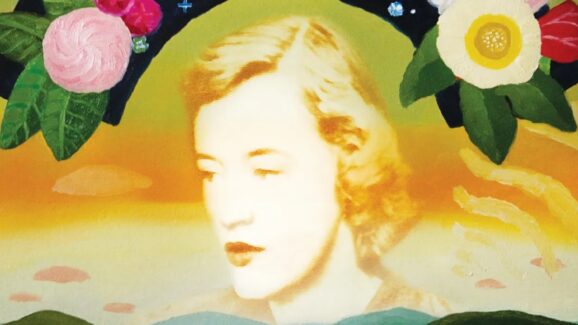
On September 12th, singer/songwriter Maia Sharp will be releasing her next solo album, Tomboy, and today she is releasing the powerful single “Only Lucky” exclusively on Glide. Every time that Sharp sets out to create a new record, she considers the terrain of her life and makes sure to bring a new angle to things. In recent years, she’s integrated her life more fully into her work with albums like Mercy Rising (2022) and Reckless Thoughts (2023) that dealt with the end of a major relationship, a cross-country move, and then the perspective you start to gain on the other side of a big emotional event.
Now, with Tomboy, Sharp seems to look at what’s left on the table when it comes to the baggage that humans tend to continue to carry in life, and particularly that of self-image or relying on past patterns of life due to their safety and security. She finds a way to embrace the terms and attitudes that once seemed alienating in her childhood with title track “Tomboy”. With new single “Only Lucky”, which we’re premiering here on Glide today, she takes a look at the bigger picture that helpfully reminds us how to focus on the truly important things. I spoke with Maia Sharp about her fresh approach to writing and recording much of her new album Tomboy, leaning into unconventional percussion, and about the inspiration behind “Only Lucky.”
Hannah Means-Shannon: I’m always very interested to see what you’ve decided to do next, because you always change things up. There’s always something different going on each time in the story behind the album. It’s not predictable at all. I’m sure that from your perspective, it’s simply what the necessary next step is.
I definitely did that thing where I sat down and asked myself, “What’s this album going to say? What’s the lens for this one that wasn’t in the last one?” At this point in my life, it’s reflecting my life more than ever. Mercy Rising was definitely I had to write from the middle of the storm, and then Reckless Thoughts was from the other side of it, and still en route to things, but with a clearer, calmer, and more peaceful perspective. So, after Reckless Thoughts, I was thinking, “What the hell is this thing going to be?”
I don’t have the strife of Mercy Rising, and I don’t have the new skin feeling of Reckless Thoughts, so I didn’t want it to be boring, but I also felt that I’m more layered now than ever, and life is richer than ever. I was thinking, “How do I convey that in an album?” I don’t know if it’s going to get conveyed, I’m just saying what I had in mind.
The sonic feeling of Tomboy is definitely from that place of mastery of certain things. It’s from a calmer place, calling the shots, but I think that some of the subject matter is unfinished business taking a longer view. That’s hard stuff to tackle in many ways, but it’s coming from an unflinching place that’s not really a place of pain. It’s like you’re not leaving anything undone.
That feels like a big compliment to say “mastery”. [Laughs] Thank you. That’s a hopeful sign that you’re receiving it in the way that I wanted it to be heard. Speaking sonically, that was one of the first assignments that I gave myself for the album. I wasn’t sure how to get things across emotionally and psychologically about where I am now, but I could give myself a new approach, Production-wise. The first thing that I told myself that I wanted to do was that I wanted to make this album more percussive and more rhythm-oriented than any of the other ones, but not have a drum kit.
I didn’t want the same instrumentation that I had on the last two albums, and really on most of my last nine albums, at this point. So I built out enough of the framework of each song, just here in my home studio, and tried to find all the signature themes, and play all the same instruments that I was playing here, but more percussively. I tried to play all the guitar parts with more of an obvious syncopation and left-footed rhythms. I would hit the face of the guitar. I would take a little handheld beanbag that I have, and I would hit it on a book a bunch of times. I have a brush for a drum set, and I would hit that on the table. There were little things like that to show where I wanted the rhythm to hit, and where I wanted the accent to be. I was thinking there was a 50-50 chance that this stuff wouldn’t survive, and it would be the cue for what happened next, but it turns out that most of it is on the record.
After I got everything framed out, and it was clear that this was the rhythm, this was where the heaviness was, this was where the lightness was, this was where it floated. Also, in those early days, before I sent it out for anyone to play on, I got this little synth called The OP-1 Field. It’s the size of your forearm. It’s crazy! I’m using maybe two percent of what it’s capable of, and I was already overwhelmed by it. You can record an album on it. I went down some rabbit holes, but found some really beautiful sonic palettes that weren’t something that you’d have heard from me in the past. It was really fun, and just really refreshing. I got those themes down, and I got those colors on, before I started to reach out and get other players on.
That is a really different approach from your previous albums where you’ve had discussions during songwriting, and sort of allowed little elements to be developed with input from other people, but especially there was a lot of collaboration when it came to the instrumentation.
Well, Eric Darken, percussionist, was my first phone call after that. I sent it out to him, and because he’s a percussionist who has so many instruments from all over the world, the idea of having him come over with instruments just didn’t make sense. It’s best to just let him do it in his room. I told him, “I don’t want it to sound like a drum kit. I’d love people to go, ‘What the fuck is that? I love it!’, not knowing what the sound is.” So he would send me anywhere from 10 to 30 tracks called things like “coffee bag” and “hubcap”. “Broom rattle” was one of them. They all sounded totally different, and they were all absolutely in the pocket of the way I wanted things. Eric is awesome, and someone I met on the Garfunkel project years ago. He’s on eight of the 10 songs, so he’s driving it. He hopped on the train, and made it a bigger, heavier train. The whole project started with percussion in mind.
And then, I got Will Honaker to come over and play bass on five or six of the songs, and he’s such a beautiful player. He’ll find a beautiful melody and plays it without ever losing the anchor. I played all the guitars on it, which was really challenging, since there are some little electric things that my buddy Josh Grange was my guy for the last two, and for a lot of other projects that I’ve worked on. I wanted to see how far I could get without asking him to play on it yet, even though he was ready to do that. There was one song, “Better Story,” that felt like it needed a guitar aficionado who was just going to rock. The electric guitarist on that song needed to be like the guy I see on stage with the fan blowing through his hair and people throwing hotel keys on stage. [Laughs] So I got Josh on that song.
At that point, were there some surprising or unexpected things that happened coming in from the other players?
I do actually like being on a team also, so starting alone also built in cues for the next phase of filling in the framework with percussion and bass, and the electric guitar. Then I reacted to what they did. I try to hand them the implications of what I feel like the song wants to be next, but I don’t tell them, “Play this note.” I love the way that they play, and I want them to bring themselves to the album. Once I hear what they come back with, I react and say, “Okay, what did they cue to me? What’s after this? What did they set me up for?” Those things that I think are going to complement what they did are, for instance, the flugelhorn, the strings, and the guest vocal. That was our interplay. It wasn’t the old-fashioned way of getting a bunch of people in the room, getting the basic tracks, and then doing the overdubs. That’s how I’ve done things forever. But I like this. I like the control of it. You still get the conversation. It’s really fun.
I feel like it must have been a great thing when Eric came back that first time, and didn’t say about the percussion, “What the hell is this?” But instead said, “Absolutely.” Because you were really pushing the boat out there to be hitting books together and creating those sounds. But I can totally hear that origin on the album. Everything on the album is about that beat and that movement. Because you’re not using the powerful drums, the music feels more permeable so these other elements feel closer and have texture.
That’s exactly what I wanted. I knew Eric would embrace things, and love that shit, because he’s always thinking of new ways to move a song along. He has a room full of things that have names that I have never heard. But to your question, yeah, the first time that you emerge out of your cave as the only one working on a project, and you may have spiraled in on yourself and you don’t really know, until you present it to someone else, is a big deal. I didn’t realize until you asked that question how much power he had in that moment! He could have deflated me. It could have been anything! But he was all about it.
When it comes to the song “Only Lucky”, I find the subject matter very relatable, as I do for a lot of the songs on the album, particularly “Tomboy.” But with “Only Lucky”, that feels like a big feature of modern life to be in a tailback, and be pissed off, and after a long wait, see a terrible accident where somebody probably died. It gives some more reflection to something that’s often kind of a blip for us, that then passes.
Right, like you fall back into your default way of thinking. Right, it might not necessarily be an image that you want to continue to access. But if you repurpose that image as something that actually makes you want to feel what could be translated as a positive thing, then it’s not so bad to glance at it in your mind. You can hear that the immediate, more literal inspiration came from just being on the road, and even more so than usual.
There was a few-week period where I was just driving everywhere, on long drives. Nashville to Fayetteville, Arkansas, and Nashville to Virginia. I flew out to California and helped my parents move here, so we came across the country. There were a lot of highway miles. There were two particular times of driving, driving, driving, that I found myself in a very long traffic jam that went on for hours. There were people getting out of their car, looking around. The line of cars was so long that we couldn’t see the source, so everyone was trying to be patient, but eventually there was crankiness. When I’m hungry, I kind of lose it! I start to question all my life choices. “What did I do to find myself on this fucking highway?? Everything sucks.” Then you eventually roll up on the reason for the line of cars, and both times, it was clearly a fatal accident. That snapped me back into the reality of how seriously lucky I am. I started to take a note or two about it.
But that’s the small lens of what inspired the song. The sort of wide-angle lens of human experience is something that I think I’ve been able to expand and use more often in daily life because of the work that I get to do with Songwriting with Soldiers.
Oh yes, I remember you’ve been doing that work for some time now. That’s a lot of trauma to work with, I’m sure.
MS: That’s really changed my viewpoint toward everything. I think that’s why I don’t shake off disturbing things and try not to access them again. Instead I think, “This is really important. It might not appear this way, but it’s actually very helpful for me to remember this.” The veterans and first responders who I work with have done things and seen things that I hope I will never have to see. And here they are opening up in front of me about it, and finding a connection with each other about it. It’s really changed the way that I look at everything.
I think the song also shines a light on the difficulties in daily life that seem overwhelming and kind of helpfully reframes that. Like the scale of tragic stuff that happens helps us put the smaller things in perspective and handle them.
One-hundred percent. That’s exactly it. It really re-rates those things. It absolutely scales them down. Something looks huge until you put it up against something that really is huge. When you practice reacting to things like that, saying, “Oh, this isn’t a big deal.”, you later realize that it actually worked to do that. It didn’t come back to cause trouble. That it really wasn’t a big deal.