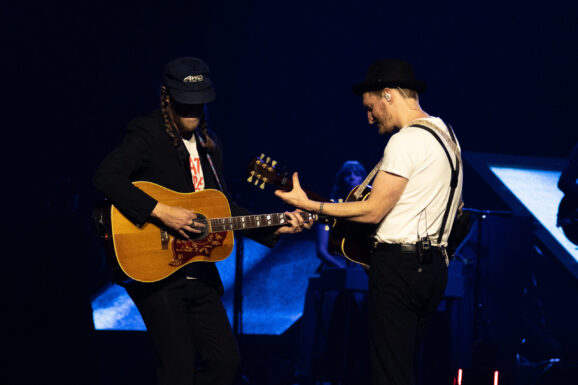
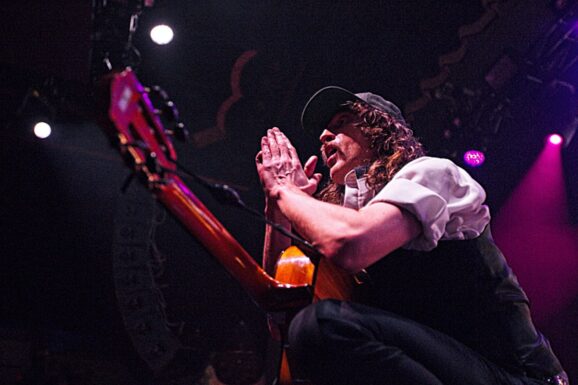
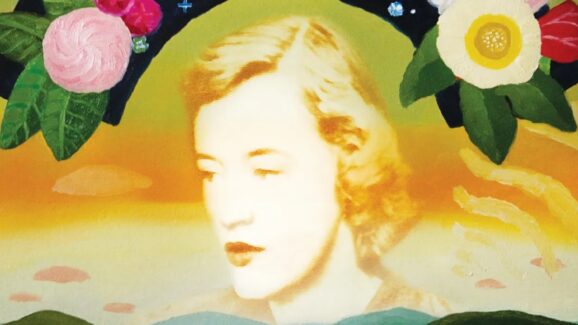
Daniel Donato is a man on the move. After years of paying his dues as a guitar prodigy in the Don Kelly Band at legendary Nashville bar Robert’s Western World, the young Donato eventually burst onto the scene with his own band Cosmic Country. Prolific in both their studio output and their non-stop touring schedule, Donato’s band has earned a reputation for their fiery, always evolving live shows as well as Donato’s formidable chops as a songwriter.
What makes Cosmic Country so fascinating is its ability to fit in the lineage of jam bands while also making the kind of songs that can appeal to country music purists. This talent puts Donato in league with peers like Billy Strings, who have reached arena-size venues by gaining the diehard fanbase of a jam band while writing the kind of songs that appease bluegrass traditionalists. Donato has also followed a similar path of staying prolific while seemingly mastering the art of modern-day band marketing with a savvy social media presence that includes sharing instant setlists and pro-shot video, and giving loyal fans a range of perks by joining his Cosmic Country Club.
Nowhere is all of this more apparent than Cosmic Country’s new album Horizons (READ OUR REVIEW). The sprawling 15-song album finds the band digging their boot heels into a sound that is more entrenched in classic country than ever before as Donato mines his encyclopedic knowledge for inspiration that includes nods to the Bakersfield sound, Bob Wills’ Western Swing, and Ernest Tubb to name just a few. At the same time, the lineup consisting of William “Mustang” McGee (bass), Nathan “Sugarleg” Aronowitz (keys), and the most recent addition, William “Bronco” Clark (drums), manages to incorporate the free-flowing jams of their live shows without sacrificing the integrity of either. Horizons is both an evolution and a testament to the talents of a band on the rise, fronted by one of the most ambitious artists working in music today.
Talking to Donato on a recent phone call revealed a palpable sense of excitement around his own journey and ambitions. Donato is filled with grandiose ideas, complex theories, and a wisened perspective on his relatively young career. He was more than happy to discuss all of these things, including his headlining appearance at the famed Ryman Auditorium this Friday, moving deeper into country music on Horizons, discovering the Grateful Dead, finding kinship in artists like Billy Strings and Charley Crockett, his quest to write a hit song, and more. If there is one clear takeaway from any discussion with Donato, it’s that he is just getting started.
You’re headlining the Ryman for the first time on Friday. Anything special in-store? for the Ryman?
We are going to record the show and immediately after, starting at 12:30PM until 2AM, we’re going next door to Robert’s Western World to do a VIP show for all of the Cosmic Country Club members, and we’re going to put them all out as a recorded box set. This has never been done in the history of Broadway, so it’s really exciting because there’s never been an artist that started out playing on the streets on Broadway that went all the way to packing out the Ryman and doing a full circle moment to where it all began and putting it on record.
Did you come up with this? Seems like a marathon.
Yes. That’s the spirit of how it’s always been my whole life. When I used to play downtown before Cosmic Country, there would be days where I would have three gigs that would be four hours long – playing from two in the afternoon until two in the morning, that kind of thing. So I’m used to it. The story behind it is something that I think will age like wine.
Sounds like a lot of work.
The whole day has turned into quite the enterprise. There are probably 30+ people making it happen, and that’s not including venue staff.
What did Vance Powell bring to the table this time around? Were there any albums he had produced that stand out for you, particularly, and made you realize you could jive?
It was really the artists he worked with and the trend that made me think he would be a great personality to ask if he wanted to be involved. Vance has the ability to deliver the modern Nashville sound very well, but he also has the ability to work with very strange bands and artists that have a lot of nuances and uncompromisable variables in their sound. That’s a very rare thing to find in Nashville because in order to get to any sort of level as an engineer to be deliver a radio country hit, you gotta put a lot of your eggs in that basket because you don’t have a lot of time to go work with Jack White or Phish or something, but Vance does and he has multiple decades of experience performing at a consistently high level at all kinds of different environments and always delivering the goods. I like that – I like somebody who can handle pressure and also be adaptive and dynamic.
I also like working with an older producer and engineer because he understands how recording used to have much more of an urgency to it, and that urgency used to be delegated to the engineer and the musicians. Now, a lot of that urgency isn’t really there, and the bandwidth of what an engineer has to do has shifted. Vance keeps up with all of these modern trends and has consulted to a lot of companies. Say like spatial audio – that’s something that Apple is doing – and he’s one of the five guys in Nashville where you can mix records for spatial audio. But he also knows what it’s like to work on tape and that you gotta get it right in the first three takes. So I like that – that’s the spirit of Cosmic Country – that you can perform something at the level that tradition used to require, but can you also integrate what is available and cutting-edge to enhance the potential quality and reach of the piece of music? He’s kind of the only guy in town who can really do that. Vance can [engineer and produce]. It’s not so much that he brought something new, it’s that there was newness that was revealed in the continuity of our relationship from Reflector to Horizons.
Is that your ethos: one foot in tradition and one foot forward thinking? I think “Blame The Train” almost seems to draw on Western Swing, but sped up. What were you referencing as an inspiration?
A lot of that is the Don Kelly sound that I got from Robert’s Western World. The way he led his band developed its own sound that could turn Red Rocks into a barn. I don’t know how he did that. He was able to figure out a way to have a four-piece band play traditional music and present it in such a way that it was very satisfying to thousands of people. That was something I instantly recognized. So that sound is a part of the Cosmic Country sound. It finds causation and primary origin in the Don Kelly Band, specifically in his leadership style and show-curation. It was a lot like James Brown; you had to have that guy calling the shots in order to make something sound like that. I learned a lot of that from him, and I take it with me everywhere I go. It’s such a great blessing of my life to have that sense of tradition be so alive.
Artists like you, Charley Crockett, and Billy Strings have an encyclopedic knowledge of a lot of country, folk, and bluegrass in addition to chops. Were you always into country music?
That through-line of those two artists being steeped in tradition, you can sense that spirit in their own original compositions. It’s such a beautiful thing, and it’s great that there are millions of people who want to hear that now. The way that it all went down for me was really at Robert’s Western World. They call themselves the home of traditional country music, and by god, it really is. Every inch of that place is history, so when I’m 14 or 15 years old and walking in there and there’s a photo of George Strait or Tom T. Hall or Merle Haggard on the wall, I would go and find out who those artists were. The bands that played there only played traditional country music. So I got to hear all of these songs played live in their purest form.
When I would hear “Settin’ The Woods On Fire” or “Honky Tonkin’” by Hank Williams, I got to see a band play them and see how amazing these songs were, and I would go and do a lot of backtracking when I wasn’t at Roberts and listen to their recording. That’s how I discovered Bob Wills, Ernest Tubb, Jimmy Martin, Bill Monroe, all these great artists. It was the only place in Nashville where that kind of music was being played, especially when I was starting. For me, it was really just the right place at the right time with the right music. When these bands would play “Stay All Night (Stay a Little Longer)” by Bob Wills, I wasn’t hearing the recording; I was hearing a six-piece band play it live. Same with Buck Owens; Willie Cantu, who was in the Buckaroos for years, he used to play at Robert’s. So when someone would play “Act Naturally,” I got to hear Buck Owens’ original drummer play it. There was so much cognicity happening in hindsight that I wasn’t consciously aware of at the moment.
At the same time, you’re rooted in these classic jam band sounds. Were you into that music growing up as well?
It was kind of twofold. The initial discovery of that kind of American music was through my U.S. History teacher, which was perfect. My history teacher, Mr. Ragland, was a real buttoned-up three-piece suit Allen Edmonds kind of a guy – first to arrive, last to arrive, you know, intense guy. I always did really well in school. I was always in advanced classes and I really loved learning, and I loved history, so I had a great relationship with Mr. Ragland. Then one night he came and saw me play at Robert’s when I was about 17 years old, playing in the Don Kelly Band, and the next day I had history class. I finished my gig, got home around midnight, and had to be ready to start school at 7:30.
Once class was wrapped, Mr. Ragland asked me to come see him at his desk, and he gave me three binders full of CDs. It turned out to be his entire Grateful Dead bootleg collection. Everything was itemized and chronologically ordered. I knew some of the depths of the Grateful Dead’s world, but it was a very intensive discography he had – every Dick’s Picks, From The Phil Zone, Legion of Mary, every era of JGB, Bobby and the Midnights, Pizza Tapes, Jerry and Dawg, Jerry and John Kahn…it was everything. There were even rehearsal tapes of when Bob Dylan played with them that he had in there.
I went to a gig that night, and I remember the first CD I took from the collection that I played in my car, it was Pembroke Pines, Florida, and the Dead was playing “Big River.” I think it was like 7 minutes 32 seconds or something, and I remember listening to it, and it all made sense to me what was going on. Same with “Dark Star”>”El Paso” from Veneta, Oregon [The] Sunshine Daydream [Concert]. Taking those older songs and letting them breathe a little, because you’re playing them live, all of that made a lot of sense to me. That band sounded like an American old-timey band. The way these Western Swing and bluegrass bands would play, every instrument was telling the story of the song. It wasn’t like radio or modern country now, where just the vocalist is telling the story and there’s a band behind them setting up the framework. I just resonated with their approach.
I always knew the Dead was a big band, but it wasn’t clear to me how fundamental they were to taking the idea of what America is and allowing that to produce an approach to playing music, which is what I think that band is. I had no idea about the fundamental necessity and how instrumental they were to this whole style. I had no idea about the false idolatry that was projected onto Jerry and all of the lore behind these Robert Hunter songs that got written in one day, and I became interested and obsessed. By the time I was 17 or 18, I was fully listening to the Grateful Dead and traditional country music all the time. I would go from Ernest Tubb’s Midnight Jamboree, and once one o’clock in the morning rolled around, I would turn on something from ’74, probably Closing of Winterland, which was one of my favorites.
So, over time, all of this music and these bands sort of intermeshed?
Yeah, because it is country music. The country music of Buck Owens and Merle Haggard became a working people’s music. They were pioneers for that sound, and they were working people picking oranges to make a dollar a day. That working-class spirit was something I identified with, and that spirit necessitates honesty and a need to talk about real things in life, like “Sing Me Back Home Before I Die.” That spirit was always alive in me, and the Grateful Dead’s music sings about real things; they were working-class guys touring all the time. They’re obviously not now if you look at ticket prices, but back in the day, a lot of their fans were working-class people. For me, it seemed like a natural extension of country music, like the next thing to do. It all just made perfect sense.
This new album leans much more into traditional country than your previous album. What do you think pulled you into this direction?
The philosophy I have is that the way we measure time is somewhat flawed. For obvious reasons, we all need to be on the same page of where to be and when to be there. But in the last five years of time, I feel like the amount of spiritual and social change in the world is dissimilar to other five-year periods. There seems to be more content injected into those five years than, say, 1995-2000. There’s been a lot in these past five years, so I wanted to use that and acknowledge that. Within that change, there is a need to qualify it, and I think there are probably a lot of points that can be qualifiers for what the change is. I think one of them is that there is a wave or trend that is pushing humanity out of production and creation.
On the production side of things, you have a company like Amazon that just announced they have over a million robots working just domestically at North American fulfillment centers. In Nashville, you have demos that are being made autonomously through advanced music software. Don’t get me wrong, some of those demos are amazing, and a lot of the software used on records made with humans also uses automated systems. With these facts happening in time, in the collective consciousness in the zeitgeist of the people, there comes this conversation that leads to a form of duality, which is, is this an authentic experience or am I having to deal with something that’s automated and systemized that doesn’t have humanity? Outside of music, if you go to pay a utility bill or schedule an appointment somewhere, nine times out of ten you’re going to deal with an automated or robotic system.
So I can tell now, in the collective conscience of listeners, they know that music is sacred, and they don’t want to give that up. With music, people do not want to give up humanity, so what you have is that most people want music to be human. That made me think about what is most human to me. Human nature is animal, that’s part of us, and you have to acknowledge it or you’ll turn into an animal, but part of us is divine and unexplainable. Every culture of every society since recorded time has had ideas that there is a part of us, individually and collectively, that is higher and eternal on some level. That requires faith to access that.
To me, I was like, where can I put my faith in this record? We have to make the most human record possible, like humans in the best and highest sense, in the most potential sense. It informed everything about this record: time, how many times we recorded a song, how many tracks we put on a song, how we would mix the song, and what we would refuse to add. That’s what I think explains the more traditional sound. It was a process of clarification, compression, and removal of variables. The cleaning up of what is possible in a studio now. A lot of songs you hear will have 120 tracks on them, and there are five to six musicians on the song. Not with us, not on this album.
How do we get it so that when people turn it on, they know they are listening to something human? I think this trend is something you’ll see more of, which is people moving forward with faith in humanity and not deploying so many forms of new technology. You’ll find people taking away. We’re getting too deep into the waters for some people. I’m all for using technology to develop a more fortified unified culture to advance potential, but with music there necessitates the accountability for you to be like, I’m not going to use all of this, I’m not going to do twenty takes, and when i sing my lyrics I’m going to make sure it’s something that people can understand and relate to because it’s a human experience.
What is the creative process like in the studio for you and your band, given this environment of trying to keep things traditional but also utilize some of the technology?
You don’t want to throw the baby out with the bathwater, because then it’s like you have good intentions, but you’re paving the road to hell based on being a hypocrite. We didn’t record this record to tape, which we could have, but it didn’t make a lot of sense to do that. Really, how the spirit of keeping everything human informed the recording process was that we did no more than five takes on one song, and we tried to get the song basically done before we ever needed to do any overdubs or cut vocals. We didn’t want to have to wait to go dive into a bunch of MIDI sounds or add some sort of layer of sound, like in a Phil Spector sense. Basically, we wanted it to sound like a band playing in a room at a very high frequency level, both musicianship-wise and recording-wise, and I feel like we achieved that.
I read that you always play new songs live before bringing them into the studio. Have you ever had any songs where you envisioned them sounding one way and then they morphed into something different after playing them live?
Every song. I write every song like Jimmie Rodgers or Hank Williams might have, on a Martin guitar. Even when you transfer a song that you wrote on acoustic to electric, the chord voice is going to be different. The way an E chord sounds on an acoustic guitar is going to be different than how it sounds on an electric, so you have to play it differently. I like that idea. Rick Rubin has this idea that you should know where to start, but not know where you’re ending. That’s not fully your job. Say I wrote a song like “Blue Eyes Crying In The Rain.” It’ll never end up sounding like “Enter Sandman,” but it does change, and I like that change, especially if I’m surrounding myself with people I musically trust. And it always ends up sounding a little more like Cosmic Country when we play it live.
I really believe that everyone in the Cosmic Country community contributes to how a song shapes itself, the more we play songs for them. Maybe there are too many verses, so we cut out a verse – we did that with “Another Dimension” and “Sunshine in the Rain.” When those songs first came out, one had four verses, now there’s two, and the other had three, now there’s two. All of that happened because we played them live, and the key changes happened. Sometimes I write a song in E and it sounds better in G, and all of that happens live. These seem like things that could be ideated in the creative process when you’re writing a song in the room, but it’s really not the case. You have to be in an environment that necessitates reflection so you can really get down to the bottom line of what needs to happen in a song.
What do your bandmates bring to the table to help facilitate that?
It’s their instruments, but it’s them. There’s a great story of Chet Atkins. He used to play guitar a lot, but then was more of a producer, and it was rarer for him to be found playing guitar at a certain point in his career. But one day he was, and there was a studio assistant there, and Chet was playing beautifully, gracefully, harmoniously, as he does, and the assistant came up to him and said “Mr. Atkins, that guitar sounds great. I see it’s one of the new Gretsch models, I play some myself, I’m a huge fan, and it sounds amazing.” Then Chet put the guitar down and said, “how does it sound now?” It’s like, oh yeah, it’s all about the person. The material – the bass, drums, piano, clavinet, upright bass, the Telecaster – all of those are secondary instruments that help reveal the personality of the individual playing it.
So what my bandmates bring to a song is their sensibilities. Nathan Sugarleg grew up playing in African American churches, and the way that gospel music is played is singular to their culture and is very different from how traditional Jewish music sounds, which I heard a lot growing up because my mom’s Jewish. It’s also very different than traditional caucasian gospel music sounds, which I heard a lot because I grew up in Spring Hill right outside of Nashville.
Nathan’s sensitivity of how to make things groove, find high points in a song, and land on lyrics that you can repeat a lot and bring a big amount of energy to, he has such a great compass for it that I really don’t have. Same thing with Mustang on bass – all of his favorite bass players are old staff players, like Muscle Shoals players, so he knows how to make sure a track never touches the floor and stays buoyant. Same with Bronco on drums, who has a fantastic way of providing danceability and dynamics. He listens because he also sings, so he knows that lyrics are important and how to get quiet in a verse and big in a chorus. All of these variables seem so small in dialogue, but when it comes time to use them in the moment of the song, they’re critical.
This album has 15 songs. What is your secret to staying so productive as a writer while also touring constantly?
I don’t like settling for that. There has to be a way. A lot of the time, the way requires a more stoic, self-accountable, persistent regimen than most people want to hear. I don’t want to blame it on the road as to why I can’t write a song or at least work on new songs. Like on our last tour, I stockpiled songs for the tour and suggested to the band that we try to play a new song every night. So you can still be creative and work, and have output. It’s just that a lot of the time, the answer points to way more accountability on the self than a lot of people like to hear. That’s fine with me.
I remember busking on the street for eight hours, and I had $50 one day, and I thought that was a lot of money, so I have no problem trying to work really hard. But that’s also a double-edged sword too; the workhorse who doesn’t know when to stop. To answer the question of how to stay productive, number one is to never stop moving. I think Del McCoury and Willie Nelson are great examples of that. I saw what happened to Don Kelly. He took two weeks off from 1983 to 2020 from playing gigs. That means every week for 37 years, he never stopped. Then he moved down to Florida, and I saw him a few years after, and he told me, and I saw it on his face that he aged like ten years.
I empathize with the idea of not being able to write on the road, but I don’t like settling for the consensus that I’m on the road, I can’t write songs. What I do is try to write a lot while I’m home and I try to get songs mostly ready to play out on the stage, so I can still be actualizing the potential. I also stockpile a lot of lyrics and ideas that are inspiring to me, so that if I do have some time on a day off – like say we’re driving through the Utah mountains for the whole day – and I have the back lounge to myself and I got a couple joints and some espresso, I can just pull out some things that are already inspiring to me so I don’t have to go and try and find the inspiration in the midst of the tragic chaos that is the road. Because it is tragically chaotic out there. It turns people, including myself, into people you’d never plan on being some days.
Some days you just want to be home, use your own toilet and bed. You go to sit down when you get home and you realize that the room isn’t moving and you feel uncomfortable. So I understand that, but I also have to remember that I started out on the street here, and I feel like my call to duty has always been that of a worker and someone who will have to roll their sleeves up and always work, and I like that. Henry Rollins feels the same way, and Bob Dylan is clearly like that. He doesn’t need the money. The third part is that if you can try and serve something that really does inspire. If you’re trying to write a song for yourself, that’s not inspiring. If I can remind myself that this is an opportunity to serve something, people, and a community, then it really does help me work harder.
You’ve accomplished quite a bit at a fairly young age. What do the next ten years look like for you and your band?
I would hope that we can scale what we’re doing so that we can play 80-100 shows a year. That would be nice. I have three goals and that’s one of them. The second one is that I really do want to get a song that’s really popular, like a great song that can be a part of someone’s life, like a “Brokedown Palace” or a “Blues Eyes Crying In The Rain.”
Like something timeless.
Yeah, like a song that someone can play when their child’s born, or the first dance of a wedding, or at a funeral. A song that people can identify enough with in their own life that they can take it with them as long as they live. That would be amazing for me and our band. The third goal I have is one that I have been working on since I was 14, and I still don’t think I’ve cracked it, which is, if you can take a recording and play it at 30% volume, and you hear one note on the guitar, you instantly know who it is. You can do that with Jerry Garcia, Willie Nelson, Jimi Hendrix. That’s been my goal since I was 14 and I’m still not there.
Do you think these last two goals require having a hit song in the traditional sense?
Yeah, I do. I know we need a hit song. It’s also the only thing that’s stopping us from selling out Red Rocks right now, because if we had a hit song, we would be at a way bigger place than we are. It would also help solidify us in the country world a little more if we were to have a hit song, which I feel like could compound and open the doors for a lot of people to hear the good news and come see what Cosmic Country is, and to see that the American ideal can still be brought to music. That’s something that breaks down borders and unifies millions of people seeking a true experience of life. That’s what the Grateful Dead and Phish did; Billy Strings is doing it. If you go see a Billy Strings show, it is bluegrass, but it’s also more than bluegrass, and that’s what I want to do with Cosmic Country.