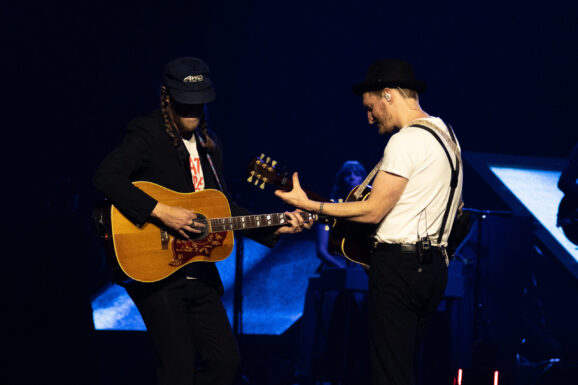
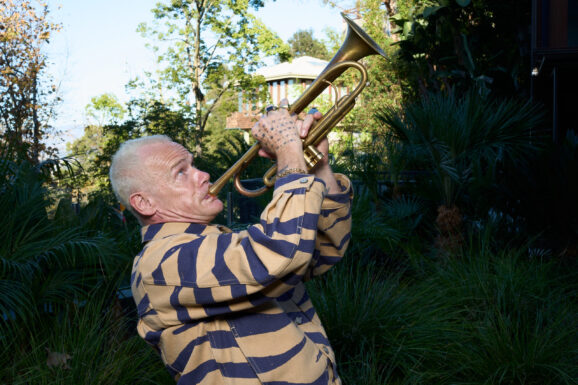
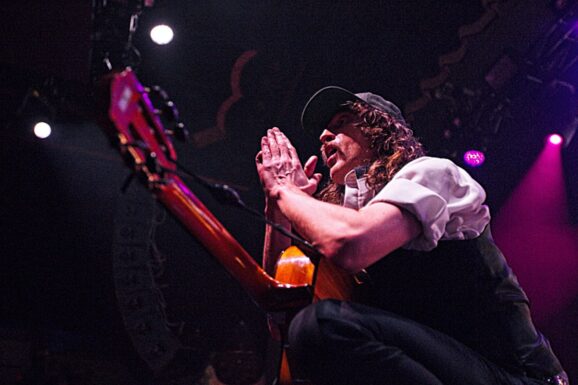
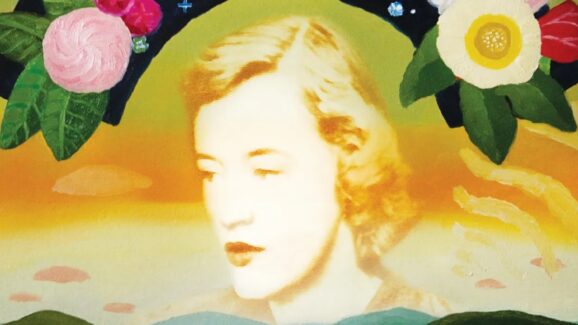
On August 22nd , Portland, Oregon-based Indie Rock band Glitterfox will be releasing their debut full-length album, decoder, which was Produced by Chris Funk of The Decemberists, via Jealous Butcher Records. Previously releasing via Kill Rock Stars, Glitterfox is steered by front person Solange Igoa (they/ them) and guitarist Andrea Walker (they/them) who collaborate with bassist Eric Stalker and drummer Blaine Heinonen, in bringing the songs to life. The sound of decoder, and of most of their recent work, builds on Americana undertones to bring out 80s New Wave and 90s Grunge accents.
As part of a wider artistic community, Glitterfox also stages a multi-media gathering called Glitterfest every year. Their world is very DIY, from their music to their merch and personal costumes. I spoke with Andrea Walker and Solange Igoa while Solange worked on transforming a silver belt into a gold conversation piece that may well turn up in one of their videos. We talked about how the songs on decoder got written, how they collaborate on songs, and the overarching magic that having a community helps bring to Glitterfox.
Do the songs on the decoder span a long period of time for you in terms of songwriting, or do they come from a more encapsulated period of time?
Andrea Walker: I wrote nine of the songs on the album, and Solange wrote two, and I wrote all nine of them in kind of a two-year period. I like it, and I think it helps add cohesion to do that. This album is also kind of chronicling a period of time. These are the things that happened. For me, writing is an intensely personal, almost journaling experience. My songs that are on decoder are about the major things that I was going through in the two to three-year period of my life. And a lot happened.
Solange Igoa: I think for me, it is a little bit more random. I don’t write as much as Andrea does. One is a lot more recent for me. One is from a musical that I’ve been attempting to write for a couple of years now.
Wow, that’s so cool about the musical, and I can definitely see the journaling approach play out for a lot of songwriters. Are these songs a selection or everything from this period of time for you?
Solange: Our manager helps us pick songs, actually. I know that Andrea makes a lot of demos at home, and for me, I have a lot of just recorded stuff, like on voice memos, that I send over to our manager, and he helps us pick which songs we’re going to do.
Andrea: Right, I’ll send him five songs, and he’ll say, “Cool, good job! Definitely that one.” We use Dropbox, and we have big folders. I’ll go through writing periods, where I’m just writing around the clock, and I’ll send him everything.
So, Solange and I write the songs, but then we bring them to the band, and the band really develops the songs so much. Our bass player and drummer contribute so much, a ton. They write their own parts. We’re taking it on the first part of the journey, by putting in our emotions and experiences, and Solange and I are creating the melodies and the lyrics, but really the band takes it so much further. They put so much attitude and creativity into the songs to really bring them to life, and into the final form that the audience gets to experience.
It sounds like surprising things can happen in that last stage. Do things ever come to life in a bigger way than you expected?
Andrea: Yeah. Eric, our bass player, writes bass lines that are really exciting to me. He started as a guitar player and learned bass so that he could join our band. In that way, he’s developed as a bass player over the years. He and our drummer write the coolest parts.
Solange: I think they both know how to let a song breathe, too, because they are both singer/songwriters themselves. Rather than thinking, “I’m going to take up all this space”, they understand when it’s time for certain things to shine. I don’t think a lot of bands have that.
Andrea: I totally agree with that. Because they are both songwriters, we all help each other. If one of us is stuck, we can work together and get that outside perspective. We’re lucky.
Solange: With the song that I wrote that’s from my musical, with the character, I hadn’t put two and two together, but brought an extremely rough recording to the band.
I’m a singer, really, and I attempt to play the guitar, and everyone listens to it, so then my song went from being this recording, an amorphous blob, to being a super-cool, Grunge, kind of ’90s song. I wasn’t even thinking about it, but the musical is set in the ’90s, so it makes sense that that song, sung by this specific character, would be a very ’90s Grunge song. I don’t even know whose idea it was.
Andrea: The song always felt that way to me. It’s just such an angsty song. I feel like I, especially, want to take your songs and do that. Like with “La da da”, I bought that fuzz pedal for that song. One night I just sat up in bed and said, “Oh my god, we should totally add a fuzz pedal.” I wanted to make “La da da” a Grunge anthem.
Your songs have a lot of angst in them! I think so musically, so when I get that emotion from the lyrics, I think, “Distortion pedal! Fuzz pedal!” It sort of takes on a life of its own. If you think of that one song, “Not Fade Away,” that we recorded, we were really stuck. That one just wasn’t working, and then I got this inspiration to change up the drum rhythm. Then we got it, and everything clicked after that. I couldn’t believe where it ended up.
Sometimes there’s one little thing, and once you figure it out, the song is like a horse that can just gallop, and it takes on a life of its own.
Solange: Totally.
Andrea: It’s a magical process. And also, we’re in a studio with our Producer, who’s bringing excellent ideas, and also with our co-producer Zach, and he’s bringing ideas. We’re throwing ideas against the wall, and whatever sticks is the direction.
Thank you for sharing that. It makes sense that a common vision develops, and once you know what it is, it’s like it’s always been there. Which song were you talking about, Solange, that was originally from your musical?
Solange: It’s called “Change Me.” We’ll see if I can get myself to do it, but my goal is to finish the musical this winter, when we get some downtime.
Andrea: Solange is actually an incredible crafter and visual artist, and she does all the art for our band.
Solange: Pretty much, the t-shirt designs, too. For merch, and all that.
Andrea: This band is pretty much an expression of both of our personalities and strengths.
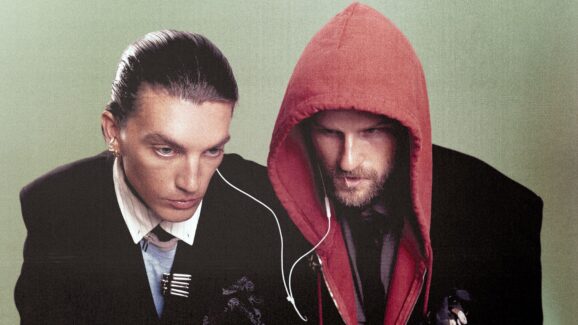
The album cover is based on a photo, but it is designed too, with the colors and the way that the TV code is coming out towards the viewer.
Solange: Yes, it’s actually a film photo. Kaylee [Kotkins], who is one of our very best friends, is also our bass player’s wife. She took the film photo, and then I took it, and edited it pretty heavily, making it really warm. Then I added the TV river thing.
Andrea: It’s kind of trippy! That photo actually wasn’t staged. It’s a candid photo. What’s interesting is that Solange and I, for the past six years, have been throwing a music festival called Glitterfest, and for the last couple of years, it’s been at Halloween. Those are Kaylee’s twin sisters, who came to Glitterfest dressed as identical devils, and we had built an outside living room scene. That’s because Glitterfest has these outside games…
Solange: It’s immersive.
Andrea: It’s become an immersive art and music festival, but very indie and DIY. They were doing a game show, so that’s actually a candid shot of Kaylee’s twin sisters participating in one of the games. When we were looking for album covers, we all just loved it. There’s another photo that we used for “Wildfires” with the twin sisters, again, inside of an arcade that we built for the festival.
Solange: That’s where the whole idea for the music video for “Wildfires” came from. It’s all devils, and different duos.
What I noticed that was great about the devil people in “Wildfires” is that they’re people of all kinds. It’s for every age, gender, ethnicity, and background. It represents something about their personality because everyone wears the devil costumes. I thought it was cute.
Solange: It is a really cute video. It turned out a lot better than I even thought it would. Kaylee is just a magical human, with fantastical thinking, but even so, it came out better than I could have imagined. What a plus.
Andrea: Kaylee is a huge asset to the band. We’re an Indie Rock band that’s just trying to survive. It’s really hard for bands to make a living off their original music, so Glitterfox always has been this collaborative affair between us and our friends. My roommate is in the room next to me right now putting together a video for us for our next single. My other roommate helped us shoot the “Gama Ray” video that Kaylee directed. It’s very much this little creative community. In our world, “Glitterfox” is the nucleus, but we bring in these multi-talented friends to help bring this dream to life.
Some people spend a lot of time trying to find or set up that kind of community. It’s great to hear that you have such a core group of connected people. People may think, “What difference can I make?” But maybe they do one step of one process for you, and it makes a difference. It’s survival mode to have a community now.
Andrea: We’re lucky here in Portland, since we’re part of a community of musicians, but we’re also part of a community of photographers, of filmmakers, of engineers. We’re part of this community where everyone goes to each other’s shows. Solange and I have always been really good at collecting people who are incredibly talented, but also really kind. We have a huge community of friends around us who really support us.
Earlier, you said that the emotion behind one of Solange’s vocals suggested a sound direction for you, Andrea. I’m interested by that, because when I listen to the album, I find some relationships between the sounds on different songs. A song like “Jessie Lee” is pretty different from “Wildfires”, but I still think there’s a kind of restraint to some of the sound, a gentleness, that ties them together. Do you have thoughts about how the songs fit together?
Andrea: When I think about the album’s sound, I think about the different influences. There’s an 80s New Wave movement, and a 90s Garage Rock Grunge influence. There’s always, even, and Americana influence. You put Solange’s lead vocal into that mix. I love hearing that there is a cohesion of sound to you. We have two songwriters, and we’re writing about all these experiences that we’re having, but there is a unity there. The image I always think about is “What if Stevie Nicks was driving a car at night, through the South, in the 80s, and singing along to the radio?”
Solange: [Laughs]
Andrea: I’m not a visual thinker, but to me, that’s where you’ve got this really powerful, really recognizable voice, who is singing along to the radio. That’s my personal metaphor for the sound.
Solange: I’ll be honest and say that I don’t think any of that cohesion on the record is due to my help at all! Maybe my vocal stylings are.
Andrea: That’s part of it.
Solange: I really tend to trust-fall into whatever the ideas are that the band comes up with. It’s very rare that I say, “Whoa! I’m not into that.” Some of that cohesion probably comes from the fact that Andrea has autism and gets on certain wavelengths, and likes to stay there for a while. Sometimes those things phase out very quickly, like that one time you decided that you wanted to turn all your t-shirts into muscle tees. [Laughs]
Andrea: Now I’m into jerseys!
Solange: I think it’s a great look. I’m here for it. We used to be really folky, though, really Americana, and a couple of years ago, Andrea realized that they had forgotten how much they really loved the 80s. So, with all of the singles that came out on Kill Rock Stars, and with a lot of these songs, I think there is a really 80s vibe. Then the 90s thing really came in when we recorded “La da da”. We’ve been really into the 80s and 90s. That naturally gives us cohesion.
Andrea: I get really narrowly focused. I think, “This is the thing, and nothing else matters.” That’s just how my brain works. It does lend itself to cohesion when you really only like a couple of things!
I suggest a silver lining to that in that some people struggle to find ways to tie together songs for an album and make it work together sonically. If you could persuade Andrea to keep going through phases for each album, that would really work.
Solange: I will have to work on my subliminal messaging, like “Listen to this song, isn’t it cool??”