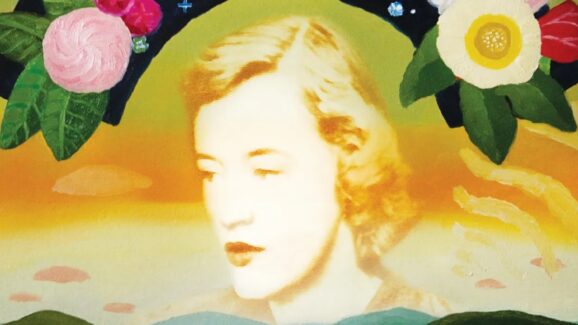
Singer/songwriter, author, and songwriting teacher Dar Williams will be releasing her thirteenth album, Hummingbird Highway, on September 12th, via Righteous Babe Records. She feels that this album, particularly, speaks to her perspectives gained as a touring musician, and within it we encounter many voices and glimpses of human history from various standpoints in time. Something particular to Williams’ songwriting, but also to this album specifically, is the way in which she finds connections between potentially unrelated situations and details that result in a deeper and greater meaning to consider.
The title track to the album, out now, is an exemplar of that exploratory principle, finding in a child’s imaginative world, and in the far-flung observations of a touring musician, one complete truth that we all need to come home and recover sometimes, and as John Donne famously discovered, “No man is an island.” I spoke with Dar Williams about this principle of relatedness in communities, locations, and within her own music. But we also spoke about the ways in which we have to discover our own processes and be prepared to follow our inner voices just as readily as we make sure that creative spaces can thrive in our outer worlds.
I feel like it’s about time I spoke to you because I have interviewed several people who have done workshops with you and collaborated with you. It feels very full-circle for me.
What a wonderful thing to hear! When Jill Sobule passed away, and I heard all of these different collaborations that people did with her, I thought, “Wow! She got around!” There were people all over the country who had connections with her. I said, “I wish I were like that?” But I guess it’s true that I’ve gotten around a bit, myself. So, thank you!
That’s definitely the kind of picture that I had of you and your work. For some people in music, there is a sense of community and connection, even though it’s a big world, and you seem to be someone who encourages that. Like-minded people perpetuate that. I’ve talked with a number of people about how to maintain connections, even when you’re not geographically close together. I think that’s possible when you have deep roots with people.
One hundred percent. Actually, it’s kind of like we pick up where we left off. When The Milk Carton Kids were first starting out, they opened some shows for me. And I said, “Well, this situation isn’t going to last long.” It was like when Norah Jones opened for me once upon a time! Then, I asked them to sing on a song of mine, and we hung out in a studio. That was in 2012. Then, I just saw them for the first time in 2025 recently, and they still got inside my perspective very quickly.
I wrote a book about community development from the perspective of a musician, and some people were wondering, “Wait a minute. If we do a garlic festival, that’s actually something that helps avoid bigotry and racism?” I say, “Yes, if you do this thing called bridging social capital, and go out and find people from the private sector, the public sector, the retired community, and people from the other side of the tracks, one hundred percent.” That will indeed create what we call “community.”
For musicians, like Kenneth and Joey, from Milk Carton Kids, they knew exactly what I was talking about on this subject. I love what you just said, and it’s true, that it’s a big world, and we don’t see each other for years sometimes, but we all get it that these filaments are actually really important. It’s what’s called “the strength of weak ties.” Your huge net of acquaintances is really important.
I have a song on my latest album that I asked a friend to send to somebody very well-known. And since they are friends, she just sent it over. I said, “Why, thank you.” From afar, we look out for each other. There’s so much meaning in my life that comes from those relationships.
There can be a misconception that your well-being as a creative person will come through having a very close personal friendship with some very famous people, for lack of better words. But actually, it’s through knowing and being connected with 50 people who do what you want to do, who have a like-mindedness. It reminds me of the forest and fungus network, where energy and resources are traveling slowly in small amounts, but it’s a huge support.
It’s exactly like that. And we get deep connections fast. Once I was looking for some sciencey words, and I found all this language for root-structures, and it was like that. The other thing about musicians is that I would say it’s 50 to a hundred. When you include people who you know from studios, and people from tour management, it’s more than 50. The other thing is you kind of have to get personal fast. Musicians will tell each other if a city has the right feel, because we need cities or towns with a little buzz or feel to them. That’s to jump-start our own mojo in writing songs. We need to kind of feel the buzz in the air to do what we do.
When you walk out on stage, there are some nights when we have to get the energy going, and some nights when you feel the energy, and you know it as soon as you walk out on stage. You know what energy you’re working with, and musicians know that because it’s a little bit about our survival.
It’s so experiential what you’re talking about. It’s so important to find places with the right vibe or atmosphere. I can take that for granted, but these days I see that as places where creative communities are still safe to express themselves and creative people are still okay on a day-to-day level. You might say that those places are more liberal.
It comes down to liberal vs. conservative sometimes these days because it has come down to the idea of something that captures the imagination, the idea of paranoia, of people feeling that they are not safe, that they have to look over their shoulder. That’s Fox News. And it’s very intentionally there to harvest fear and perpetuate isolation. But when you create something in a community, you can do something different.
My friend George, in Beacon, created a bar that had Pop art, Dylan posters, Guinness posters, craft beers, cheap beers, no television, so that all of his friends who he worked with in construction could sit next to all of his friends who he’d worked with in a gallery. With places that have bridges and footpaths, metaphorically, you’ll have some inoculation from paranoia, and you’ll have something called “positive proximity.” It’s beneficial to have neighbors and to live side-by-side with people. I don’t like half of them, but I kind of love them all. I do a thrift sale in my town, and we’re up to 60 volunteers. I love them all, but some are hard to deal with. [Laughs]
I appreciate what you’re saying. I don’t feel that communities have to be separate. It’s almost like erasing the borderland or boundary to make sure that no one is self-isolating. Live shows, by the way, help a lot with creating bridges.
I agree with you. And they help to keep the “heartbeat” going in a community. We have to keep on pushing ourselves, as well.
Do you have a personal practice for being creative? That’s the other side of this, staying creative while trying to be aware of one’s community, of one’s outer life.
Yes and no. A friend of mine asked what my process was, and I froze for a week. I said, “I don’t have a process.” I finally brought this to a therapist, and this was a while ago. She said, “If you’ve written ten studio albums and four books, you have a process. I don’t know what to call it, or what it looks like, but you have one.” That helped a lot. She said, “Go do a thing once a week that brings out the playful side of you.” I wrote a book about songwriting where I write about all of the different things people do to stay inspired. My rule of thumb is that my work is to stay inspired and find situations that are inspiring, as opposed to sitting down at a desk and writing every day.
I have friends who really hold themselves to a specific discipline of sitting down every day to write, or with a guitar, for an hour, and I understand that. I think it does keep the wheel turning. But that can also create a lot of hit-and-miss writing. That’s sort of how I’ve justified myself. Some people mix that up with getting out and making sure they see something inspiring. That way, the song doesn’t sound like, “Here’s the song I forced myself to write.” I think it’s got to start with the feel, the tingle in the air, and that’s really hard to find. But museums and galleries are great, because they are filled with works by people who, themselves, thought poetically.
How did you decide which songs to put on this album? Are there songs in different stages of development, and it’s just the most complete ones that make the cut?
I start to write songs, and if they are not working, they tend to self-select out of existence. But when it’s time to get into the studio, I know the songs. There’s very little that I cut away. One song wasn’t finishing this time. Once, I had a song with one line missing, and in the studio, in five or ten minutes, I actually wrote that line. But I knew that little miracle wasn’t going to happen this time, and so I dropped it. I just didn’t have that 11th song. The songs that I see through are generally the ones that I want to record, then there are something like ten halflings, who never make it to a full song.
These songs have a lot of complexity to them, and they seem like they have a lot of work put into them, so I’m not surprised that if they get finished, they get recorded. There are so many ideas and sounds, with a lot of energy needed for performance. These aren’t sketches, but very full paintings.
Right. I call that “the voice of the songs.” Some songs have a very casual thing, and they are sketches that come out really beautifully, and it’s better not to overwork them. Some songs have a voice that is not very intricate. Other songs may have intricacy. Actually, there’s a song on this album called “The Way I Go” which is very simple. It took so long, sticking to the casual voice. I just had to imagine that I was one of those people in the early 70s, like with those tight jeans with really massive bell-bottoms. [Laughs] It was hard to imagine myself in a rainbow van, but it worked! I kind of found a persona for the voice of that song. But, gosh, casual was hard!
That song is one that I actually thought of when we were talking just now about process, and about the voices of judgement on how to do things that come from outside oneself.
Because I wrote a songwriting book, I then went and read other people’s songwriting books, and that led to writing this song. I loved Mary Gauthier’s book so much! Because it was so personal, and she’s a friend of mine. But I read another one that was very prescriptive, and I just got paralyzed. I then sat down and played a D chord. I said, “The way I go is the only way I know.”
When they say, “Write what you know.”, I say, “That’s very broad, because maybe in a past life I was a painter.” But to know your own feel, your own way of ambulating through the world, is essential to me. Then, it took me like three years to really finish the song!
How I write a song is how I live my life, I realized. It’s highly organic, feeling as I go, appreciating that I learn so much every day. But like in the song, the tide goes in, the tide goes out, and it leaves new flotsam for me to examine. Sometimes it’s kelp, and sometimes it’s a message in a bottle.
Every day, I encounter things, take them in, and make of them what I will, and that’s my way. Over time, it accumulates, even though our footprints disappear in the sand. We still know, “We were there.” That’s the real gift of age, as well. There are a lot of layers at this point, and you can’t take that away. That’s a known thing.