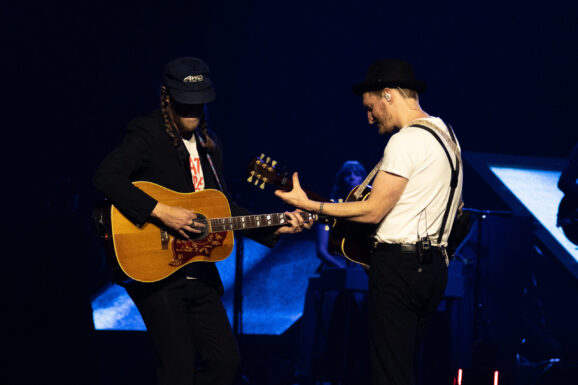
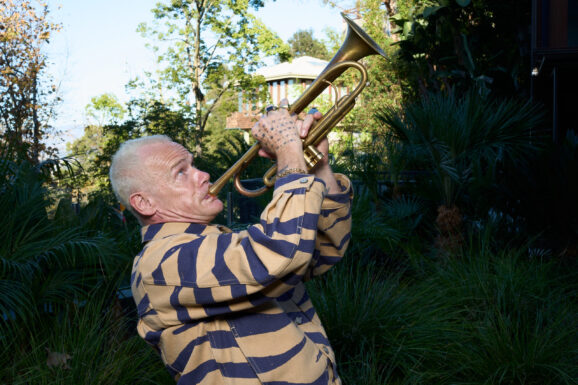
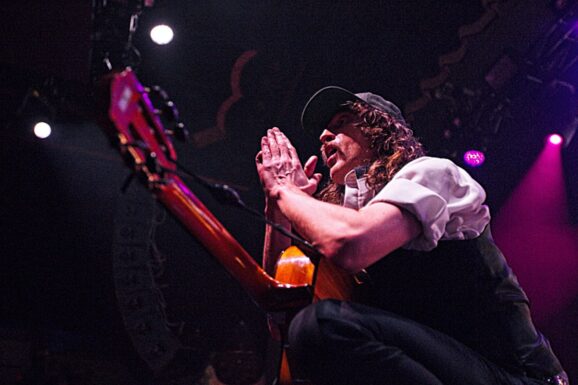
When Howe Gelb, M. Ward, and McKowski were in the same place at the same time at a wedding in Tucson, Arizona, none of them imagined that a spur-of-the-moment collaboration would blossom into something else: Geckøs. Each had long histories of collaboration—Gelb best known as the restless spirit behind Giant Sand, Ward for his work with Monsters of Folk and She & Him—yet their busy individual schedules hardly left room for another band.
The story of Geckøs begins with that wedding. Asked to play the couple’s first dance, the three musicians—who had each worked with one another in different settings, but never together as a trio—found themselves with a crowd waiting, a dive-bar venue in need of a band, and no real plan. So they simply started playing.
What came out was “Wedding Waltz,” a dreamy, Southwestern-tinged ballad featuring Ward singing in Spanish over nylon-string guitar. The performance sparked the same thought in all three: why not keep going? “If we had tried to plan it,” McKowski later said, “it never would have happened. It just unfolded naturally.”
Transforming the songs of Geckøs into a full-fledged album, however, proved to be a challenge. Gelb remained in Tucson, Ward was based in Portland, and McKowski was back home in Omagh, Ireland. Recording sessions stretched across continents—from London to Bristol to their own hometowns. Yet the distance only sharpened their focus, and the result is a self-titled debut out today that stands as one of 2025’s most eclectic and intimate first listens. Gelb’s gravelly desert tones merge with Ward’s rustic warmth, while McKowski—known from his work in The Lost Brothers—adds a refined folk sensibility. Together, GECKØS feels both spontaneous and deeply considered, the sound of three seasoned artists finding unexpected harmony.
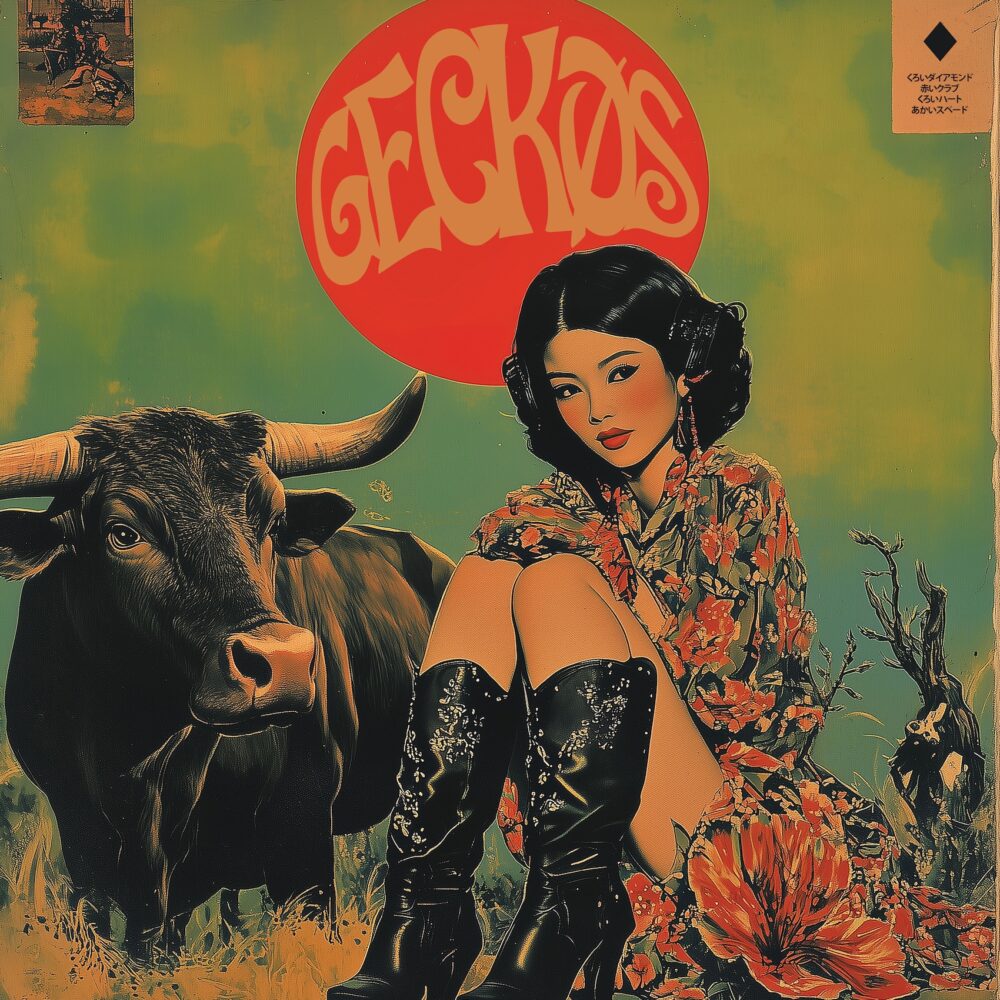
Glide had the opportunity to hear Gelb’s insightful viewpoints on collaborating with his pals and elaborating on the gifts of ear jostles.
You’ve collaborated with countless artists over the past four decades, but Geckøs feels more like a spontaneous spark. When working on music for the wedding, at what point did you realize that you, Matt, and Mark could turn it into something more substantial and fully realized?
After it had become whatever it was, it realized us. McKowski’s song skeletons beckon for submission… a story appears outta the heart from a memory tucked away that suggests it’s ok to be laid out with such a spark of his earworm melodic assemblage. One was a vision of teenage rascal endeavor on “Black Diamond” (named after the railroad bridge we hung out) or the quirk of irk as a spine tingle hillbilly-gypsy love affair in “Dance of the Gecko.” Matt took the opportunity to sing primarily in the tongue of his own ancients. But that’s what McKowski’s music does. I’m gonna guess it haunts so welcomingly because it beckons from the fertile song soil of the land that invented it: Ireland.
Matt has described you as his mentor and mentioned that you brought him on his first European tour. Given that trust and mutual respect, did you ever imagine the two of you forming a band together sooner?
It hadn’t occurred to me. In either case, when music is most alive, it is a matter of handing it down or handing it over, and keeping it flowing out as it flowed into you. There’s no crediting or owing, just mutual understanding or acknowledgment of how it flows. The atmosphere is there from the get-go, but nothing is expected. Once the fates take over, it seems to be initiated. Many years ago, Matt had my daughter sing “Moon River” with him on stage in Tucson. Taking the time to treat her like a viable, gifted source of song and sweetly negotiating the ascent up to the stage is the kind of tender-hearted nuance that embodies the ideal of the flow.
What unique strengths do each of you contribute to the project? And what do you feel Matt and Mark have helped awaken or develop in your own artistry?
It’s a relief to find yourself surrounded by the rare pleasures of sonic rendering amongst like-minded hearts. Although I usually tend to test my own borders of song construction until they buckle, with Mark & Matt, the choice is to rather reflect how each other’s music tends to filter through us and ask what more it would like applied.
It’s said that Mark provided many of the early song ideas. Can you walk us through what his initial sketches were like and how you and Matt expanded on them?
Mark and Matt individually are a couple of my favorite guitar music creators. They each play in a way that awakens the ear instead of dead ends with cliche.
And when the ear is so jostled by that new strum, it can’t help but take part in some hum. Maybe it’s a matter of being really thankful for the gift of ear jostle. So much lyrical imagery comes to mind when being inspired like that. Mark’s music beckons, and whatever is on your mind at that first moment of listening lyrically reckons. It’s that simple and swift. “
“Dance of the Gecko” is both hypnotic and distinctively yours, yet it also feels like a group statement. How did that track come together, and would you consider it the centerpiece of your live sets?
That was during the wedding days, and Mark booked into our friend Gabe Sullivan’s studio to lay down a few instrumental tracks he already had. When I showed up, he asked if I had any lyrics to add. I searched my phone texts from earlier that day and found a note to a friend of some musings … but it read in poetic fashion, and so I tried to riff upon it at the moment of impact when the mic was on during Mark’s playback. It kinda fit. And then Matt had this grand melody in mind with a punkish enthusiasm to use only phonics instead of actual words. Brilliant! They ended up taking out a line or two of mine in post-production while editing, where I waxed on about a poor critter flattened in the middle of the road. … which was in itself an excellent collaborative result in grateful elimination. Ya know .. like when a true pal lets ya know your shirts on inside out.
Matt brings a fiery energy with his Spanish vocals on “Lo Hice” and “El Techno.” Since it was his first time singing in Spanish, did you have any hesitation about heading in that direction?
There’s never any hesitation .. period. One never knows the sublime treasures that await if trepidation is allowed the order of the day.
Your piano work on “Scoundrel” feels both nostalgic and deeply expressive. Do you often begin your writing process at the piano, and do these more delicate passages come naturally to you?
I have a piano set up beside my bed at home, and the mics are set up already. Sometimes in the wee hours of the night, it beckons. I click on the recording machine in case something worthwhile gets captured. And then I begin to put my feelings of the season into chord form and improvise melodic threads. And then go back to bed. Weeks later, I will listen to some of these sketches. Sometimes there’s a hidden treasure.
How has your appreciation of Ireland and Irish music grown through this collaboration? Did it challenge any assumptions you may have had going in?:
I hear Irish influence in much of American music and thoroughly in the written verse. I like to think they invented ‘song.’ For Matt to sing in Spanish on Mark’s Irish-made music made a lot of sense to me, probably because in Arizona, there is a very large Mexican-Irish melting pot, and it feels natural.
Before Geckøs, how familiar were you with Matt and Mark’s other projects—like The Lost Brothers, M. Ward, Monsters of Folk, or She & Him—and were there particular elements of their sound you hoped to bring into this group?
I met Mark ages ago when we both played a festival in Glasgow with the Lost Brothers. Many years later, they asked me to produce one of their albums in Tucson. And relegated the hands-on task to my friend Gabriel Sullivan, coincidentally of Irish-Mexican heritage. It ended up quite beautiful. And again, I joined them in their next album, recorded in NYC. Matt opened up for me on the road back in 2000 or so and was immediately taken with his attack and delivery. I helped with getting his first album out and invited him on the road to open some European / UK shows way back when. It’s a great relief to discover music that no one has heard of yet. Like seeing a movie you know nothing about that hasn’t been ruined by previews or reviews. Like stumbling upon a pristine lake or pasture in some hidden parts of the landscape no one goes to. True treasure.
The sequencing of the 11 songs on the debut feels intentional and satisfying. How much thought went into arranging them in that order, and is there a story or overarching theme that connects them
That much I had enjoyed having no part of. Mark and Matt saw fit to assemble the album as it is, and then Mark added beautiful segue Sonics between the tracks. I only got to love the results, and not get in the way of it.
Your live band features other notable players, like Tommy Larkin and Beth Goodfellow. How does this stage presentation differ musically from your past projects, and do you enjoy stepping into that shared leadership role? What do you have the most relief about having Matt or Mark do that you previously would have taken on?
It’s a particularly satisfied smile in the shared allowance of responsibility, whether it’s driving the van or determining the way forward in a band. And leaving it to Mark to mastermind and Matt to add his directives is of grand freedom for this feller’s preoccupation of purpose. I love them blazing the trail. I’ll be a little slow in lugging this piano. But I get there. The live band is a tremendous club of glee .. which also includes Thøger Lund on bass.
Do you see Geckøs continuing beyond this album—with more songs or another record down the line? What do you think the future holds?
Hahahahaha. That question never fails to tickle. It’s always been there with every album barely out yet. It’s almost like the“amen” to a prayer. It has to be asked at the end of every interview about something new, but also always seems ironic because the new thing is so new, none of us ever knows anything more than barely understanding what just happened. Interviews seem like you’re the therapist asking all the questions and then summing it up at the end by asking the client patient what neurosis they plan on having next. It’s a sweet tickle just the same.