Zigzagging through the pedestrian traffic populating the much-maligned street construction of downtown Burlington, Vermont, there was a palpably convivial air under the near full moon on October 4th. And that sense of lighthearted liberation crystallized under the bright marquee of the Flynn Center, then permeated the venerable theater once Brad Mehldau and Christian McBride began to play.
A little over ten years ago, Mehldau appeared with saxophonist Joshua Redman on the same Mainstage of the Flynn Center, and a noticeable disconnect was evident between the two musicians. In contrast, on this early fall evening, Mehldau and bassist Christian McBride comfortably occupied the same space, neither crowding each other, physically or instrumentally, nor leaving an inordinate amount of space between them.
Based on an artistic connection dating back thirty-one years to the 1994 album Moodswing (not coincidentally by the Joshua Redman Quartet), this was indeed a meeting of the minds. Yet the first impression of the concert was a practical one: the sound in the room was impeccable. The bell-like clarity of the keys was comparable to the deeper tones of the bass (it never boomed) in such a way that the sonics complemented each other as fully as the musicianship.
To that end, McBride’s bass cushioned Mehldau’s piano, giving lift to the latter’s intricate playing so that it retained a palpable jollity, rather than becoming so intense that it conjures a visceral impact that’s slightly off-putting. In that respect, Irving Berlin’s “How Deep Is The Ocean” was an inviting way to open the show.
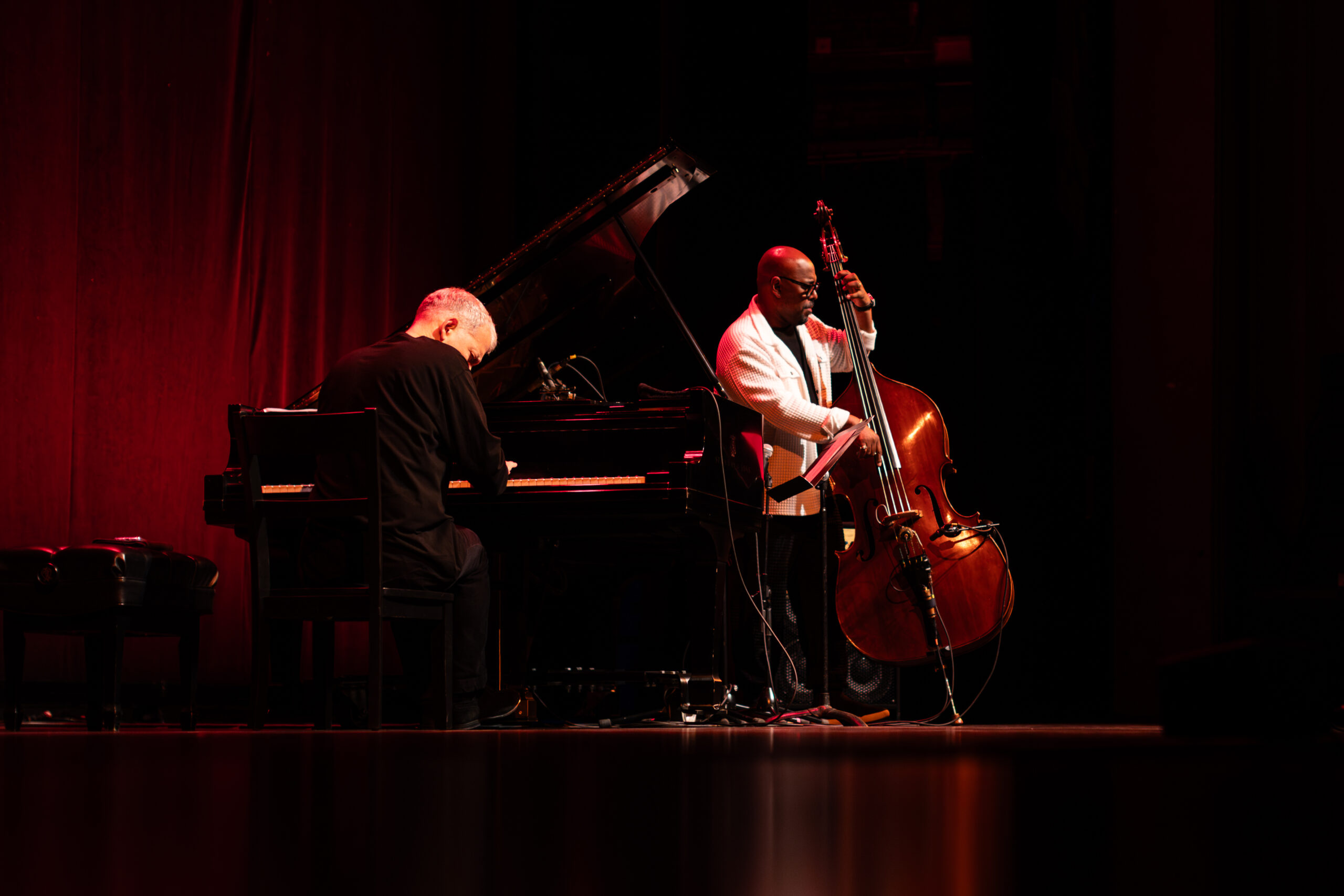
But that selection also set the stage for quicker and more frequent expressions of spontaneity as the nearly two-hour performance unfolded. The pair clearly deferred to each other on John Coltrane’s “Satellite,” and even more so Burt Bacharach and Hal David’s “Wives And Lovers,” but that respect did not preclude a subliminal back and forth (or two).
The exquisite balance in play during such moments extended into other, more obvious realms as well. Brad Mehldau introduced “August Wind” as a composition he wrote specifically for his work with McBride, while the latter explained his original contribution of the evening, “The Shade of the Cedar Tree,” as a homage to another iconic jazz pianist, Cedar Walton.
Even as the two artists each took time for effusive tributes to each other (as well as the venue and Vermont in general), they both granted each other some time alone on stage, albeit in abbreviated intervals. Mehldau scampered through Bob Dylan’s “Don’t Think Twice, It’s All Right,” infusing this inherently scabrous putdown of the Nobel Laureate’s with a playful sense of irony.
McBride’s take on “Fly Me to the Moon” was more of the same, but perhaps slightly redundant. The bassist evinced no greater agility on his instrument during this interval than at other junctures while playing with his comrade. This segment, however, reminded us of how remarkably fluid his runs on the double bass can be.
Based on Mehldau’s two mentions of energy coming from the sold-out audience, Hoagy Carmichael’s “The Nearness of You” may have been a recognition of that mutual connection as much as a benediction to the attendees. Whatever the case, McBride’s laughing riposte to those clapping along (slightly out of time) was accepted in the spirit of generosity in which it was offered, that is, as an encore in the form of Stevie Wonder’s song “Golden Lady.”
It was hardly a surprise that there was no merchandise available for sale in the lobby of the Flynn Center before or after the show. Brad Mehldau and Christian McBride’s collaboration evinced a purity of intent that would preclude such mercenary concerns. As such, the engrossing experience they and the attendees shared was indeed a salve to the soul, one especially precious in ‘these troubled times’ the brilliant pianist/composer referenced early in the otherwise wholly memorable single set in the Green Mountains.
Photos courtesy Luke Awtry