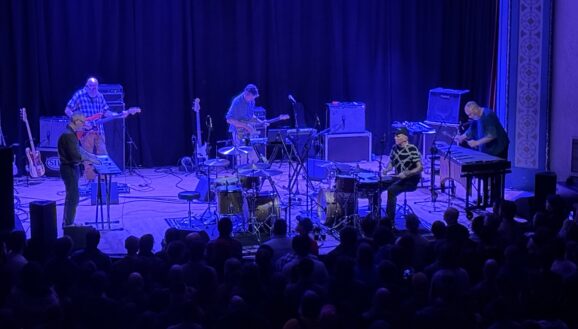
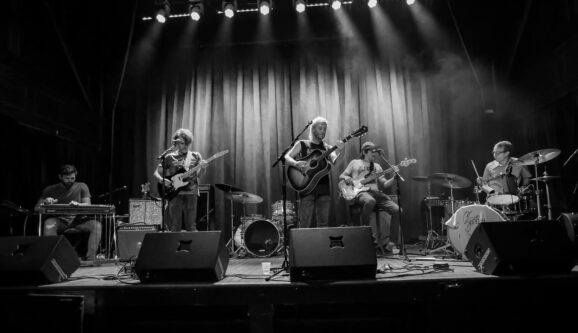
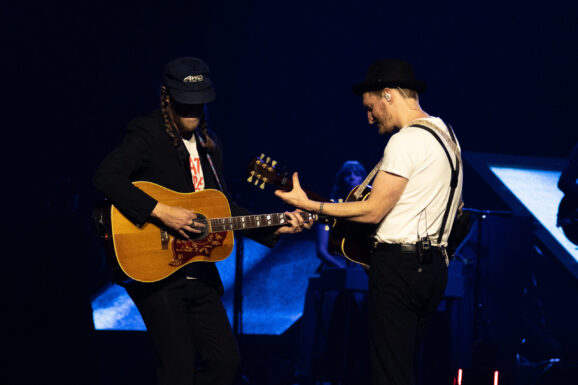
When seeing the band Tortoise live, one needs to keep one’s eyes wide open and glued to the stage as the five members will change instruments in a nanosecond. It’s a spectacle. Their setup includes three different drum sets and as many as five keyboards/synths. On the other hand, listening to Tortoise on record, this new one, Touch, included, is best experienced with eyes closed. That’s because the cinematic imagery the band evokes will take the listener to dramas, thrillers, action movies, and maybe even hints of noir. In truth, it is not quite as revelatory now as so many bands have drawn on what Tortoise pioneered 35 years ago.
Yet, due mostly to geography, Touch is the most challenging album the group has ever made. Previous albums had the five principals hunkered down in a studio in Chicago, facilitating exchanges of ideas and fertile collaboration. Some of the band members have since moved, so the band was forced to share ideas across three studios. Real time was no longer an option. The album was four years in the making. Two members, including guitarist/keyboardist Jeff Parker and John Herndon, are in Los Angeles. John McIntyre is in Portland, and Dan Bitney and Doug McCombs remain in Chicago. Ironically, considering the experimentation, retakes, layer after layer, Parker claims that it is the most cohesive record that they have made. They had to adapt and succeeded in doing so. Arguably, new locations yield new influences. The band proves they are anything but stagnant.
This kind of process required patience. For example, one drummer thinks another drummer can best handle the piece, and the drummer in mind thinks a third drumming member is better suited. Consequently, there may be two drummers splitting the same song. There can also be multiple mallet parts and multiple guitars, and certainly multiple synthesizers. Ascribing instruments to these five members, aside from Parker and bassist McCombs, would make one’s eyes glaze over.
The headline points to ‘genre-agnostic.’ Thirty years ago, the Tortoise sound was so new, it became its own genre, dubbed ‘post-rock.’ Yet, while that may be the foundation, there are many nods to jazz, electronica, krautrock, and the aforementioned cinematic soundscape. Three of the pieces have already been released. “Works and Days” reveals signature, heavily snare and bell-driven industrial-sounding percussion, reverberating guitar figures, and melodic synth strains. It has an accompanying video. “Oganesson,” first introduced at last year’s Big Ears, is a rhythmically tricky 7/4 funk tune with keyboards in the forefront and dazzling bass guitar from McCombs. The ambient ‘noise’ adds a suspenseful element, akin to a spy movie. Herndon and McCombs drive a steady underpinning in “Layered Presence” where Parker plays organ and clavinet, accompanied by synths by Bitney and Herndon. It also has an accompanying video.
The opening, pulsating “Vexations” also delivers an infectious underlying beat over which the synths, guitar, piano, and a mesh of indescribable effects induce mind wandering. Other highlights include the prime example of their cinematic soundtrack bent in “Promenade a deux” where they add a guesting viola and violin. “Axial Seamount,” on the surface, is a fairly simple percussion workout that weaves in the other sounds. Yet it’s one of those that lingers in your head, perfect for jogging or a brisk walk. By contrast, the vibraphone-driven “A Title Comes” showcases the band’s ethereal side. While there are wisps of noir in several tracks, “Night Gang” takes noir to its deepest level, powered in part by McCombs’ deep-voiced bass VI guitar, not to mention the various sounds swirling through it. Having pointed out a few tracks, though, is not to suggest sampling tracks. There’s a careful sequencing to the record that one can only appreciate listening to it in its entirety. Let it take you places.