With five decades of hindsight, Neil Young and Crazy Horse’s Zuma (released 11/10/75) boasts the most cogent, linear logic of any album in the former Buffalo Springfielder’s discography. With an ideal balance of tightly-structured tracks, extended improvisational interludes, and two essentially acoustic, harmony pieces, it readily qualifies as a perfect LP (alongside Little Feat’s Dixie Chicken and The Beatles’ Revolver, among very few others).
Not surprisingly, the all-around clarity of the album follows the depths of murk within those records now dubbed ‘The Ditch Trilogy:’ Time Fades Away, On The Beach, and Tonight’s The Night (all three of which were (ironically?) packaged in 2017’s Original Album Release Series 5-8). Still, the album’s pervasive continuity belies a slightly patchwork nature, reminiscent of so many of the Canadian rock icon’s long players.
Interwoven with six cuts featuring Crazy Horse–in a new configuration with multi-instrumentalist/singer Frank ‘Poncho’ Sampedro in place of the late Danny Whitten–Crosby, Stills and Nash harmonize on “Through My Sails,” while Tim Drummond plays bass and Russ Kinkel handles congas on a similarly soft piece of crooning called “Pardon My Heart.”
That pair of numbers is, however, of a piece with the rest of the record, in sum an updated microcosm of the acoustic/electric polarities of style Young proffered in so many of his live performances in the late Sixties and early Seventies. Ergo, the compact arrangements of “Don’t Cry No Tears,” “Looking for A Love” and “Barstool Blues” balance the more open-ended likes of “Danger Bird” and “Cortez The Killer.”
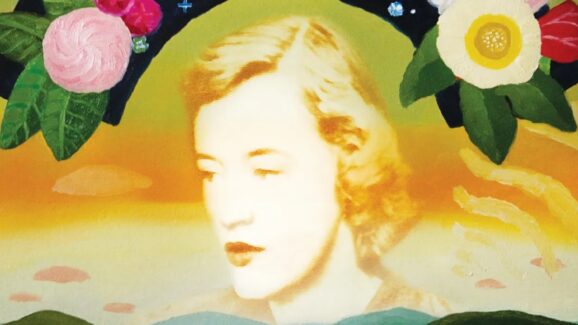
The nine tracks total flow effortlessly throughout, as if played in a single session (like 2017’s Hitchhiker was back in 1976). The overall uniformity of sound renders appropriate the black-and-white cover art by Mazzeo, but at the same time, the atmosphere is multi-colored, almost equally so, within the longer tracks and the roughly three-minute duration of both “Stupid Girl” and “Drive Back.”
In that way, Zuma radiates a simplicity of intent very reminiscent of Neil’s 1975 candid interview with Cameron Crowe for Rolling Stone Magazine. The chemistry is deceptively potent between the self-described loner and Crazy Horse, at this point still including bassist/vocalist Billy and drummer/vocalist Ralph Molina alongside the aforementioned Sampedro (who retired in 2014, after which Nils Lofgren would eventually return to the fold).
The singing and playing of this music resonates, especially in the version mastered by Bernie Grundman in the aforementioned box. In that respect, Zuma is thus comprised of moments both deeply intimate and wondrously expansive, its material the work of an unconscious, unfettered mind, in turn candid (to a fault?) and imaginative (too much so?).
Nevertheless, “Lookin’ For A Love” is as valid in its own way as “Cortez The Killer,” those cuts at opposite ends of a spectrum that span the album’s nearly 37-minute playing time. Not surprisingly, the bandleader’s guitar work is as economical on the former as it is exploratory on the latter.
In that sense, this seventh album of Young’s corresponds to 1969’s Everybody Knows This Is Nowhere and Ragged Glory from twenty-one years later (though the latter record is blemished at the end by “Mother Earth”). Oddly enough, given the camaraderie on display during Zuma, Neil and The Horse had something of an on-again/off-again relationship over the years.
An artist who can often allow himself to be overwhelmed by all the options available to him–much like his kindred spirit Bob Dylan–this inveterate iconoclast nevertheless knows how to savor purity of expression, whether it’s a single song (“Ohio,” for instance) or an album in its entirety, such as Zuma.