If you were lucky enough to attend one of their infamous South By Southwest day parties in the alley off South Congress’s Yard Dog Art Gallery, then you likely experienced the magic of Bloodshot Records. These beer-soaked parties were raucous and gloriously unhinged in the way that anyone who loves rock and roll can appreciate. Perhaps most importantly, they were a day of celebration and camaraderie for the bands and the fans behind Chicago’s “insurgent country” record label. Perhaps you caught the Waco Brothers in one of their debauched country-punk performances, or you experienced pioneering alt-country acts like the Old 97s and the Bottle Rockets during their breakout years. Or maybe you were late to the party, but you felt like you got there as fast as you could, falling in love with real-deal troubadours like Justin Townes Earle, Robbie Fulks, the Vandoliers, or Lydia Loveless, to name just a handful of the heavy-hitters who called this influential indie label home.
At the helm behind the wonderful chaos of Bloodshot was Rob Miller, an avid music fan (first and foremost) who founded the label in 1994 along with partners Nan Warshaw and Eric Babcock. It was Miller and his small but passionate staff who brought Bloodshot from a scrappy bootstrapping operation putting out compilations to a professional, tastemaking, and yes, still bootstrapping operation known for taking risks on exciting yet not always marketable artists while occasionally releasing career-making albums. Among the label’s alumni are now well-known artists like Neko Case, The Sadies, Ryan Adams, Alejandro Escovedo, Murder By Death, and many more. Along the way, Bloodshot developed a fiercely loyal fanbase who bought up every release and packed the clubs to see their acts while evangelizing the label every chance they got.
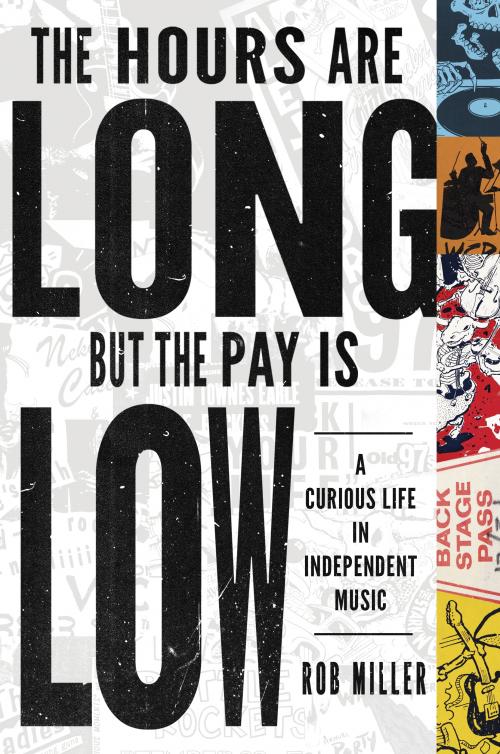
Then one day it was all over. In 2019, amid the #MeToo movement’s flurry, allegations were made against Warsaw that ultimately snowballed into the label’s demise and sale. While anyone paying close attention can speculate and draw conclusions, maybe even point a few fingers, the craziness of it all was enough for Miller to throw in the towel. Following a sale of the catalogue in 2021, Miller was able to walk away from it all and focus on the next chapter, which meant moving to the country and working on his memoir. The result of that tumultuous yet reflective and fertile period is the forthcoming book The Hours Are Long, But the Pay Is Low: A Curious Life in Independent Music (due out November 25th via University of Illinois Press). While some might expect Miller to use his platform as a way to rant against the unfortunate demise of Bloodshot as we know it, he took the high road and wrote about his own journey from being a music lover to a label owner without getting caught in the drama of it all. The result is a book that captures the love, passion, and drive that allowed Bloodshot to thrive over the course of nearly thirty years. For anyone who remotely cares about alt-country and Americana music, and all points in between, Miller’s book is a must-read.
Recently, Miller took the time to chat about his new memoir, the journey and greatness of Bloodshot, the downfall, and where everything stands today, and more.
How long were you kicking around the idea of writing a memoir, and when did you finally decide to commit?
People had been asking me to do something of the sort for a long time. The question was, what angle to take. A “History of Bloodshot” struck me as sort of boring and limiting. I wanted to write something that would appeal to a reader who perhaps didn’t know about the label, but who could relate to the stories of finding community through music. A fan of small labels and indie artists in a broader sense. To find a universality in my rather peculiar history. It was during COVID, that period of forced separation from our communities, when I connected the personal to the bigger story.
What was your process like going through all of these old memories? Did you have to reach to people to get them to share stories?
I am a compulsive note-taker. Anyone who knows me well has noticed I’m always scribbling in a notebook I carry with me. These are my memories. Who knows if they are true? What’s true now anyway? Aren’t facts passé? (Though I did clarify with Mary of the Detroit Cobras what model car she had). To provide the superstructure of the book, I went through 25 years of interviews I had given, and realized that I’d been asked the same few questions over and over. It got me thinking why those questions had such durability. Why, regardless of whatever artist or project we were promoting at the time, did they retain their pull? I also realized that, given space/editorial constraints, I couldn’t give the answers I wanted. “Why did you start a label—give it to me in 7 words or less.” This was my opportunity to answer them in full, and by doing that, I saw how interrelated they were, how one answer flowed into the next question, how the way I ran the business was unknowingly shaped by events decades earlier.
Considering the sheer cost of everything, plus our hyper-digital media landscape, do you think Bloodshot would be possible in today’s environment?
Fortunately for my brain and my stress-eroded stomach lining, I don’t have to think about such things anymore. I doff my proverbial hat to anyone passionate/stupid/misguided/brilliant enough to roll up their sleeves and get into the short-attention-spanned and meme-d to death trenches and fight/figure it out. It is a noble battle.
It seems like much has been written and covered around the algorithm and how that impacts independent artists and labels. In your opinion, what are the implications of this system? I know you talk about it in your book, but curious to get some real-time perspective.
I’m not well-versed in the dark, sinister arts of economics or computer science (thanks Creative Writing degree!), but if I had to boil it down into a pithy slogan you can chisel into the tombstone of Independent Music, it would be: More and more of the money getting pushed upward into fewer and fewer hands, and not to the people doing the creating and innovating.
In our ideology-driven environment (for better or worse), do you think it helps artists to boycott streaming platforms and pull their music? I know there has been some back-and-forth between what artists want and what their labels need, which complicates things. Is there a middle ground or some positivity that you can reflect on?
Like all leaps in technology, there are positives. To be in a small town, in some deep backwater with no good record store, access to different points of view, or even the basic awareness that there are choices in the greater world on how one can live their lives, the internet was revolutionary. At its best, it democratizes the dissemination of art and weirdo opinions and can foster community. But where there is money to be made and sheep to be fleeced, and the tech bros get involved, as they invariably will be, bad faith actors proliferate. It can quickly turn promise into peril.
It also engenders a certain laziness and an entitlement that is detrimental to independent creative communities, the sense that “I should have access to everything instantly and, if I feel like it on this given day, toss a few digital pennies into a digital tip jar.” If everyone is racing to the bottom of cheap and convenient, then art, culture, and the small economies that embrace and support them will find it increasingly difficult to thrive in this environment.
I think if supporters of independent artists and music understand the ramifications of certain behaviors (not giving into mindless streaming, for one), these technologies can be beneficial for promotion. But all parties need to start from the premise that these creations have inherent value. If participating in certain platforms cannot meet that very low bar, then artists are certainly within their rights to consider their best interests and look elsewhere. Hopefully, their fans and their labels will understand.
I was struck by how much of a foodie you are and incorporate such great food stories into the book. Was that an intention from the beginning?
Well, I’m not a foodie, per se. I prefer clam shacks and rib joints to places where I need a dictionary handy to read the menu.
If you are into weird, small bands and labels, it’s not a stretch to suggest you’d drive far from the interstate to find that weird, small diner that serves God’s perfect pork tenderloin sammich or peach cobbler. It’s all part of the same tapestry that celebrates and cherishes the unique, the out of the way, the crackpots, and the dreamers.
Food, like music, is such a meaningful and easy mechanism for connecting to people. In countless clubs, events, stores, or while talking to bands and fans, if I started swapping intel about someone’s favorite road stops, burger barns, or fried chicken stands, I found an enthusiastic fellow traveler on a similar world journey as mine.
One thing that struck me was that the book seems to almost intentionally omit any details about your partners at the label. I know things didn’t end well, but did you consciously aim to keep them out of the story, or was it simply the goal to focus on your individual experience through the years?
Well, it is told through my own lens, yes, and I in no way want to claim that I started this all on my own. During the very early years, when there were three of us, I tried to show the collaborative spirit of the endeavor. One of the partners left after 2 or 3 years, so he wasn’t around for most of it. And yes, it ended badly, very badly. Pointlessly so. However, I did not want the story to sink into the mire of gossip, score-settling, and tedious dissections of what is right versus what is legal. The book is, at its heart, about principles and motivations. Since I no longer knew what that remaining partner’s values were – or whether they lost them along the way or, depressingly, never had them to begin with – I chose not to discuss it. It is irrelevant to the larger point.
So much of what you talk about in the book is essentially about bootstrapping and grassroots approaches that seem almost impossible in today’s environment, where just touring is difficult to sustain. From your vantage point and experience, what is your outlook for the future of indie music in general and the realities of touring and releasing records?
The future of indie music, indeed any creative enterprise outside the mainstream, flows from the very real need for us, the fans, to value the music, the effort, deeply and sincerely. Without that, if we are content to be spoon-fed AI-generated lukewarm, tasteless soup served to us in a cup made of plastic and greed, then the end result will not be very satisfactory.
This may be hard to do, but can you maybe rank your top five favorite Bloodshot releases of all time?
Hard? It’s damn near impossible. Depends on the day, the mood. The beauty of that catalog is that it keeps giving. I can always find something new or fresh in it. Some albums exist for me in a specific context, or, like Neko Case’s Furnace Room Lullaby, in a particular point in the arc of her development as an artist, one that hinted at what was to come. Some bands may not have put out the one “perfect” record, but over the course of 2 or 3 or 4, I could put together one absolutely killer album, front to back. There are sleepers that didn’t sell much, but that I keep going back to, like Maggie Bjorklund’s Coming Home, or The Yawpers’ American Man. I could go on and on like this, but, ok, to your question, here’s a handful of genuine classics that never sound dated, that are, to me, classics:
Old 97’s Wreck Your Life
Alejandro Escovedo A Man Under The Influence
Robbie Fulks South Mouth
Justin Townes Earle Harlem River Blues
Sarah Shook & the Disarmers Sidelong
But there are a hundred others.
What is your personal favorite memory from the Bloodshot SXSW parties?
Probably the one I can’t remember…
Again, not to sidestep the question, but it can’t really be distilled into moments. Mostly, it was, year to year, the sense of community and the exhilaration that came with it. I mean, some years I’d be down there so bedraggled and beaten and tired – the vicissitudes of the industry will grind you down – but then we’d have that party and it would energize myself and the staff for months afterwards. To see and FEEL the impact in that one day was a powerful antidote to what ailed us. But yeah, a few, Kirk Rundstrom of Split Lip Rayfield stage diving from the second-story balcony and the crowdsurfing back to the stage, the Waco Brothers making the tent vibrate when they did their version of “Baba O’Riley,” any time Alejandro Escovedo would come by and do “Castanets.” Mostly, though, it was in the moments like when Ruby Boots, unknown at the time of her first Yard Dog party, her debut record not out yet, playing to people who had never heard of her, came off the stage with a look of shocked exultation. The crowd, the community with a sense of shared purpose, embraced her fully, and in that moment, on that stage, she was a fucking star. There’s nothing like it.
For anyone considering getting into the indie record label game now or even existing labels that are just scraping by, do you have any parting advice?
The old joke answer to the question of “what advice would you give to someone starting a label” was always, “Don’t!”
But if you are a mule-headed as I was, then you won’t listen to me, anyway, so go ahead and do it, but everything should flow outward from your passionate belief in what you do. If you go into this racket to make an easy buck, you should try crypto or Labubu speculation instead.
I’m guessing you can’t speak much about it for legal or other reasons, but what do you think of where Bloodshot is headed now that the label is no longer in your hands?
I have no idea what they are up to. They have never spoken to me about the artists, their music, their potential, their history, anything. It is too painful to think about, so I try not to.
You made such a big mark on music with the label. Can we expect any more music industry work from Rob Miller or are those days officially behind you?
After I left the label, I received many offers from other labels, content creators, and management positions. But I never fancied the idea of having a boss. Many of the artists, staff, and lots of fans asked if I was going to start another label. Well, the first time I had no idea how hard it would all be. Now I did. Fool me once, as the saying goes…
What I really came to appreciate in the writing of the book is that music is a stream, a continuum, and I was luckier than most for most of the time to have a pretty good ride. But now I’m gonna hang out for a while, let my feet dangle in the cool, deep pool at the bend, and let others pick up the paddle. The music will keep coming.