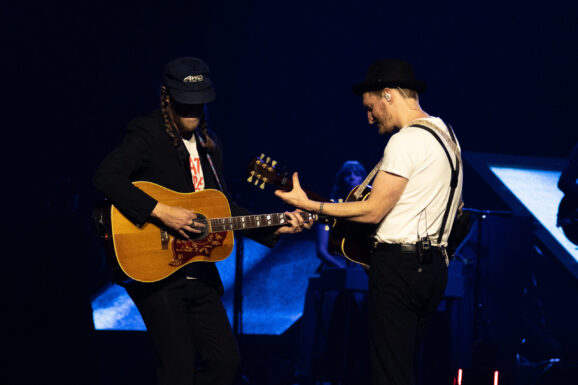
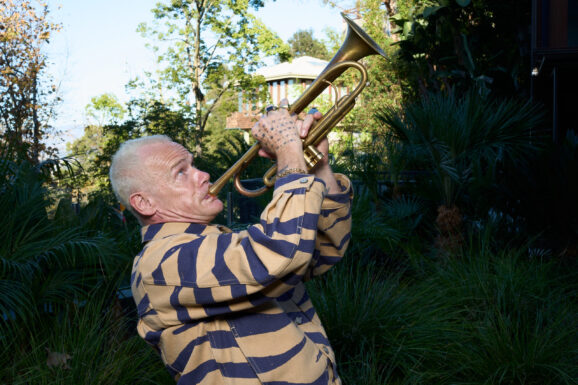
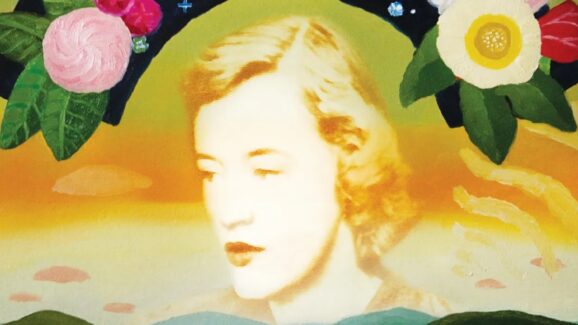
The Salt Collective is an international collaborative project initiated by French songwriter and guitarist Stéphane Schück, who also works in the field of medicine. They released their debut album, Life, in 2023, the product of a fairly remote process of collaboration, but a very satisfying expression of many musical voices brought together. Now, they will be releasing their second album, A Brief History of Blindness, which is an “exploration of hope, memory, and resilience”, on November 21st, The construction method of both albums allowed for experimentation to a marked degree, as each musician was invited to contribute to lyrics, melody, and orchestration.
Like their first album, A Brief History of Blindness brings together an array of estimable talent and creativity, featuring contributions from Aimee Mann, Mike Mills (R.E.M.), Andy Partridge (XTC), and Matthew Caws (Nada Surf), among others. But unlike the first album, this one was substantially recorded live in North Carolina, at Mitch Easter’s Fidelitorium, making for an energetic experience for those involved. The core studio band consisted of Rob Ladd (The Connells) on drums, Gene Holder (The dB’s) on bass, Stéphane Schück on guitars & sound design, Mitch Easter (Let’s Active) on guitars, and Wes Lachot on organ, piano, and Nord, and the album was produced by Chris Stamey and mastered by Dave McNair.
Today, Glide is excited to offer an exclusive premiere of the album, which is truly an all-star affair.
I spoke with Stéphane Schück about the songwriting and recording process that The Salt Collective has refined on these two albums, about his own creative approach, and about some of the specific tracks we find on this stand-out new album.
I’m familiar with the previous album that was released by The Salt Collective, and given the experimental nature of the group and the album, I’m glad that you have kept going, and produced a second album. It wasn’t a given, so it was a nice surprise.
Yes! But it’s an incredible story, the story of Salt Collective. It’s just like a fan’s dream, because I’m playing with all of my idols, from when I was a teenager. I had posters of them in my home, dB’s posters, like for Repercussion, and I listen to their records. At that time, I was saying to myself, “I want to play music because I want to write something and play something like the song ‘Happenstance.”
That’s really the song that changed my life, and I was lucky enough to play it with Chris Stamey on stage. It’s kind of a dream that never stopped, and for me, it’s something that’s just amazing. I’m a music lover, I’m a fan, I’m from France. I could go on forever about it. There’s been so much collaboration on the last album and on the new album. I’m still amazed by this story.
And this time, you got to be in-person with them much more than last time, so it’s a new level.
Yes. It’s true that with the last one, there were many things that were recorded remotely, and we couldn’t be together, but we didn’t feel like we were so far away from each other. However, with The History of Blindness, we were all together in the studio, in the Fidelitorium in North Carolina. We were live in the studio, for the foundation of bass, drums, and guitars, and it was much more like a live band. Then, of course, afterwards, we added layers, and layers. And sometimes we had to say, “Stop! That’s too many layers!” But the foundation was captured in that way, in the studio.
I feel like I can hear, or at least sense, that live core aspect to the songs. It feels like an anchor for each of the songs that enables them to do all these surprising things. Without a strong core, you can have a pretty song, but it’s not as memorable, so this was smart to do those live recordings. I’m not surprised that Mitch Easter and Chris Stamey knew to do that, as a construction strategy, because they are such excellent Producers.
They are, exactly. You’re right. You’ve got this energy of playing together, which is something that every musician experiences when playing with other musicians. It’s a kind of invisible language that happens. It’s a kind of stimulation. It’s a great feeling. I think you feel it when you listen to the song.
What form were the songs in before the studio? Were they recordings that everyone had heard, or was it very open to work-shopping in the studio.
We experimented with methodology between the songs. I wrote all the music in my little studio, here in Paris. I was playing guitar chords and putting on bass. Then we’d have something like a big piece of raw stone. And I’d send this to Chris, and he’d make the selections. Then, the methodology was to give this to a singer. And they’d have total freedom of writing the lyrics, and they’d have no indication otherwise, just the music. They’d be free to add the melody line.
They were free to write the lyrics, and sometimes I’d just give the title. They might base the lyrics on this. Of course, I had some idea of the melody line, but I kept that to myself. Then, you’d see the song moving in new directions that you hadn’t imagined. It’s a process of creativity that’s really, really entertaining and satisfying for us, because it’s a true collaboration. When we had the melody line and the lyrics, we’d create the arrangements and get them ready for the studio. Then, we’d send the song to each musician, and they’d work on their parts, again with total freedom. All the musicians would add their skills and talents, because these people I’m playing with are just amazing. So, you see, the song would “grow up” as each musician added their personality to the song.
It could seem a little schizophrenic at times, because we had all these people working together, but the end result, strangely, would be coherent. And then, the Production work would contribute to that. It’s a really interesting way to make music together, and I think it’s a methodology that made them feel good.
I think it’s clear that the result has to do with who these people are, as you say, also. They are not only incredibly proficient musicians, but they also have their own ideas to include. Some people would want more of a road map, but these are people who are all at points in their musical careers where they want to do new things and experiment.
You’re correct. I think it’s so interesting because all these people have reached points in their careers where they are famous, but this methodology is about total collaboration, where there’s no ego at all. When you’re in a band, sometimes the songwriter is saying, “We’re going to play like this.” But here, everyone brings their own voice to the song, and it’s amazing to see how the songs are evolving. I have all the demos. What you hear are the final results, but it’s months of working and trying things. I think of the song “Cloud To Cloud” with Matthew Caws; there were 16 versions of the song. But at the end, it seemed crystal clear that the structure would be a certain way.
When a lot of people work together on a project, the biggest difficulty can often be getting different people to agree on the final form. Was that ever an issue? Or did the Producers help make those final calls among so many possibilities?
It’s supposed to be an issue, but it has never been an issue with The Salt Collective. We really work together with Chris. Chris is a producer, but I am also really involved in Production. I think there are thousands and thousands of emails that were exchanged between me and Chris. I have to count them one day! We never have an issue because Chris always gives you choices and has variants to listen to. With other people I’ve worked with, it hasn’t been like that; I’ve been told, “This is the song.” And that has been really frustrating.
With Chris, it’s really satisfying because he isn’t like that. He gives people open choices at each stage of production. He asks, “What do you think? What are your ideas on this?” Sometimes we could spend hours and hours on two bars. So it was not an issue at all; it was a constant exchange from the first demo through to mastering.
What influenced you when you were writing these songs initially? I mean either musically or personally. I feel like there’s a serious little edge to the songs.
Yes. I think that when you’re making music, it’s creativity. At the beginning, first, you want to change the world because your song doesn’t exist, and then it appears. You want to change something. This is a strong feeling of creativity, bringing something to life from nothing. But, in fact, it’s not from nothing. It’s from what you are, what are feeling, what your mood is the moment that you are writing the songs.
There is not necessarily a message, then. You’re playing something just because you feel something. And it’s a kind of communication with other people. You have to be empathetic when you are writing music. Sometimes you can write music only for yourself, since you want to feel better. But when you are in the process of creativity, you have to feel the presence of other people, and this is communication directed towards them.
Of course, you want to share something, a mood, or ideas, and the way that you see the world. It’s kind of your vision that you hope people will think is cool. It’s the same feeling working in medicine, when you’re a medical doctor, or you’re working in the field of health—you have to be empathetic towards others. You have to feel the other person, the humanity. Those two fields are not too far apart.
Do you find yourself imagining the people who you are speaking to?
Exactly so.
On our title track, “A Brief History of Blindness”, we have the wonderful Lynn Blakey. I love the mood of that song, and it made me think about human connection and the lack of connection in relationships. Is that a song that you knew, initially, would be on the album?
This song is very particular because I wrote it years ago, maybe eight years ago. I was playing it with my French band as a trio. We really loved to play this one together, so we had recorded it in a French studio. It’s the only song on the album that was not recorded at The Fidelitorium. I think it was one of Chris’s favorites, which is why it gives a name to the album. I wanted to have a female vocal on this one, and to me that was obvious from the beginning. There were some minor chords, with a high tempo. This is something I like a lot: something melancholic but high-energy.
I was sure that Lynn would find some gorgeous vocal lines on this, so I sent her the music. She came out with a melodic line, and we talked about the idea of a history of blindness, the idea that we are not seeing things even with our eyes wide open. Then there was a huge work of layering that created an urgent feeling in the song, and we started and stopped work on that song a few times. Then there was a kind of false ending in the song, where you think the song is going to end, but it doesn’t. It’s a kind of surprising song, moving from the verse to the chorus, then going back and forth. I like it a lot.
I kind of assumed and realized that traditional song structures are not that important on this album. That’s part of what makes it exciting, because you don’t know how each song is going to develop. It feels dramatic.
Yes. I like that a lot.
The song “You Swallowed the Sun” is very different. It does have more of a traditional Pop song structure and an almost 1960s sound to it.
Yes! That one is crazy because it’s a collaboration between Chris Stamey and Andy Partridge. I was really impressed by how Chris wrote the song and interacted with Andy. I know they had a lot of exchanges about this song. My only hope is that they will make songs again, together, because I’m dreaming of a full album by Chris Stamey and Andy Patridge!
It sounded great.
Yes, I’m pushing them to work together. The result on the song is amazing. It’s XTC and The dB’s together, and the sound is pure happiness.
Which is the opposite of the lyrics, which are quite sad! But I think the force of the lyrics lies in their honesty.
Yes, exactly.