Ov Sulfur is a Blackened Deathcore band based in Las Vegas who will be releasing their second full-length album, Endless on January 16th via Century Media Records. Made up of already experienced musicians, they hit the ground running with their first EP and album, and have put considerable thought into the direction of this second album and the ways in which it could take them into new territory. While their previous releases have taken an anti-religious approach, for Endless, Ov Sulfur decided to focus in on specific emotions for each track, drawing on their personal experiences. They also made two key musical additions, including more overt melody lines as well as more interacting vocal lines. Within this exploration, Ov Sulfur also brought in songwriting from more of the band members to make up the album. The result is a powerful statement, and one which feels very much focused on audience experience.
Made up of Ricky Hoover (vocals), Chase Wilson (guitars, vocals), Leviathvn (drums), Josh Bearden (bass), and Christian Becker (guitars), two of whom are newer band members, Ov Sulfur is now taking further advantage of the broad musical abilities of their members to make sure that these songs can come across as well live as they do in the studio. I spoke with frontman Ricky Hoover about the band’s mindset and how the songwriting on Endless developed in such a specific direction.
I know that the band did a lot of playing after the release of your debut album, The Burden Ov Faith. Do you think that so much performance gave you ideas about what you wanted to do, sonically, on this new album?
Yes. I believe that playing live helps you, as a band, and it shows you what each of your members brings to the table. That way, when you’re writing, you can play on each person’s strengths. That’s something you learn from playing together every day.
I notice that your drummer, Leviathvn, wrote some songs for this album, but also that you have two new members, so you’re still expanding.
This band’s been around for about five years. A lot of times with bands, when they are first starting out, there are things that go on behind the scenes that the public doesn’t usually see because they haven’t built up momentum yet. You’ll have member changes, and some coming and going. For us, the band has kind of always been in the limelight.
With these two new members, one of whom is brand-new, Christian Becker. The first time I met him was when I played with his band years ago, and we hit it off. The other member is the person who actually recorded and produced our EP, Josh Beardon. They are both really big assets to the band, just like Levi. Levi is a multi-instrumental musician as well. So everybody in this band can do a couple of different things, which I think helps us a lot.
Regarding what you said about the band having quite a public career from the start, I think one of the reasons for that is that you’ve all had previous musical experience and could launch straight ahead like that. I can see from the collaborations on your previous album and this one that you have a lot of connections in musical communities, too. The “newness” is a bit of an illusion.
We’ve all been fortunate in different ways. With my previous band, I did a lot of touring and was very much involved in the music scene back then. Probably more so than now, since I’m older, and I now have a wife and kids. I’m busy with family stuff a lot. But back then, I think my involvement meant I got to know a lot of people. Carrying over into this band, I’ve been able to call in a few favors! And collaborate with some great people.
I think that what I’m hearing about this album, Endless, is true, which is that it’s a little more personal. It’s not that you didn’t take the ideas of the first album personally, but I noticed that the writing was drawn from the emotion of specific experiences. When it came to writing, was that a decision you made ahead of time, to focus on emotions, or is that more how you chose what went on the album?
Our writing dynamic is that Chase and Levi will write the music, and usually, lyrics and lyrical content come last. I like listening to the songs and having them evoke something in me that makes me write. That’s how I decide the direction of a song. With this new album, everybody wanted to expand and take our music to the next step. With that being said, I really tried to push myself vocally and lyrically, but the way in which I pushed myself lyrically was to step back. With this band, particularly, I’ve always tried to include as much lyrical content and as many words as possible. I wanted our lyrics to be something that people would have to look up to understand. I wanted the lyrics to be intelligent and leave people questioning a little bit.
With this album, I had to push myself not to do that. I had to push myself to work more simplistically with these words that didn’t necessarily need to be looked up. I let these words really speak, and ring out, and that was very difficult for me, because I like big, complex words. But with an album that was more emotionally driven, more personally relatable, which is what we were going for, it’s not always the best thing to put huge words in. So, I wanted to push myself to do that, and I always wanted to push myself pattern-wise, timing-wise, vocal-sound-wise, all these things.
When I heard the songs, I just got in my own head about the idea of writing kind of depressive stuff again. This album is pretty depressive, lyrically. The idea came to me of endless emotions. We all have emotions, and sometimes they can feel like they are endless, whether we want them to stop or don’t want them to stop. But what if these endless emotions were the constant? That’s what we decided to write about: things that, if they were endless, would be torture.
It’s so true that we don’t really know why, but when we feel an emotion, it also feels like it’s going to stay forever, bad and good. That’s why positive emotions can lead people to make unwise decisions based on that, like on a first date, deciding that you’re going to marry someone. We can sympathize with that, because the big feeling is so in control, and we want it to last forever. But the negative side is that when you’re in an emotional loop and you can’t get out of a dark state, it really feels like this is going to go on forever. We don’t have a lot of control over our emotions.
Our consciousness is also kind of momentary. In the moment of something, it feels endless, even if it’s not. Hopelessness is one of the worst things that you can feel, and it feels like it lasts forever. We’ve all shared that experience in one form or another, so that’s why I wanted the general theme of the album to be along those lines.
I feel like there is a general sense of distilling that idea into several of these songs. The songs focus on specific things, intensified and made bigger. You take those three minutes and focus on one thing, but I can see how that’s different than the more complex philosophical ideas that you were exploring on your previous albums. It’s a challenge. Did you enjoy doing something different?
Yes. Obviously, I’m outspoken with my views on religion. When I was in my other band, I did write about those things as well, but I guess I wasn’t so abrasive or so directly up front about it. But now we’ve already done the in-your-face anti-religious stuff. People like us for that, yes, and I am very proud of the material that we’ve made together, but I wanted to do something even more relatable. I wanted to make something that people would feel more. And I think with this album, everybody we’ve shown it to feels the album. I think, sonically and lyrically, feelings are tied together in there.
I can see how that could work really well live, because people can really be in that moment, in that particular emotion, with you. Have you played these songs live yet?
We played “Seed” before we released it, and people seemed to be really receptive to that, which was awesome. As the touring goes on, hopefully, we’ll start putting the new songs in the setlist. It’s exciting and fun to put new stuff in.
Do you allow yourselves to do things in the studio that then need a little work to figure out live?
[Laughs] There is quite a lot of stuff that we’ve done in the studio, where afterwards, I’ve said, “Oh, shit, I have to teach myself how to do this live! Oh my God!” One of our oldest songs, “Behind the Hand of God,” is incredibly difficult to do live because there is no room for breath for all. With me and my arrogance, I’ve recorded some parts on the new album that are even harder to do, for myself, without realizing it. Basically, I practice every day to do them. And I can confidently say that I can now do everything on the new album, just from practicing. Time will tell!
I imagine the setlist is important for not stacking things with extreme vocals together.
You would think so! But we don’t pay too much attention to that, vocally. We put things together based on what sounds good together. And then we work on it, together, live. I also practice things the old-fashioned way, driving around in my car. We always used to do that back in the day, and I do it still, because it’s familiar.
Are the windows up?
Most of the time! You don’t want to scare people next to you.
There are two newer, related things about this album that you all did this time around. You used more melody, and there is more use of multiple vocal lines interacting. Your vocal interaction approach seems to have started on the previous album, and you expanded that here. That’s all adding to the complexity of what you need to be able to do live, though.
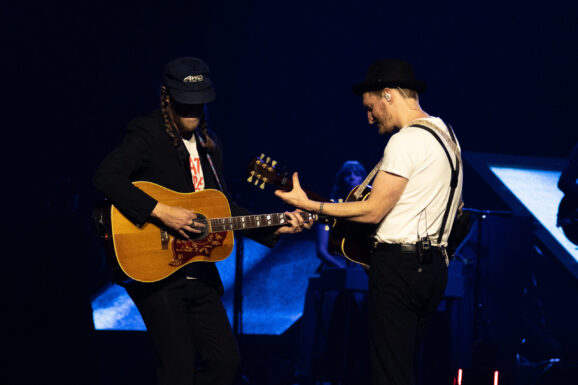
I’m fortunate in that all of the members in this band are multi-instrumental. Everyone can play guitar. I can’t play guitar to the calibre of the other musicians, but I can do it. They can all sing, they can all scream, they can all play their instruments while doing both, which is mind-blowing. Live, we are able to tackle different things. We can stack up vocal harmonies, or do a higher scream and a lower scream together, so that it sounds like the album more.
My biggest thing is having it sound as close to the album as possible. Learning how to do the cleaner vocals right after doing the heavier vocals was something that took me a minute. You’re constantly learning to do something better, but if I have a part where there’s a scream under a singing part, I have other members of my band who can nail that.