There are many elements that made The Grateful Dead singular, but one of the most defining was having two primary songwriters and lead singers. Plenty of bands shared the load—The Clash, The Beatles, The Who, Fleetwood Mac, even Uncle Tupelo—but the dynamic between Bob Weir and Jerry Garcia went far beyond simple balance. Their contrasting voices and writing styles created an improvisational dialogue that served as a launchpad for the band’s most adventurous sets, allowing moods to shift fluidly throughout a night.
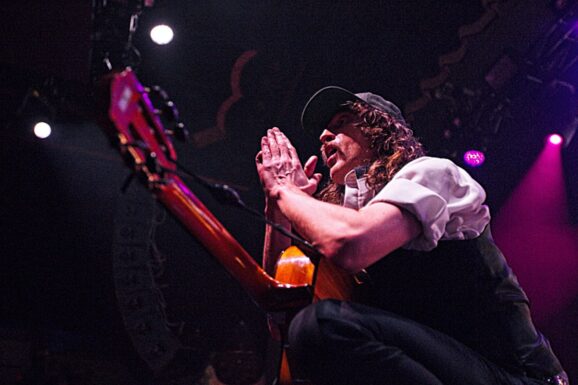
Now imagine a world with no Jerry songs—where the band could only build a show from Bobby tunes. As we continue to mourn the loss of one of rock’s most charismatic voices and guitarists, we thought it fitting to explore an ideal Grateful Dead concert constructed entirely from Weir compositions. Where Garcia’s songs often leaned inward—melancholy, reflective, quietly searching—Weir’s material pushed outward. His tunes thrived on tension, rhythm, and confrontation, bringing with them exaggerated stage movements, sharp vocal yelps, and theatrical intensity you’d never see from his elder counterpart.
Each song here is placed as it might have appeared in a late ’80s Grateful Dead setlist, during the Brent Mydland era—when Bobby’s sharper edges, funkier grooves, and rhythmic authority often helped define the band’s nightly momentum.
SET 1
“Feel Like A Stranger“
As a mood-setting opener, few songs can fire up a crowd for a wild, unpredictable night like this one. With its spacey effects, Bobby’s playful vocal twists, and synth-driven textures, the tune—think of it as an 80s-era Dead track—casts a sense of mystery as the lights dim. It draws us into a world where the song’s quiet, quirky take on human connection rules, signaling that tonight, anything goes.
“Jack Straw”
When it comes to Grateful Dead songs that could inspire a movie scene—and there are plenty—this dusty narrative stands out, reflecting Bobby’s love for Westerns and outlaw tales. Often a first-set anchor, it’s treasured for its dramatic shifts and Robert Hunter’s sharp storytelling. Like many Dead tunes, it effortlessly melts hope, tension, and darkness together. When Bobby sings “just a mile to gooooo,” you feel the thrill of freedom and the daring that comes with following the band—or your own muse—into the unknown.
“Looks Like Rain”
It wouldn’t be a Bobby list without this love song—one that inspires either joy or eye-rolls. But Bobby had many sides, and when he leans into his stories of street cats in the throes of romance, it wouldn’t be the same without a little taste of that signature Bobby “charm.”
“New Minglewood Blues”
This stomper captures Bobby at his most showmanlike, delivering a gritty, rootsy blues reinvention. He often tweaked the lyrics—shifting lines, locations, or emphasis—so every performance felt fresh and of the moment. The song shone across all eras of The Dead: Bobby’s rhythm guitar driving the groove, Jerry taking soaring solos, and in the Brent Mydland years, an absolutely scorching organ would set fire to the version.
“El Paso”
Bobby’s “Cowboy-song slot” had become a staple of the Dead’s first sets early on, with Marty Robbins’ “El Paso” assuming the role on a regular basis since its 1969 debut. While most commonly presented as a standalone number, the Dead’s most memorable performances of this saloon-era country classic occurred in the midst of some sprawling early-70’s “Dark Stars”, which often found the extended doses of psychedelia adding a heightened sense of drama to Robbins’ tale of tragedy and love.
“Stuck Inside of Mobile With The Memphis Blues Again”
Most Dead shows almost always included a Bob Dylan tune, and Bobby could deliver a Dylan song with as much clarity and conviction as Dylan himself. While “When I Paint My Masterpiece” or “Desolation Row” were always fitting options, this one often served as a mid–first set landmark. Its mid-tempo groove and rich sense of atmosphere gave the song room to breathe, and Bobby consistently took on Dylan’s most ambitious, lyrically dense material with fearless commitment.
“Cassidy”
Another song that captures Bobby at his most spiritually guided—one that may have helped usher in the later-day “maestro” he ultimately became. On the surface, it feels light and playful, almost effortless, yet beneath that ease lies a deep, carefully woven complexity. And with Garcia’s soaring guitar lifting the music skyward, the song blossoms into its climactic release:
“Flight of the seabirds, scattered like lost words
Wheel to the storm and fly.”
“Let It Grow”
Written by Weir and John Perry Barlow, the song emerged in 1973 as the second half of Weather Report Suite. It showcases Weir’s guitar work at its most distinctive, with his jazzy chord voicings gradually shaping the piece into one of the band’s true epics. In performance, it often became a defining moment of the first set, with early 1973–74 versions widely regarded as the most beloved.
“The Music Never Stopped”
“Listen here, it comes again”—a dance-driven song packed with Bobby’s familiar turns of phrase and rooted in the communal spirit of the ’60s. Lines like “Everybody’s dancing / come on clap your hands” echo that shared, celebratory ethos, while the song’s mantra has always been tied to the music’s sense of endurance. In later years, Bobby leaned fully into that idea, repeatedly emphasizing the immortal refrain: “never stop, never stop.” Of course, Donna Jean versions from the 70’s always add that extra spark.
SET 2
“Sugar Magnolia”>
Emerging from the hush of set break—when anticipation hung in the air, whatever you took that night is starting to really hit you hard, and the only real hope for relief was the band’s return—this playful song snapped everything back to life. Its springy, upbeat pulse pulled people to their feet, instantly resetting the room and signaling the promise of an epic second set.
“Truckin”>
One of those rare Grateful Dead songs that even non-Deadheads can recognize—and often sing most of the words to. While far from obscure, this laid-back shuffle is packed with easy, communal sing-along moments. You can picture Bobby standing tall at the mic, head slightly tilted, leaning into the groove and belting out some of the band’s most instantly identifiable lyrics, turning a simple refrain into a shared ritual between the stage and the crowd.
“Estimated Prophet?>
First emerging in the late ’70s, it quickly became a second-set staple and eventually evolved into a beast all its own. When Weir delivered lines like “And I’ll call down thunder and speak the same / And my work fills the sky with flame / And might and glory gonna be my name / And men gonna light my way,” he did so with unmistakable authority. His rhythm guitar lays down reggae-influenced chords that create a slow-burning, hypnotic groove, while Jerry’s envelope filter adds that unmistakable, voice-like tone—something that could only ever sound like Estimated.
“Playing in the Band”>
Perhaps Weir’s hallmark song, it stands as one of the band’s most exploratory vehicles. The moment Bobby opens with “some folks search for reason,” you know the second set is about to slip into a trance-like space, with the entire band leaning fully into their roles as architects of tension and release. Through it all, Bobby’s rhythm guitar locks in, driving a tight, syncopated groove that anchors the journey.
“Drums”
Bobby gets a well-needed break
“Space”>
Bobby now gets an extended break
“The Other One”>
There’s nothing more chill-inducing than this psychedelic jam vehicle—one that doesn’t just define a song, but can feel like it defines an entire sense of self. This is Bobby at his most dangerous, where the spiritual journey can either overwhelm the mind or become one of the most expansive and rewarding experiences of a lifetime. Coming out of Space only adds to the thrill….
“Playin’ Reprise”>
Oftentimes, the band would abandon “Playing in the Band’s” main theme only to return to several songs later with this resounding reprise.
“Throwing Stones”
This politically and socially charged arena-rocker served as both critique and reflection, questioning the world around it while driving the music to a peak late in the second set. Lines like “Always awake, always around, singing ‘ashes, ashes all fall down’” perfectly set the mood, capturing the song’s uneasy tension as it pushed the set toward its climax.
“Turn On Your Lovelight”
While early versions featured Pigpen on vocals, Bobby eventually took the reins and transformed the song into a jam-focused R&B/blues workout, turning it into a powerful and triumphant sendoff.
ENCORE
“One More Saturday Night”
A straightforward, high-energy rocker that stands in sharp contrast to the Dead’s more exploratory jams—and when Bobby lets loose with his howling refrains, there’s truly nothing else like it. Perhaps a sign that the end of the show for many is just the start of the night for others.
Honorable Bobby Song Considerations
“Lost Sailor>Saint of Circumstance.”
“Hell in a Bucket”
“Mexicali Blues”
“Black Throated Wind”
“Good Lovin'”
“When I Paint My Masterpiece”
“Big River”
“Me and My Uncle”
“Around and Around”
“Wang Dang Doodle”
“Samson & Delilah”
“I Need A Miracle”