
Toad The Wet Sprocket has issued some intriguing anthologies over the years, including PS (A Toad Retrospective) and In Light Syrup, but it’s arguable that none are so fascinating as RINGS: The Acoustic Sessions.
Anyone surprised by the appearance of this unorthodox album hasn’t been following the band closely over the years. Originally emerging in the late ‘Eighties and’80s and achieving some measurable success in the next decade before its dissolution, the quartet subsequently regrouped frequently over the ensuing years on both the stage and the studio.
A formal reunion in 2010 only reaffirmed the DIY idiosyncrasies the quartet worked so assiduously to establish at the outset of their existence, first independently, then on Columbia Records. Drummer Randy Guss officially departed the group ten years later, thereby leaving multi-instrumentalists/vocalists/songwriters Dean Dinning, Todd Nichols, and Glen Phillips as the creators of a new studio album, 2021’s Starting Now, and, at this juncture, the architects of what amounts to a capsule history of Toad.
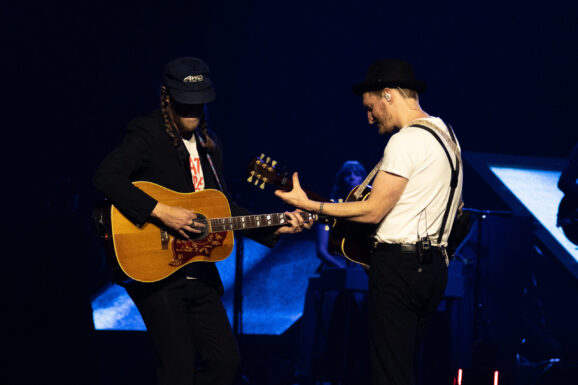
Clearly, the three-men took this production (with recordist Sean McCue) ultra-seriously. They are not simply offering barebones renditions of excerpts from their catalog, but as suggested through Carl Thomson’s touch of percussion during the open-ended arrangement of “Woodburning”–plus the electric guitar and light drumming along with piano on the title song–TTWS circa 2026 are simultaneously reinventing and rediscovering this material in line with their long-term experience together and apart (Phillips has toured as a solo act over the years).
Interestingly enough, too, the latter, Nichols and Dinning, are not doing this all alone. Sara Watkins’ two contributions, including forlorn fiddle on “Nanci” may be the most high profile, but on “All I Want” and “Inside,” Brian Mann plays an inviting accordion, Michelle Beauchesne chips in with an evocative cello part on “Jam”, “Transient Whales” and “Scenes from a Vinyl Recliner,” and Steve Hernandez slips vibraphone in on the latter cut and “Little Heaven.”
Those recruits and others suggest, in no uncertain terms, that the Toad trio has confidence aplenty in itself and, by extension, in the original material it composes (in a variety of collaborative alignments). Toward that end, lyrics to all fourteen compositions are included in the package (on a poster no less!), furthering an implicit invitation to the group’s fans as well as casual musiclovers to regard this near fifty-minute long title with the same abiding respect the artists afford it. By the time the fourth cut rolls around, “Inside” compels the reader to read the words along with the poised performances.
“All I Want” may be an (over-) obvious choice with which to open the set, but the intimacy of Phillips’ lead vocal coincides with the clarity of Nichols’ and Dinning’s counterpoint harmonies, otherwise used so sparingly on The Acoustic Sessions. Seemingly intent on (re)connecting the band with its community, Toad invites the aforementioned Watkins’ to play a violin that echoes the lingering intonation of the phrase ‘slowly grow old’ at the end of “Walk On The Ocean.”
Along similarly reflective lines, “Fall Down” becomes a metaphor for the culmination of a life well (?) lived. But the lighter, brighter notes of “California Wasted” offset any melancholy arising from those tracks so that, with other selections like “Something’s Always Wrong” ranging from three to four minutes and proceeding in quick succession, the music takes the form of a personal diary.
Mixing by Robert Stevenson and mastering by Dave McNair only adds sonic clarity that matches the artists’ self-awareness. In the end, with RINGS: The Acoustic Sessions, Toad The Wet Sprocket reaffirms the veracity of a longstanding maxim: the proof of a good song is the extent to which it will accommodate a variety of arrangements. With artful and engaging nuance, Toad the Wet Sprocket at once reasserts the validity of its lifeline and transcends it.



One Response
Thank you for your review! I heard it yesterday for the first time – it’s really enjoyable. Check out “Little Heaven”