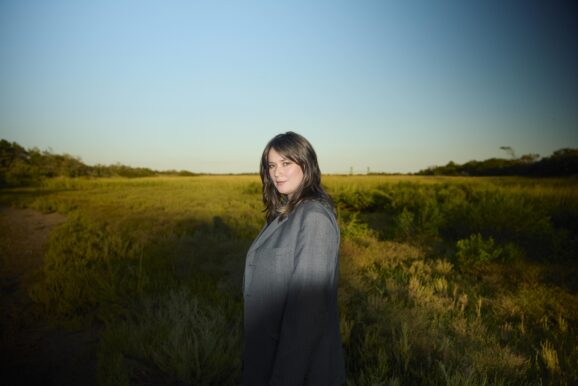
When a Flower Doesn’t Grow, the full-length debut from Ontario indie rock duo Softcult, is a collection of introspective alt-rock that balances heavy riffs with jangling melodies. Twins Mercedes and Phoenix Arn-Horn self-produced the album, using the eleven tracks to explore sexuality, gender roles, and emotional growth.
The title comes from a quote from Dutch author Alexander Den Heijer, who said, “When a flower doesn’t bloom, you fix the environment in which it grows, not the flower.” The album explores that tension between repression, trauma, and attempts to create the proper environment for growth. Mercedes recently ended a nine-year relationship and came out as queer. The album delves into her time trying to be something she wasn’t, the uncertainty of her new identity, and her experiences as a woman in a patriarchal society.
Sonically, Softcult’s music channels grunge’s dark, murky power chords and the ethereal soundscapes of shoegaze, with a dash of riot grrrl snarl. After an intro, “Pill to Swallow” introduces the album’s themes of resistance, transformation, and personal exploration. “I’m looking up through a pinhole down at the bottom,” Mercedes sings through a thick wall of sound that renders individual notes unintelligible. “Always fighting tooth and nail for everything, yeah. And it drips down from the top. We’re starving here.”
Most of the songs share the same thick production, with layers of distorted guitar creating a cacophony in which Mercedes sings in a soft drone. The angry “16/25” makes that shoegaze more hostile, with Phoenix’s aggressive drums laying the foundation for an alt-rock headbanger about predatory behavior toward underage girls. “She doesn’t know how to love you. She doesn’t know how to drive. She doesn’t know how to touch you. She’s sixteen, you’re 25,” Mercedes sings.
“She Said, He Said” tells the too-common story of sexual assault and the tendency to blame or disbelieve the victims. “You have to see it to believe it,” Mercedes yells. The nasty bassline and heavy guitars add an appropriately menacing feeling. “Now it’s her word against his, but he’s your friend, so you’ve gotta take his side. I mean, he’s such a ‘nice guy,’” Mercedes sings.
Softcult’s heaviest moments come in “Tired.” The song is an act of defiance. Mercedes lists her grievances one by one, as if shouting through a megaphone at a protest. “Tired of the exploitation. Tired of the deprivation. Tired of discrimination. Tired of capitulation,” she yells. With her shouted vocals and sludgy guitar riffs, the protest anthem sounds on the verge of combustion.
“Queen of Nothing” is equal parts haunting and beautiful. Mercedes’s dream-like voice, floating over a gently strummed guitar drenched in reverb and fuzz, sounds vulnerable as she grapples with unrealistic and contradictory expectations. “Won’t you get up off your knees? Unbecoming how you try so hard to please,” she sings.
Throughout When a Flower Doesn’t Grow, the Arn-Horns serve up swaths of fuzzed-out rock that are heavy at moments, but usually a soft, droning mesh of intertwining sounds. At its best, the music accentuates the songs’ difficult subject matter. At other times, it becomes monotonous, with the immersive layers distracting and turning into a wash of indistinguishable noise.
After ten songs of tension, the album ends on a more optimistic note. The title track finds Mercedes leaving an unhealthy environment and starting to explore. “All you wanted was the feel the rain on the wrong side of the windowpane,” Mercedes sings. In the chorus, she makes the album’s theme her mantra. “When a flower doesn’t grow, do we blame the dying rose? Or the soil that it called home?”