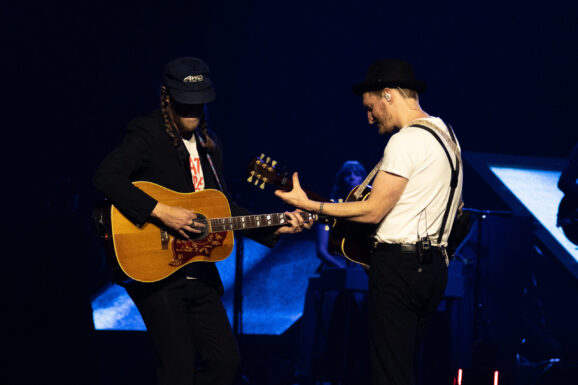
On February 5th, a rare sight was seen in Boston: the Jazz Mandolin Project was on the road beyond Burlington, Vermont, for their first tour in over 20 years. The quartet, with Jamie Masefield on mandolin, Danton Boller on upright bass, Michael “Mad Dog” Mavridoglou on keyboards and trumpet, and Phish’s own Jon Fishman on drums, sold out the thousand-capacity Paradise Rock Club on Commonwealth Avenue near Boston University. With no opener, the group took the stage around 8:30 and unloaded their jazzy fusion on a crowd of folks curious to see what this project was all about.
Appearing in normcore street clothes – gray t-shirt and blue jeans – Fishman perched behind a far more modest drum kit than the one he plays with his regular touring band. Though he skipped the tunic for this occasion, at least his t-shirt included the cartoon graphic of a lady who appeared to be puking donuts. In this group, though, even though Phish fans comprised the lion’s share of the audience, the other three musicians had the first say.
Beginning with a number titled “Phoenicians,” Masefield, Boller, and Mavridoglou offered a gentle prelude to the evening, a lively interplay without drums that eventually kicked in with a familiar snare roll, Fishman joining the party with a calypso groove. As a musical introduction, Masefield, in his untucked collared shirt, strode over to Mavridoglou, snug in his sweater on the keys, and peered over stylish, black-framed glasses at his bandmate. The two interwove a melody of jazz piano and mandolin, while Boller plucked his bass and Fishman toyed with the rhythm. Likewise, Masefield wandered over to Boller, rocking his flannel, who turned the theme in other, plunky directions. And after showing what he himself could do with a mandolin, picking and strumming in turn, Masefield faced Fishman, bidding him to solo.
In Phish, though Fishman’s rhythms are an essential element to every groove, he often seems hard-pressed to take a solo. In this case, his reticence came through again. He smirked shyly as he showed off some of his jazz solo skills.
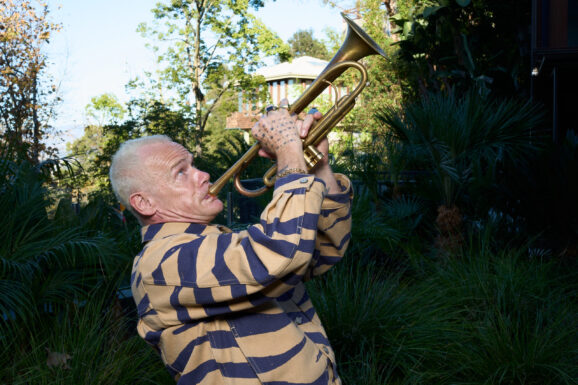
After meeting the band, as it were, the second song, “Stiles,” found Mavridoglou grabbing a trumpet and blowing some notes that sounded not unlike Miles Davis himself. One of the more jazz-heavy tunes, “Stiles,” found the group talking to each other in sound, Masefield’s mandolin punctuating Boller’s deep bass runs. And in “Spiders,” the set’s third song, Fishman caught the stop-start groove of this minor-key noir. While Boller held down the rhythm, and Masefield and Mavridoglou spoke through their instruments with ease, Fishman seemed hard-pressed at times to follow. Perhaps, without his extensive kit, he was limited in what he could do. More likely, the off-tempo arrangements were stretching his skills. By the end of the number, though, the group wizened up and followed Fishman instead, who drove them deep into a spacey jam, noises throbbing, sirens blaring, the sound impressively big for only four musicians.
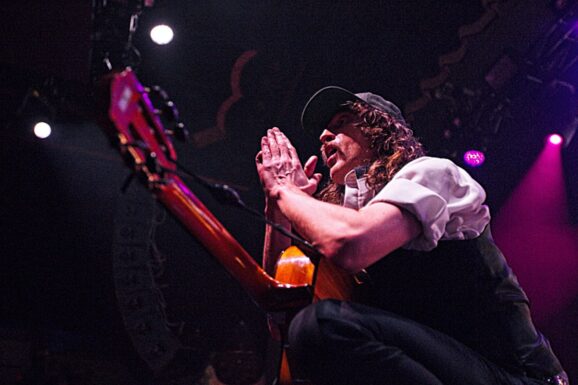
After that opening sequence, Masefield switched to a mandolin. He plugged in a gourd-looking thing and, from its strings, played a far-eastern melody, Mavridoglou’s trumpet matching staccato fills. Fishman had his say, racking the rims of his tom-toms, raking his sticks across his symbols, and the crowd rewarded him with mild applause. This was hard work, melding in with a jazz quartet, though the exotic sound was its own reward.
“Hi everybody,” Masefield said before the next song. “Thank you so much for coming tonight to hear us play. We haven’t played together in twenty years!” They’d practiced a total of 17 hours that week, Masefield said, plus a show last night in Burlington, Vermont, before heading down to Boston.
So this was a work in progress, too, with the group welcoming the crowd to witness the process of learning to play together again.
The lower level was packed, people in ski caps and puffy coats filling every space, barely room to slide past the bar. More attendees packed the wrap-around balcony, grooving and dancing in beanies and hoodies, the scent of patchouli and weed rising up in the corners. Folks stood by to let others through, just as they’d learned to do out of necessity on the snow-piled sidewalks outside, while the Project caught another groove, bleating, blaring, and twanging through “Hamhock” before Masefield introduced the band.
When he got to the evening’s main attraction, Masefield announced, “On the drums, Soupcan Fishman!” A new nickname was born – or revealed. “My name is Jamie Masefield, and we’re going to play one more song, then take a brief break.” That one more song was familiar to everyone, a Steve Wonder hit – “Sir Duke” – all instrumental with the audience mouthing the words: you can feel it all over.
At 10 pm, the second set began with “Black Market,” a Weather Report cover with a trickling mandolin, a soaring rhythm, the bass and drums congealing, and Masefield showing his range, turning his mandolin into a piano, then into a blues guitar. In the jammier portion of the song, Fishman seemed to enjoy disrupting the rhythm, crashing the beat. An echo effect on the keys threw the jam into deep space, Boller showing his mettle with long fingers on the upright bass. Tall and lean, he commanded his big bass with authority, lending structure to the Project, Fishman watching him often for where to go next.
When Fishman traded the drumsticks for brushes on “Chinquapin,” the sound lightened. Lilting countermelodies played beneath a row of white lights, evoking perhaps the Green Mountains this group descended from. The next song, “Clip,” constituted a swinging 6/8 boogie, deconstructed jazz. The Miles Davis trumpet returned from Mavridoglou, who’d stripped down to his own black t-shirt during setbreak. And Masefield, before the next song, picked up that guard thing again and told the crowd, “This is not a mandolin. This is a mandola. A Gibson 1913 mandola.” The instrument, apparently, plays a lower tone than a mandolin, and after Masefield learned this tour was going to happen, he went out and got one. With that instrument, he wrote a new tune.
“This is a very quiet song,” Masefield said. “And we hope that you all are ready to get quiet and think about everything important in your lives.”
Before Masefield was done speaking, Fishman slammed into an up-tempo rock beat, back in 4/4 rhythm. Boller walked his fingers in a blues cadence up and down his bass. Mavridoglou blew a sassy trumpet. The sound of “Husky” was rollicking, propulsive. Masefield led the group to a hush, and then Fishman, relishing his role, it seemed, cranked it all back up again, before another hush and another round before the song came to an end.
However, the group had more jamming to do. Back on his mandolin, Masefield directed the band through “The Baobab Tree,” quintessential jazz fusion under green and yellow lights. Mavridoglou’s trumpet said something mournful and profound during this chompy second-set jam. On the outro, the tone was utterly electric, yet sweet, and Masefield added, “Imagine folks getting together and playing such odd music, and people come to listen! I think that’s awesome.”
Now to close the set, a country-rock melody crept into the group’s self-described “odd music.” Something familiar, like the Laurel Canyon sound… An elder in the crowd informed everyone around him: “Powderfinger” by Neil Young and Crazy Horse. The band was wailing, Fishman in the pocket, driving this group like everyone knows he’s able to do.
The night wasn’t over. For the encore, Masefield and Boller came back out to pick a lovely version of Led Zeppelin’s “Going to California. Right as they were wrapping up, a stagehand snuck out in a green windbreaker to place a music stand in front of Fishman’s drumkit microphone. When Fishman and Mavridoglou came back to the stage, the former shared his first comprehensible words of the evening: “It’s karaoke night at the Paradise.”
To chants of “Soupcan,” Fishman counted to four and smashed into a rock cover of Black Sabbath’s “War Pigs.” He sang while he played, howling and smiling. Did he sing the song well? Who’s to say? He sang with gusto, with enthusiasm. He sang it as he meant it. Masefield killed it on the overdrive mandolin solo and, after another verse, Mavridoglou on the keyboards got a crack at the distorted progression. Boller’s bass thumped, multicolored lights shifted above their heads, and Fishman’s high-pitched hollers ended the show.
“That was a lotta fun,” Fishman said as the lights went up. “Thanks.”