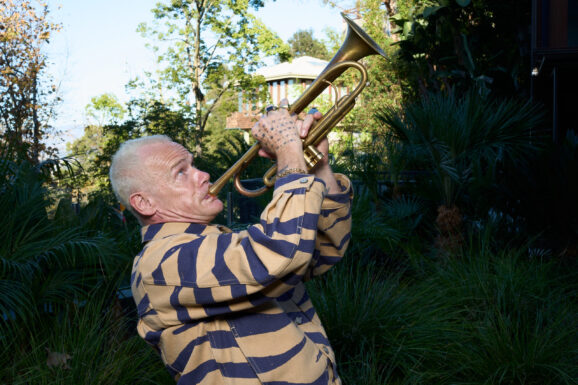
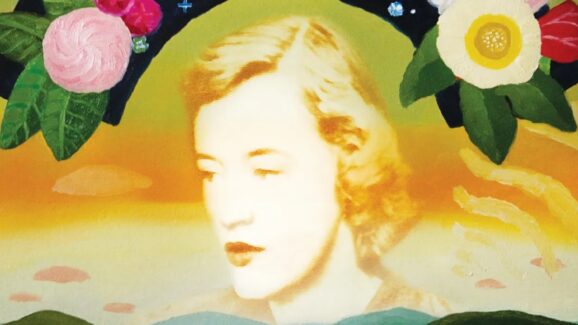
Rachael Sage has never treated songwriting as a statement alone. Her songs are intimate, sometimes devastatingly so, but they are also theatrical, expansive, and carefully staged. For more than three decades, Sage has built a body of work that feels less like a journal than a series of rooms: some private, some communal, all lit by emotional honesty and melodic grace. Her newest album, Canopy, continues that tradition, offering songs shaped as much by empathy and observation as by autobiography. After a cancer scare that sharpened her sense of time and beauty, Sage’s music now feels not quieter, but clearer—rooted in the belief that songs can still bring people together in a fractured world.
Born in Port Chester, New York, Sage grew up surrounded by art long before she understood herself as an artist. “My mom is very into visual arts,” she said. “So she took us to a lot of museums growing up.” Music arrived early, both as instinct and mystery. She never met her grandfather, but family lore holds that he played piano by ear. “I have this image of wondering how he, you know, what relationship he had with the piano and what kind of music he would have played by ear… It’s a mystery for me.”
Movement came first. Sage was placed in ballet classes as a toddler, eventually studying at the School of American Ballet and dancing professionally with New York City Ballet as a teenager. That training shaped her musical instincts in lasting ways. “That culture and that relationship to music came together at a very young age,” she explained. “My sense of emotion and inspiration really was more about the music even than the movement for me.” She remembers coming home from dance class and sitting at the piano for hours. “It was my best friend, and it kind of gave me back whatever I put into it.”
Her ear developed everywhere—synagogue music, Jewish folk songs, Broadway cast albums, doo-wop in the car, Casey Kasem’s Top 40. A single weekend changed everything when a friend introduced her to James Taylor, Carole King, Cat Stevens, Laura Nyro, and Bread. “Finally, I was like, oh, okay, maybe this is sort of what I’m doing,” she said. That realization would eventually bloom into a songwriting voice capable of balancing pop hooks with emotional depth.
Sage has always resisted the idea that songs must be strictly autobiographical. “These things are kind of mirrors of my emotional life,” she said, “but as the albums forged on, I was widening that lens… to include stories and insights of peers and the wider world.” As for those listeners who expect confessions every time. “Sometimes they’re almost disappointed… like, ‘Oh, it’s not as much dirt as I hoped for.’”
That widening perspective defines her catalog, which contains many songs that feel like hidden doorways for attentive listeners. Tracks such as “Bravery’s On Fire” and “No Regrets” capture her refusal to frame vulnerability as weakness, while “Blue Sky Days” and “English Tea” reveal her gift for pairing melodic lightness with emotional complexity. Even “Passion,” one of her quieter triumphs, carries a theatrical sense of longing that has always set her apart.
After years of writing, Sage released her debut album, Morbid Romantic, an early statement of intent. Around the same time, she was coming up through New York City’s late-’90s scene, playing rooms like The Bitter End and Sin-é. “What an incredible time it was to come up then,” she said. “We just felt like we were hustling… but there were a lot of places to play, and people would go out just to hear anything.”
Live performance became her proving ground. Early coffeehouse gigs taught her what it meant to be emotionally exposed to strangers. “There’s nothing more naked than debuting a new song,” she said. Those moments sharpened her craft and her resolve. “You just kind of dug in and said, ‘I’m committed.’”
That commitment led to pivotal moments, including when Ani DiFranco invited Sage to tour after receiving a homemade CD and handwritten note. Suddenly, Sage was playing for thousands each night. “I had to find the confidence, even though I was petrified,” she said. “It was trial by fire.” Touring taught her how insecurity could become fuel, how fear could sharpen performance rather than blunt it.
Over time, Sage became known for lyrics that didn’t flinch from emotional conflict. “Some older songs were written when I was really struggling,” she said, describing a period when she explored pain with almost Shakespearean intensity. That approach shifted after she was diagnosed with uterine cancer. Though she is now gratefully in remission, the experience changed her sense of urgency and perception. “A cancer scare sends that message home to every cell in your body,” she said. “Every day is precious.” It also reshaped her writing. “I was more apt to want to find the lighter side of things… to turn something dark into something light.”
That evolution is deeply felt on Canopy, one of Sage’s most connective records. “This has been one of the most gratifyingly connective records I’ve ever released,” she said. Many of its songs were written with others in mind, centered on inclusivity and empathy. Touring behind it, she feels she is living the record’s message in real time. “This is what music can do,” she said. “We can alter the nature of our time together in a positive way.”
Canopy also reaches backward, pairing new material with songs written decades earlier, allowing her younger and older selves to meet. “Songs don’t expire,” Sage said. “They’re just waiting to be plucked from the garden.” It’s a philosophy that explains the remarkable consistency of her output, building a catalog defined not by trends but by trust—in melody, in language, in emotional truth.
“I’m 30 years in music,” Sage said, “but I think I’m going to be doing this till I’m hopefully well into my 80s… so I’m just getting started.” It doesn’t sound like bravado. It sounds like fact. After decades of quietly excellent work, Rachael Sage continues to make music that insists on empathy, connection, and the radical act of paying attention—proof that vulnerability, when paired with craft, only deepens with time.