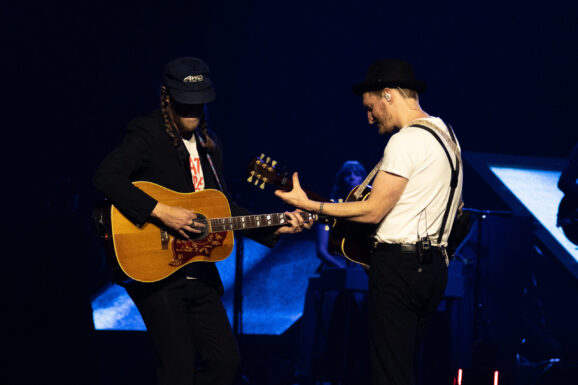
Just over six months since their last LP was released — and coming off a seven-year musical drought — Mumford & Sons have turned in Prizefighter, yet another full-length record. Like last year’s Rushmere, their latest is a nice blend of their earlier folk revival sound and their more recent, indie rock/pop-focused approach.
Along with tapping an inspirational vein, the band brings in several guests to perform on the record, including Chris Stapleton, Hozier, Gracie Abrams, The National’s Aaron Dessner, and Gigi Perez. Of that grouping, Stapleton seems like the oddest pairing, best known for his classic country sound, but it works surprisingly well on the opening track, “Here.” Stapleton’s deep baritone pairs well with Marcus Mumford’s mid-range tenor; both are known for their emotional delivery, and the blend works exceedingly well over a slow, steady drumbeat and a piano that swells throughout.
The duet with Hozier, “Rubber Band Man,” an early single, sounds like it came off the band’s more banjo-heavy debut. It’s another delicately pretty ballad that has come to define the band more than a decade after that debut. “The Banjo Song,” co-written by Dessner and Jon Bellion, also recalls their early singles and boasts some of the best harmonies on the record. The most powerful duet here, though, is with Abrams on “Badlands.” An emotional high point of the album, it recalls Peter Gabriel and Kate Bush singing “Don’t Give Up.”
Like Rushmore before it, lyrically Prizefighter finds the band relying on more personal experiences — especially on the solemn “Conversations With My Son” — coming off less restrained and guarded than they did on albums like Delta. The sparse arrangements on “Alleycat” and the title track drag down the momentum a bit, especially in the middle of the album, but they regain traction on the triumphant “Begin Again.” The set closes with “Clover,” another powerful ballad that feels like a spiritual sibling to the Glen Hansard and Markéta Irglová song “Falling Slowly.”
While not every track lands with equal weight, Prizefighter succeeds on the strength of its emotional candor and well-matched — if at times surprising — collaborations. The band leans into what they do best — swelling ballads, earnest confessionals, and gratifying harmonies — and as a result, the album feels less like a reinvention than a reaffirmation of what they do best.