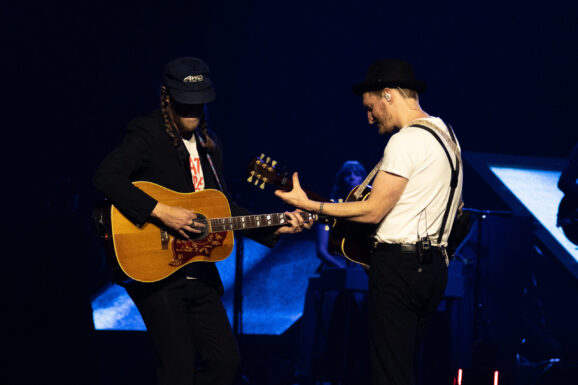
Portland, Oregon-based Chicano Rock artist Joshua Josué recently released his second full-length album, Broadcast To the Surf Ballroom, which is a very special project that gathers some of the unfinished demos and fragments left behind by Buddy Holly and Ritchie Valens at the time of their deaths and completes those songs, bringing them each to a full studio recording. The title of the album refers to the final performance of Holly and Valens at the Surf Ballroom before their tragic plane crash the next day.
Josué carefully handles the material, avoiding covering the songs in his own way or trying to take on their musical identities. Rather, he sketches in the missing pieces, fills out the instrumentation in a way that was in keeping with their sensibilities, and brings his knowledge of live performance of many of these songs to bear. Because of the live focus that he wanted to preserve, the album was recorded nearly live with minimal overdubs at Roseleaf Studio. The songs feel more textured, more human, as a result, and also capture the wild energy of early Rock ‘n Roll. I spoke with Joshua Josué about the album on a day that also happened to be the actual anniversary of “The Day The Music Died”, February 3rd, and also the day of the album’s release.
I’m excited to see that you have quite a few shows celebrating this album, so people can hear this music live. I see that you already played an opening show in Portland.
Joshua Josué: Yes, our opening show was in Portland. Then we headed over to Bend. Touring on the West Coast, everything is hours apart. That’s why I want to get to the East Coast, because you can hit several cities in a shorter amount of time.
The last time that we spoke, I don’t think you mentioned this album idea. We were talking about Beneath the Sand, your first album. Was it already on your mind back then, or is this a project with a newer impetus?
I had been thinking about doing this for years. I grew up listening to Buddy Holly and Ritchie Valens, and to the demo tapes they didn’t officially release but were released after their deaths. After both Buddy and Ritchie died, their managers/producers wanted to make more money, so they started releasing everything they had from them. I thought, “As an artist, I wouldn’t be very happy that someone released my home-recordings, but as a fan, I’m grateful that I got to listen to those.” With Buddy Holly, his manager, Norman Petty, would extract Buddy’s vocals, put them on a tape, then add instrumentation to them. Sometimes, those were not very good. With Ritchie, his manager took some of the demos he recorded at his manager Bob Keane’s house and released some of them.
I grew up listening to those, and I always thought it would be neat to finish some of the songs they didn’t have time to finish, the ones they never lived to record properly. I thought about that for a number of years, and this past late summer, when I was out promoting Beneath The Sand, I had a lot of time sitting in the van to think. I thought it would be a neat thing to do, and release it near the time of their last show, which was on February 2nd, 1959. They got in a plane and died on February 3rd.
So I finished writing some of these songs, and I just rearranged and recorded others. I decided to call the album, Broadcast to the Surf Ballroom, because their last show was at the Surf Ballroom. This album is a letter, or a broadcast, to that place and time. I’ve made it with a lot of respect for Buddy and Ritchie, because I just adore their music, and I’m a huge fan of theirs. I’ve dreamt about doing this for many years, but this just felt like the right time, so I did.
How did you go about recording it once you were sure you wanted to?
We did it pretty quickly. It’s a near-live album. We went into the studio and recorded for two days. The first day, we recorded seven of the ten songs. The next day, we finished them up, and I went in and recorded some vocals and a few overdubs. Which makes it mostly live.
That makes it even more fitting that it connects with that last concert of theirs, a live album for a live show. It’s like a continuum.
Yes!
Had you been playing some of these songs out over recent years? I saw that your guitarist on this album is also someone who plays live with you.
On this record, Ben Rice is on guitar, and Ben Rice was one of the guitarists on the last album. Ben and I have written a number of songs together and worked together on various projects in my band, his band, and others. We’ve written songs together for Curtis Delgado’s albums. We’ve become a little bit of a songwriting team and a duo. But I’ve played some of these songs for quite a while, because I was initially inspired to make music by seeing the film La Bamba. I loved that movie in the theater, and I had a hundred dollars saved from mowing lawns as a teenager, so I went out and bought a second-hand guitar. Then I started learning Buddy Holly and Ritchie Valens songs, so my music journey started with them.
Now, at this juncture in my life, it feels like everything has gone full circle, and I’m paying respect to where it all started. As a more mature musician, I feel like I’m able to perform those songs and record those songs in a way that I wasn’t able to as a teenager.
And maybe, potentially, hear them a little differently now.
Yes, absolutely. You hear them differently when you’re a teenager than when you’re an adult. Some of it is just the sheer genius of their songwriting. When I was young and playing Punk Rock, I would play Buddy Holly in some of my Punk Rock bands. I was familiar with basic music theory, including major and minor chords, but Buddy would play what seemed like a random number of major chords that didn’t fit the key.
I used to think that he’d stumbled across something that was just cool, but as I’ve become a bass player, a clarinet player, and from expanding on my guitar, I have realized that what Buddy did on some of the bridges of his songs was take the circle of fifths, and move backward, moving in fourths, which is a really standard Jazz technique that a lot of Jazz players will do. I was blown away by that. I had no idea that he was a teenager. As an adult, I can see that he was looking at music theory.
When I approach this music, I think, “Wow, they were so young, it’s such a shame they didn’t get to live longer.” But then I listen to the songs, and I think, “Wow, these are so deep.” They really feel old for their age in terms of what they managed to communicate. These are songs that young people can definitely relate to, but their depth can also speak to older audiences. “Learning the Game” is one of those songs if you listen to it closely. Just the honesty and directness of it is impressive. The emotion is there.
That’s especially true with those later Buddy Holly apartment tapes, such as “Learning the Game.” There’s such honesty, vulnerability, and such maturity. The story behind that song is that Waylon Jennings had started being Buddy Holly’s bass player towards the end of Buddy’s life. He was on that last tour that Buddy died on. The story of that song was that Waylon was 17, and he was going through his first heartbreak. Buddy, as an older musician, all of 22, was consoling Waylon and wrote that song with Waylon in mind. He was saying, “You’re just learning the game. Hearts are broken, love can be untrue, and this is part of life. This is part of growing up.” And Waylon then helped him with some of the lyrics.
I’ve often thought, as I’m sure you have, “What would these guys have sounded like in the 1960s?” I feel like, since these were their latest compositions, we might get a little preview of where they were headed. Do you feel that way?
I feel like Buddy was started to Produce other artists, and starting to Produce other artists. He was also taking acting classes and wanted to get into film, like Elvis, but he wanted to do it in what he said was the “right way.” He was experimenting with recording styles and techniques, and you can hear the evolution in his songwriting. With Ritchie, there’s just a real glimpse into the 60s with him. His early band was the early Wrecking Crew. On bass, you have Carol Kaye, along with Paul McCartney, who is, in my opinion, one of the two greatest bass players. Earl Palmer was on drums, and René Hall on guitar.
One of the really cool things with them is that when an artist came in to play with them, most of them were not allowed to play their own instrument, because most young artists were not at the caliber of The Wrecking Crew. They were the greatest musicians and greatest Jazz players in LA at the time.
Something that speaks volumes is that Ritchie played his own guitar on those recording sessions. Some of the outtakes and B-sides were released later, when they were rolling tape, when people were just warming up. You can hear Ritchie playing his guitar with these amazing Los Angeles players, and he’s holding his own. To think of what he could have been, not only as a songwriter and a singer, but as a guitar player. At 17, he was just amazing. He was really sticking within the pentatonic scale, but he played it with such enthusiasm and so much heart, in the same way that I would say B.B. King does. Ritchie had that, and that was at 17, so where would he have been as a mature musician at 40 or 45? It’s just hard to imagine.
How did you pick which songs you would cover? Was it mainly an emotional decision, picking what songs you felt closest to?
It was a hard choice. A lot of it was dictated by time and money, because there’s so much more that I would have loved to do. Maybe eventually there will be a volume two to this, because there’s so much material that they left behind. We recorded this album very quickly, which is why it has 10 songs. If I had more time, it would probably have had 20 songs. There was a long list of things I wanted to do, and letting go of some of those songs was very difficult, so I suspect I will revisit more of their songs in the future.
HMS: It’s nice that this is no longer just a dream for you now, that you know how to do a project like this now, so if you decide to do more, the path is laid out to make it happen.
JJ: Right. Something that’s been exciting and uplifting is that I was in LA a couple of weeks ago and noticed that several members of Ritchie Valens’ family follow me. Occasionally, they comment on my posts, especially when I’m playing a Ritchie song on a video. I reached out to Ritchie’s nephew. Ritchie had a brother named Bob. Bob’s son comments on my posts, so I reached out to him. He’s named Richard, and I told him that I’d be in LA and asked if he’d like to meet up. He said, “Absolutely.”
So we met up there in the San Fernando Valley and had breakfast one day. He looks so much like Ritchie and his dad, Bob. We talked about all things Ritchie and “La Bamba.” He said that the next time I was in town, because he would love for me to meet the rest of the family, and to bring my guitar, the family would love to hear me play. That was really special. Additionally, I visited Ritchie’s grave and posted about it on Instagram. Then, Ritchie’s high school girlfriend Donna, about whom he wrote the song “Oh Donna,” commented on my post, so I reached out to her. And we ended up chatting. She said she’d watched my videos online and that I had a livestream coming up, so she watched our livestream. I was able to sing “Oh Donna” and dedicate it to Donna, which was really a special moment in my life.
HMS: That’s absolutely incredible. Good for you for reaching out to them and connecting in such a human way over such an important legacy.