
Jessica Lea Mayfield does not enter a room so much as drift into it, like cigarette smoke curling toward a ceiling stained by old songs. She speaks softly, almost apologetically, as if volume were a vulgarity. Yet the life behind that voice has been anything but quiet. It has rattled down highways, slept in parking lots, sung for spare change, and stood beneath stage lights that never quite felt like home.
Her music is glamour gone groovy gone gritty — a shimmer dragged through gravel. The songs are dark, yes, but darkness is not cynicism. It is confession. It is testimony. It is a woman kneeling before the truth and refusing to blink.
“I was born in Ohio, and then we moved to Tennessee around the time I was eight,” she said. “We were sort of like gypsy people, and we lived on a bus.”
Nashville. Smithville. Lebanon. Rock Island. Towns strung together like beads on a rosary of asphalt. Her childhood was not suburban lawns and school dances; it was bluegrass festivals up and down the East Coast. Upstate New York. Indiana. Ohio. Kentucky. West Virginia. “It was a lot of fun,” she said. Then she pauses. “It was hard.”
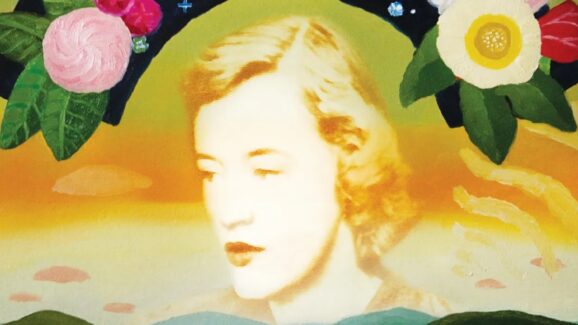
Her family band toured constantly. Mandolins in cases. Guitars stacked against vinyl seats. Her mother, Valerie Mayfield, played mandolin and remembered everything — the roads, the people, the small kindnesses that kept a traveling family afloat. “Mom was the one with the memory,” Jessica said. “She was very outgoing, very social.” Valerie recently passed, and in the attic Jessica found relics of her own ascent: magazines she had appeared in, souvenirs from European tours — a stuffed animal labeled London, an Eiffel Tower keychain. Proof that the girl on the bus had crossed oceans.

Because before there were magazines, there were street corners.
“You have to think about it,” she said. “My parents were homeless and we lived on a bus and we played for tips for food.” At times, the family would spread out to different corners to earn more money. “The theory was if we were all on separate street corners, we would make more money.” She and her brother, children unwilling to be alone, would find each other anyway. At day’s end they pooled their change and bought a sack of burgers.
Music was not romance. Music was survival.
“For me, it got me out,” she said. Out of Ohio. Out of a narrow future. “Music was God and the center of everything.”
At eleven, back in Kent, Ohio, she haunted an open mic at Brady’s Café. Her brother worked in the kitchen. She would bus over alone, sing Nirvana, Foo Fighters, Stone Temple Pilots — “poorly,” she insisted, though the evidence suggests otherwise. The first song she ever wrote, she played there by herself. That moment — a child declaring her own words into a microphone — was a private covenant.
Her songs would grow heavier. On records like “Make My Head Sing…“ and “Sorry Is Gone,” loneliness becomes a cathedral. She wrote through abuse, through divorce, through nights that seemed engineered to test the tensile strength of a human soul. “I was the loneliest I had ever been,” she said.
Mayfield knows something about dread, and appreciates the elaborate methods with which some people manage to fill the void.
She fills it with melody.
At her mother’s funeral, something clicked. “Everyone in my family is emotionally stunted,” she said. “They keep everything in. But everyone speaks through song.” At the service, relatives sang their grief rather than spoke it. Jessica realized she had been doing the same thing her entire life — writing songs that said what she could not say aloud. “I would write everything I wanted to tell someone in a song,” she said. “And then I’d never actually say it. I’d just be like, ‘Here’s the new song I wrote.’”
This is her private gospel: confession through chord changes.
And yet she resists the pulpit.
She is uncomfortable about being front and center in the music world. “People say, ‘You should be selling out stadiums. You should be Taylor Swift.’ That sounds like my worst nightmare,” she said. In a perfect universe, she would write songs in the shadows while someone else took the spotlight. Fame, as commonly defined, does not interest her. Connection does.
After shows, a line forms at the merch table. A woman in tears. A man whispering about his divorce. A stranger who survived because a song existed. “I never expected that my music would help people,” she said. “But knowing that I did — that’s my marker of success.”
The industry has shifted beneath her feet. Streaming platforms give away what once paid the rent. “I used to be a product,” she said. “Now it’s all free.” Social media fractures audiences into private bubbles. “There’s no middle class of artists anymore,” she added. “You’re either struggling or making $400,000 a night.”
She does not rage against it. She simply steps back.
She takes self-imposed breaks. An album finished two years ago waits patiently. Another album’s worth of songs lives in voice notes. “I write all the time,” she said. “It’s therapeutic. It’s become less important whether I share it.”
She loves dogs. She loves hiking alone in the woods. She loves video games — farming simulations, repetitive and soothing, carrots planted in pixelated soil. A perfect day is two dogs in her lap and silence.

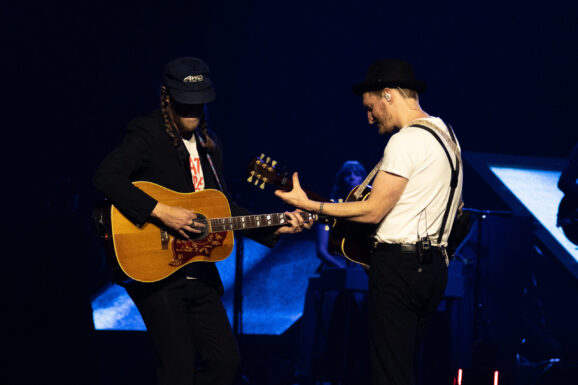
Yet collaboration has begun to lure her outward. She recently recorded a full cover of Pinkerton, the beloved confessional album by Weezer, snowed in with a friend and singing the entire record over rough piano tracks. It started as a joke. It became devotion. She has worked closely over the years with Seth Avett of The Avett Brothers, a friendship spanning more than two decades — one of the longest constants in her life. “If something cool happens or something bad happens, he’s one of the first people I text,” she said.
Now, in a rare season of stability, she has found love again. An apartment taken on impulse. Roommates who helped carry her belongings upstairs. A relationship that unfolded gently. “Every day I wake up and thank God,” she said. “Thank you for letting me wake up again. I’m going to do the best I can with this one.”
The best and worst things she has learned often arrive together.
Jessica Lea Mayfield is not the ingénue of “With Blasphemy So Heartfelt” anymore. She will never again be a teenage girl writing first-kiss songs under fluorescent bedroom lights. “I physically cannot go back,” she said. Nor would she want to.
She has lived too much. Seen too much. Survived too much.
What remains is dread and grace — intertwined like harmony lines in a minor key. A woman raised on the road, forged in bluegrass tents and back alleys, still discovering herself daily. Still writing. Still searching for the balance between being seen and being spared.
She may never want the stadium lights.
But somewhere, in the quiet after a show, as a stranger whispers thank you through tears, she understands that her private gospel has found its congregation.
For story ideas and suggestions, Brian D’Ambrosio may be reached at dambrosiobrian@hotmail.com



One Response
A beautiful epistemic window into an ontological musical drifting key.