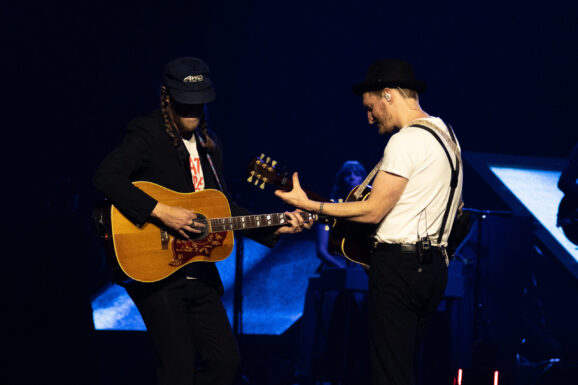
Snarky Puppy will host the GroundUP Music Festival this weekend, March 13–15, at the Miami Beach Bandshell. The eclectic lineup goes well beyond performances from the festival’s hosts, featuring artists like Flying Lotus, Rickie Lee Jones, Patrice Rushen, Isaiah Sharkey, and Bilal among others.
This year marks the 10th anniversary of the festival, which has also expanded internationally in recent years with editions in Italy.
Though often labeled a jazz band, Snarky Puppy’s bassist and bandleader Michael League prefers to describe the group as an instrumental pop band with improvisation—a description that captures their blend of tight compositions, deep grooves, and open-ended solo sections. Still, he admits that many fans hear shades of progressive rock in the group’s sprawling arrangements.
If that sounds like a lot to unpack, the music itself quickly clarifies things. Take the band’s signature track “Lingus,” a slick slice of funk that could easily sit alongside a classic 1970s jazz-fusion recording.
During a January Zoom interview from Brooklyn, League laughed when asked if people ever confuse Snarky Puppy with the industrial band Skinny Puppy. He admitted he hadn’t even heard of Skinny Puppy when he named his own group—and joked that he might have chosen something different had he known.
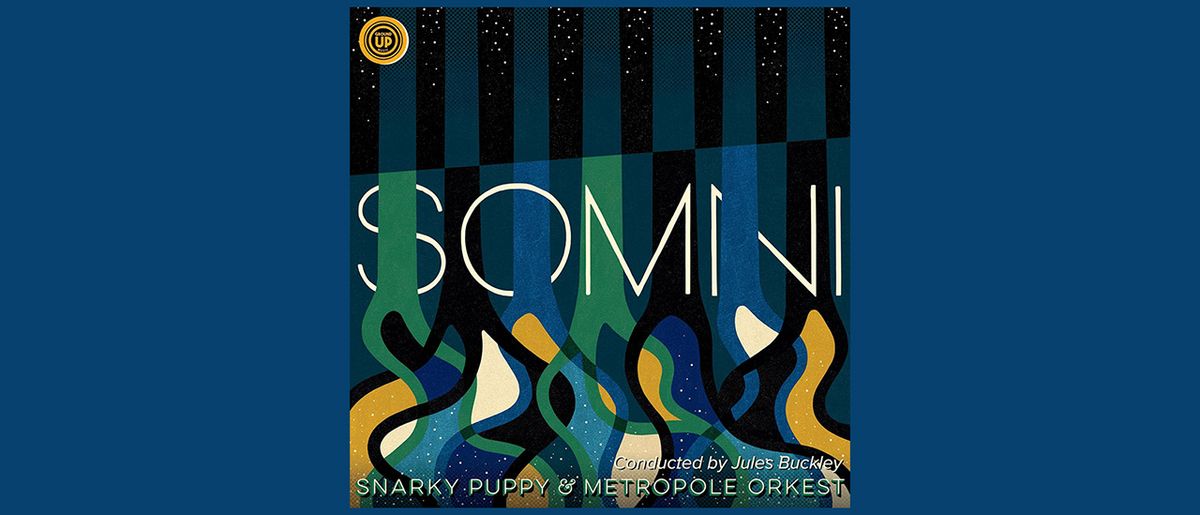
The conversation also touched on Somni, the band’s release from 2025 , which highlights their more cinematic and meticulously arranged side. Some listeners have even compared its sweeping feel to a classic James Bond film theme—something League said he hears fairly often.
At the time of the interview, League was wrapping up a residency at the legendary Blue Note Jazz Club, performing in a variety of different lineups and musical configurations. Even while immersed in those shows, however, he already had his sights set on the next big gathering in March.
The last weekend of the residency is coming up. You’ve said before that you consider yourself a connector as far as other musicians. Was this a factor in putting together the lineup?
I think it’s just a thing that’s natural, to see people play and think, “Wow, wouldn’t those two people sound really good together? Those 5 people sound really good together, or, um, it’s not really a thing I have to put a lot of thought or energy into. And I think for me, it’s much more natural than other elements of music making. When you have the right people involved in a situation, it informs the music you write, the music you choose, or the way you arrange it. If you just had random people, if someone said, “All right, I’m going to send you five random musicians, make sure you have music ready for them.” You know, it’s like, that that would require so much more effort than if someone said, “This particular musician is going to play guitar, this one particular one on drums, blah, blah, blah.” I just think of them as who they are as a player, personality-wise.
So, it’s more of a conversational approach where I could get this group of people together metaphorically and have a cup of coffee, but instead of having a cup of coffee and talking, we’re talking music.
Sure, yeah.
How do you plan the music for the residency? Is it “Ok, guys, we’ve got these 10 charts ready to roll for tonight. Are you having standards that you’re pulling from for the different groups?
For the groups that exist, like the Snarky Puppy Guitars, there’s already repertoire. So, it’s just about choosing. It’s like, okay, which Snarky Puppy songs are we going to rearrange for this guitarist? I wrote new music for some of the newer groups. I formed two new bands with two drummers, and I wrote music for both of those bands. There’s definitely been no standards. Everything that we’ve performed has been original, either written for the band, specifically for this project or previously written for the band, with the exception of the first two groups, which were devoted to playing very specific cover repertoire. Like for the Snarky Puppy Dallas Funk Quintet, we did only songs by Texas composers.
In which way do the rehearsals work for something like that? Do the band members fly in X number of days before, and that’s when the rehearsals take place? Or is it that everybody plays at such a high level that you can sort of blow through the charts?
Yeah, we get together and play through the songs on the day of the first show. Everybody learns the music in advance. I sent everything out weeks ago to everybody, and they come and prepare it, and we just run it at soundcheck.
You’ve described Snarky Puppy as pop music with improvisation. There is a clear contrast between the composed and improvisational parts. So when you’re talking about the improvisational part, how do you, how do you rehearse something that’s supposed to be spontaneous?
We don’t rehearse.
Don’t rehearse. Well, there you go. I noticed that live, after the composed part ends, you bring it down to the featured soloist for that song. And then sort of bring all the musicians up behind them, in a kind of a rising swirl of sound. Is that a fair description?
Depends on the song or the solo section. I mean, some solos, the sections are designed to be drops and momentum, so that you have space to hear the soloist. And some solo sections, the train kind of keeps rolling. I don’t like the idea of doing something all the time. I like it to be different every night. So it just depends.
There are no rehearsals. So how do you, as the band leader, communicate intent to the other players? Is it like a traffic cop type situation?
Yeah, that’s exactly how I think of it. It’s not necessarily that I’m telling people what to do. I’m just confirming what everybody thinks we should do.
You also want to prevent train wrecks.
For sure.
How do you prevent something like that? What’s an example of a train wreck, and how would you prevent it?
The only kind of train-wreck situation I can imagine is half the band going to the next section and half the band not, you know, so that’s mostly what I’m cueing is like, “Do we go on or do we stay?” You know, like 95% of my cues are that.
And does you being a bass player figure into that? I think of the bass very much as a foundational instrument. Is that part of how you guide things?
No, I think it could be anybody. I could be playing any instrument and still doing that. I mean, the bass is, you know, no pun intended, fundamental to the emotional character of whatever section you’re in. If everybody goes on and the bass player doesn’t, it’s like a disaster. If everybody goes on and a keyboard player doesn’t, they can quickly correct. Me being a bass player, it’s just a coincidence, you know. I think, personally, it was very challenging for many years to lead as a bass player because the instrument is so supportive in its role, so complementary, and so kind of in the background in so many senses. It felt a bit like splitting my brain in two, like being a leader with my body and with my mouth and giving cues, but then still trying to play like someone standing on the back of the stage. It took a while for me to do that.
When you were growing up, were you ever a rock guy at all? A lot of the modern jazz guys seem to have liked rock as teenagers and branched out.
Exact same. I started with rock and then my brain kind of opened up to other stuff.
So what was the spark there for you? What were your high school and early college interests and where did the branch in listening come in?
I think I listened mostly to rock and pop and funk and that kind of stuff until I got into high school. And then, I think it was kind of like Steely Dan that kind of started to get me into kind of the jazz vocabulary. And then my brother gave me an Oscar Peterson record, Live at the Blue Note. And, um, you know, just started kind of going down that hole and never really stopped.
Do you have a favorite rock style or genre?
I really love stuff kind of like Led Zeppelin era stuff, Zeppelin, Hendrix, Buddy Miles. That’s kind of like my favorite stuff. And also, ‘90s. I really love bands like Soundgarden and Nirvana, love that kind of stuff. Also, I think the prog stuff is not one of my favorite kinds of rock, but there are just certain songs or records that I really, really dig.
Prog frequently doesn’t have much of the flexibility or looseness you seem to value in music.
There are a lot of people, prog-loving people who like Snarky Puppy. I think that our music kind of maybe resembles prog. But it’s funny because really nobody in the band listens to that stuff. I think it’s just a combination of things that we combine to form a sound that’s like prog, but it’s not really like us trying to be proggy.
You’ve got big, broad ears. How does that all tie together in the festival? How do you know who’s a fit there?
Yeah, I mean, you know, we’re now celebrating our 10th year in Miami and our second year in Italy. The only requirements that I have are that it has to be an artist that sounds amazing live and we have to choose a diverse offering.
The audience should be surprised and stimulated in a lot of different ways. So we try to pick artists from around the world, different styles of music, you know, keep things fresh for people.
What can people expect from multiple Snarky Puppy appearances?
We play totally different sets every night. And I think this year, because we just released Somni, we’ll be playing a lot of music from that record live, if not all of it.
The Somni album was something of a departure, as it was much more orchestrated. What’s the response been like to the album?
It’s been really positive, yeah. It’s probably the most positive response to a record we’ve had since, I don’t know, since maybe Culcha Vulcha in 2016 or something.
Do you have a theory as to what people are hearing that is generating such positive feedback?
No, no idea.
Somnihas a very cinematic quality to it. I found myself thinking, “Michael League should score a James Bond movie.” The melody was complete, well-produced, and had a certain style or attitude.
Thank you. Yeah, I’m glad it came across. We’ve been hearing that Bond comment for like 15 years. It must be a thing, because I hear it from so many people all the time. I definitely wouldn’t be opposed to doing a soundtrack for a huge movie. Somni is a very clear album musically. It’s not ambiguous. The melodies are strong and very distinct. I think that, as the band gets older and as I get more experience as a composer, the ideas become stated more clearly.
You put it out there, your job is done, and what people take from it, they take from it.
I’ve never understood why people resonate with certain things more than others. You know, there are some records we made that, you know, we never got negative reactions to an album, but there are some records we made that didn’t really get a lot of, you know, an overwhelming amount of positive feedback, and other records that did. And to be honest, I don’t hear the difference between those two records (laughs). You know what I mean?