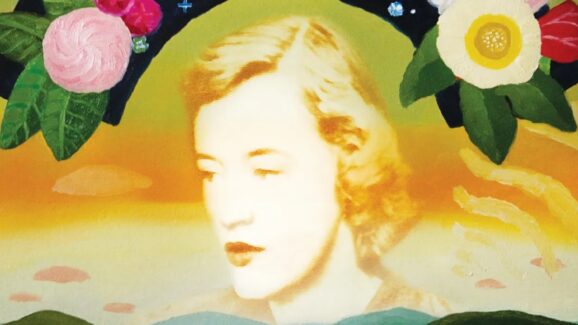
Transmitter is the latest addition to the Cut Worms universe, but this is a very different artist from the one we’re used to. Led by singer/songwriter/musician Max Clarke and started as a solo home-recording project, Cut Worms was once a lo-fi outing with daring tendencies to stretch their limited recording equipment into universal moments of unifying rock. That description of Cut Worms would be a sufficient one, up until the release of Transmitter on March 13.
Produced by Jeff Tweedy at Wilco’s famous Loft Studio in Chicago, Clarke’s latest outing as Cut Worms is some of his most poignant work to date. The new, professional-level digs allowed the musician to put his lyrics and voice first, zeroing in on his range and current mindset to unlock new levels of honesty, almost as if Clarke is learning to trust the listener for the first time. From the moment you press play on the opening track, the soulful “Worlds Unknown,” there is a palpable maturity in Clarke’s voice, more confident and assured. He flexes his storytelling muscles on highlights like the twangy “Barfly,” while raw moments like “Walk in an Absent Mind” and the emotional album closer “Dream” paint a vivid portrait of this new, candid era of Cut Worms.
With a new LP produced by a legend coming right around the corner, Clarke gave Glide a few moments of his time to discuss Transmitter, the current state of the music industry, and the process of working in an iconic space like The Loft. You can read our full conversation below.
I want to start with your move to New York City all those years ago. What inspired you to move there rather than to other art-centered cities like Nashville or Los Angeles? What were those first few days in a new city like?
Well, I don’t know. I think I’ve always kind of wanted to live here at some point. It was actually my partner’s idea. We were living in Chicago, and we reached a place where the city didn’t feel new anymore; we seemed to reach a ceiling there in some ways. As soon as I moved here, I pretty quickly met a lot of really helpful people, like-minded people; I just got really lucky. I think how many people there are in New York City and how much is going on is inspiring, but at the same time, it’s kind of anonymous in a freeing kind of way.
What was it like working with Jeff Tweedy in the famous Loft Studios? Did the experience change the way you approached your writing and recording methods?
It was great working there with him. I wouldn’t say it really changed the writing; I had written the songs before going there. As far as bringing them to a more fleshed-out, final state, it happened quickly there because they’re so well set up for making music there. They have tons of really great instruments and all quality gear, and they know how to use it, so it’s all just very efficient. It doesn’t take very long to figure out something that works.
You began writing this album while on tour with Wilco in 2024. What was it like seeing these songs evolve in the studio? Are you the type to be constantly demoing, or do you wait for inspiration to strike?
It kind of depends. I guess I’m always, to some degree, thinking about ideas, but I do have to kind of sit down with the intention to write. It’s difficult for me to write on tour; I don’t usually do that. Maybe I’ll have an idea or something, but it’s hard to be on the road doing that. At least, I kind of need to be in a solitary space for a good length of time, free to come and go, and not be rushed.
What were those first sessions like? Was it an innate chemistry between you and Tweedy, or did it grow over time? Did that chemistry start during the tour?
I didn’t really get to know Jeff at all on tour; I may have met him once. Once I got into the studio, I found that he was a pretty easy person to work with. Pretty easy-going, smart, and funny, Tweedy always has a lot of good ideas. The chemistry wasn’t something that really had to be worked at. I went into it being pretty open to whatever he was going to bring to it. I kind of just let it happen in that way.
Since you only met him once during the tour, how did it come to be that Tweedy would produce Transmitter?
It was actually on tour when Wilco invited us to join them at the end of their set at the last show. We joined them on stage to do a whole thing, and in order to do that, I had to quickly rehearse something with them in the backstage area. This was a couple of shows before that last one, and during those rehearsals, we were having conversations with the whole Wilco band. Basically, I was just saying that I had a new record I was going to work on, and I had been looking at different producers and stuff. Jeff, kind of off-handedly, was like, “Well, if you ever want to record at The Loft, you’re welcome to do that.”
I was kind of like, “Oh, Thanks,” but then later on, I think it was at the end of the last day of tour, Glenn Kotche, Wilco’s drummer, said to me, “You know, Jeff doesn’t really offer that to everyone. You should hit him up on it.” I didn’t know if Jeff was just being nice in saying that. I reached out to see how involved he wanted to be in the process, and it turned out he was interested in working on it together. It worked out nicely that way.
You’re no stranger to recording yourself at home. What was it like transitioning to the studio? Do you see a difference in how you write when you’re in one compared to the others?
In a studio setting, having other people around is the biggest difference. At home, you can come back to things; just leave them for a little while. When you’re on the clock, you only have so much time in the studio. It’s much more pressurized; you kind of have to figure out what it’s going to be quickly so that you can use the resources that are at hand.
Having other people around, I think, you go through that process quicker. If you were tinkering away at something, I could just be trying out different instruments or playing a different part for hours on end if I were by myself. I don’t want to feel like I’m wasting other people’s time; you can kind of use their consciousness. If they react to something that you do, you can go, “Oh, well, that must work.” Whereas, if it’s just me, I could come up with a hundred things that work, but it might not be one thing that jumps out of me the same way that someone else would react to it.
How many songs were recorded for Transmitter? What was it like sequencing the tracklist?
It’s pretty much the ones that are on the record that were written for it. I mean, I’ve always got kind of a backlog of half-baked ideas that need fleshing out or other parts. Once it was established that I was going to be going to that studio to do this with Jeff, I wanted to put together the best things I could. I tried to get the strongest songs that I had so that we could make them the best they could be.
These songs feel a lot more vulnerable and personal than on your previous projects. Was that a conscious decision, or did this level of honesty pour out of you?
It wasn’t really a conscious decision. It’s kind of what just happened this time around.
The song “Walk in an Absent Mind” feels particularly personal. Do you feel more exposed releasing profoundly honest music like this?
A little bit. That one in particular, I feel like, partially what makes it feel that way, is the way it was recorded. The vocals are pretty dry and way up front. I think people have given me a little guff in the past; it’s easy to fall into the thing of using a lot of reverb effects and using things like that as a crutch. I don’t really feel like I ever have done, my thing is mainly focused on the songs, I just happen to like that sound. For this one, it made sense to go in the other direction and just see what would happen there.
Reading through interviews and bios, you seem to be heavily influenced by literature and the authors you admire. Do you have any book recommendations, or ones that you feel pair well with Transmitter? What were you reading during the writing period of your new album?
One book I’ve noted for this is Contact by Carl Sagan, a sci-fi story about Earth being contacted by aliens. The idea of this kind of ephemeral transmission coming from who knows where was definitely something that stuck in my head and was present. Maybe it wasn’t present throughout the whole writing process, but more so as the record was being completed. I was thinking about how everything fit together, just general themes.
Are you typically listening/reading/watching other things when you’re in album mode?
By the time I get to the recording part, I’m pretty zoned in on just that. I’m typically not listening to anything else. I’ll watch movies and Simpsons reruns in my spare time, but once it gets to that point, I’m pretty much just thinking about that piece of work.
There is a big tour planned for Transmitter. What about being on tour are you looking forward to the most? Are there any songs off the new album you’re particularly excited to perform live?
I’m pretty excited to play most of the new record live. I just had some rehearsals with my band the other day, which was the first time we all got together. I’m pretty happy with how things are sounding. A lot of the album translates well to being played live, which can be a challenge when you make a record, especially when you do a lot of overdubs, which I tend to do. It can be hard to transfer that to something that can be played live, but these songs, I feel like, are pretty concise, sturdy songs that can be played well with a five-piece band.
I’m excited to get those out there. It’s a cliche that the artist wants to play all their new stuff, and people want to hear the old stuff, but they’re going to hear the new stuff whether they like it or not. Hopefully that’s okay.
Do you have any favorite cities or venues that you’re excited to get back to on this tour?
We’re going to some places we’ve been, and a couple we haven’t been. I always kind of just look forward to being on the West Coast a little bit and seeing Los Angeles, San Francisco, and Portland. I live on the East Coast, so I don’t get out there very often. It’s always kind of a different world out there. Also, just being in the West of the States, it’s a different geography and landscape, which is nice to see and experience on the road.
I want to go back to your time at The Loft in Chicago, the city you moved out of. Did returning to the city to record Transmitter stir up any emotions that influenced the album?
It definitely stirred some things up. I don’t know if it felt like a homecoming as much as this surreal, strange thing. Having lived there for several years, quite a while ago at this point, I was in a different part of my life back then. That was before I was ever on a record label or had any real recognition at all for playing music. I was just kind of toiling away there, and at that time, I don’t think I ever would’ve expected that I would be working with Jeff Tweedy or Wilco or anything. That would’ve all seemed pretty far-fetched at the time. So it was kind of strange going back there and having some time to just walk around the city by myself and reminisce a bit.
The release date for Transmitter is only a few days away. What sort of emotions get stirred up before you put an album out into the world?
It’s not scary to me necessarily. It takes so long to put the whole thing together, to write it and record it, package it, and do all this promotional stuff. It’s just kind of strange the way the industry works now. As soon as the record comes out, it kind of seems like everything sort of falls away a little bit. Everything is in the anticipation of this thing. It’s like, once it’s actually out, maybe you’ll get a few more press things. There are only so many things you can say about something, and I always feel like the work speaks for itself anyway.
I guess it’s always a little bit of a letdown when you put something out, and put all this work into it, and all it amounts to is just one day when it gets posted online. You see the news articles with headlines like “250 albums that came out today.” It’s like, “Oh, God,” but you really can’t think about all of that. It’s not what it’s about at all.
Speaking to that anticipation, how long has Transmitter been complete? Was there a long waiting period before the release date?
Well, kind of. The record was essentially done being recorded, and I forgot when we got the final mixes, but I think it was pretty early in 2025. What I think happened was that my record label had its schedule already filled with releases for 2025, so it kind of had to get pushed back. It’s probably been like seven months, which you do need that time to get the album art and press photos together. We’ve done three music videos now. That stuff takes time; it all just takes a while and a lot of work.
There seems to be a bit of frustration when you talk about the industry and the behind-the-scenes happenings when you’re releasing an album. As you continue to release and record music, is all this red tape something you’ve recently noticed, or has this been the story for your career?
I mean, I’ve been aware of it for a long time, pretty much since I’ve even been in the industry, per se, it’s been pretty much the same way. It’s been pretty centered on streaming. It’s not like when I was growing up, when you were selling albums or CDs with people buying these physical things. It’s all essentially online for free. I won’t get into the whole streaming royalties and all that stuff; it’s all very complicated. It’s hard to keep track of all that stuff, and there are a lot of unknowns. It’s just a lot more complex and convoluted these days. Whereas it used to be more of a one-to-one ratio; one person buys a CD, and you get a sale.
The nature of media in general, too. When I was younger and first had the inklings of wanting to play music, my idea of having really made it would be to be the musical guest on Conan O’Brien’s show. Now that doesn’t exist anymore, there are still two or three late-night shows, but they don’t carry the same weight. You kind of just have to do as much as you can. People’s attention is very fragmented and kind of isolated into these niche things. So you almost have to split yourself up into a thousand pieces to go in all these different directions and avenues, which is exhausting for one. It’s just strange, it’s weird that there’s not one cohesive, overarching culture like there used to be. Everyone is into their own things.
If there was one thing you could change about the industry and the process of releasing music, like eliminating streaming services, what would it be?
I don’t know if eliminating it would be helpful. I like streaming music as much as anyone else. It’s kind of the same with any industry in the entire world, trying to wrestle the money away from the very top one percent who have all of it. All these things that exist, like avenues for getting things out, like streaming and the internet, are great. It’s just a shame that no one or very few people who actually do the creating of this stuff that is consumed can live comfortably because of greed, essentially.
The same thing goes for mainstream radio. If that avenue were more open to everyone, I think it would do everyone a lot of good. At this point, it’s a pretty much closed market where you have to go through a very specific channel, career-wise, to get on the radio. There’s just too much money involved. My answer would be that if the wealth were just more distributed in general, it would just make everything better for everyone. There would be more art, and probably better art, that everyone can experience. It would be nice if they could figure it out.