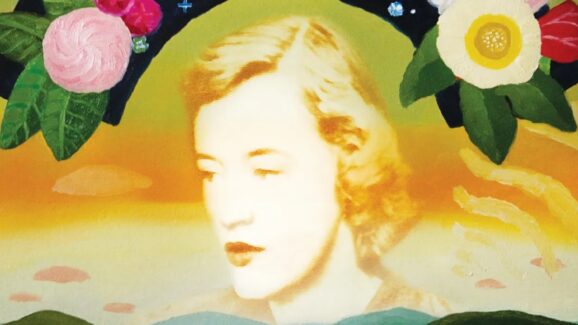
On February 27th Season of Mist released Berlin-based post-metal band Unverkalt’s album Héréditaire, their first with the label, but their third album overall. The new album shows a lot of maturity, both in its ambitious compositions and multiple vocal styles, and in its overarching message about the inherited violence and conflict we face and struggle with in daily life. Focusing even more generally on the burdens we carry as modern people, Unverkalt brought a strong atmosphere of outreach and shared discussion to Héréditaire, while also emphasizing big sounds, dramatic storytelling, and intricate artistry.
As a very DIY band, Unverkalt also made their own compelling videos, and, as a multicultural, collaborative unit, the varied band members bring their own skill sets into the mix to help craft their visual image and social presence. At this time, they project a particularly strong image of their goals and identity, and bring that to the very focused ideas on Héréditaire. I spoke with band members Dimitra Kalavrezou (vocals)and Eli Mavrychev (guitars, vocals) about Unverkalt joining Season of Mist, their working methods as a band, bringing together the ideas and sounds of Héréditaire, and their plans for live performances coming up.
I noticed that this is your first album with Season of Mist, but your third album overall. When you came to Season of Mist, had you already gotten this album into shape for release, or did that happen afterwards?
Dimitra Kalavrezou: We approached Season of Mist with some of the album already completed, but we had a lot of it to complete still, even after the signing.
Eli Mavrychev: I think we sent them the full album, which was already premixed. It hadn’t gone to our final mixer or to mastering yet. But they already knew what the entire album was going to be about, and we talked with them. We had everything in mind for the album, but we didn’t know that it would land at Season of Mist. When we considered all of our options, it was the best match.
I just asked because, as a band, you seem very self-motivated, so I wondered if the ideas for this album were already in place. It seems like this album is a very natural development for the band and the next piece of the puzzle.
Eli: Absolutely. I think one of the reasons why we partnered with Season of Mist was that they encouraged us to grow and experiment the way that we wanted to, and we really appreciated that. Some Indie labels can be tricky, but they showed us trust in believing in our album. We could focus on the artistic parts, the creative development, while the rest was taken care of by the label. That’s the healthiest relationship in our scene of underground music.
Dimitra: It was really great to hear, “Okay, guys, we are here to support you. Our job is to really just spread the word.” It’s been really important, and we have been grateful. We do a lot of DIY work since we actually shot all the videos ourselves. It’s work that we really love, because when it’s DIY, you know what the direction will be, and that it will have the vibe that you want it to have.
Eli: We also fully recorded the album by ourselves.
Wow! I didn’t know that. That’s amazing about the videos, too, since they are really impressive, professional, and atmospheric.
Eli: We used our home studios and the studio of our drummer, Christian, in Berlin. I think we recorded in three studios, total, pretty much independently, without time limits. Some bands go to the studio for one to two weeks, and just work hard, but our situation was easier, because we weren’t dependent on anybody. That’s how the band has always been doing things. It leaves room for the necessary experimentation in the arrangements that, in a way, make the album deeper. If you go to a commercial studio, things may go wrong, with little room or time to fix them afterwards.
Dimitra: It was really cool, the process.
It’s great that you’ve laid out your process on previous albums, and you know what works for you, at this point, through trial and error. I feel like this album is very complete and has a clear identity of what you wanted to create. These are a lot of skills you’ve learned at this point!
Dimitra: Just so you understand the whole picture, Themis [Ioannou (guitars, keys)] is a graphic motion designer. Over the past few years, he’s been creating a lot of graphics and videos. He went in that direction, and we’d just add elements during the video shoot. I think that’s one of our favorite parts of making the videos, is that it’s open, and we can have ideas about the costuming and the shooting. We don’t have any limitations, because it’s our baby, so we just went all the way to create something that leaves an impact on us, first of all. Then the audience can interpret our work as they see fit. It was really awesome to work together and bring ideas to the table.
Eli: Most of the band members have experience in visual arts, music, the event industry, and marketing. So, we are combining all these. The way that we split work within the band, and who contributes what, and how we exchange opinions. Someone, for instance, will be responsible for editing, designing, musical parts, finding the right sound, or doing the final recordings.
The sense of responsibility and ownership is really cool, and the way we exchange opinions is also very healthy. There’s nothing even close to conflict. This setup really makes life easier. If you look at most bands in the world, 60 or 70 percent of them are driven mainly by one or two people, who are like the masterminds. We really appreciate how we share responsibilities within the band. It enables us to move along the path we’ve chosen and to be helpful to each other.
Dimitra: Being an underground band usually means that you have to figure out ways to do things yourself, especially with the music industry being what it is right now. You have to constantly figure out how everything works, like social media. But we help each other with that in this band.
What do you think led to the themes that you address on this album? Is it drawn from life experience? You speak about the things that have been handed down, the problems that weigh us down from previous generations, but we’re the ones who pay the price.
Dimitra: When it comes to writing, you start coming up with all the ideas and thoughts that you are having, beneath the surface. You want to really go deeper. For me, that’s super important, because life is very short and we need to understand ourselves. We need to understand how we can do better, and feel better, how we can get rid of things we don’t want anymore. There’s a lot of pressure from society, and a lot of pain in the world, and we need to do better. I think that was the main thing that was on our minds when it came to making the record, or at least it was for me.
Eli: Definitely. I think, over the past few years, everything globally has slowly gone to hell. There’s COVID, and there are a bunch of wars escalating here and there. Governments are changing, and a lot of right-wing shit is going on. It’s absolutely crazy. We could never have thought that it would get so bad. A lot of things that are happening are things that you don’t feel that you can have an effect on.
We were working with Dimitra on these lyrics, and she came up with these ideas. It’s more of a broader concept, and more personal, than the concepts of our previous albums. It wasn’t inspired by a third party or categories of artistic expression. In this case, it’s a stage of the band, and where we are right now. People are seeking their identity. We are all in a constant search, wondering how we can influence things and how to deal with those we cannot. I think it’s a constant struggle.
Some of those things, like people being mistreated, are things we saw growing up, and others we are experiencing right now. In the band, we also have people from different countries. Some of the people are from Greece, Eastern Europe, or Germany. We talk about this together and come up with lyrics that touch on different aspects of identity, and how different upbringings and cultures affect us and our generation. That was very much the inspiration for the album. I think the cool part is that a lot of people can really listen to this album and find something that they can relate to. It is, in a way, contemporary, and will always be, because there will always be problems.
Unfortunately, yes.
Eli: To what degree, though, we don’t know, and hopefully things will improve. But it is a period of time when we combined our efforts to create these messages, in the reality we live in, and with many references to history, religion, and culture.
Dimitra: I found that having this process was a relief for me. During the recording, I could write whatever I wanted and be free with my thoughts, fears, and insecurities. And maybe someone can connect with it. That’s what we were hoping for with this record, and I think it’s very honest in its approach. It was a good process for us.
There are hard ideas here, but I can imagine that it can be helpful to you to give them shape and bring the emotions forward in the music. The emotions are especially powerful, both in the vocals and in the music, and create a specific atmosphere.
Eli: Absolutely, that’s what we were going for. It’s extremely important to us, and a relief, to see it come to life.
HMS: Are you thinking about how this will translate into a live performance?
Eli: We will be playing a record release show scheduled for April 11th in Berlin, Germany, where we are based. We will also do some more shows later this year. But that will be the first time we’ve performed any of the songs from Héréditaire, and we will be playing with two other bands who are our friends. We’re looking forward to it, and we’ve been working for some time already on arranging the live part of this. We’re looking at a different order within the songs, and you want to do things a little bit differently live than you do on the album, but you still want to bring all the message, all the power, and all the atmosphere. We can’t wait!
Dimitra: It’s really beautiful to see the people during the live show, because when you release the music, you can’t see how people feel about it. It will be so amazing to have a show and really understand how the audience feels and what the audience’s journey has been in their minds.
Eli: The exchange of energy between the audience and the artist is so important for us. It powers you up even more as a band. This album was ready quite a long time ago, so we are ready, and it’s important for us.
It’s a really big album, in terms of ideas, in terms of emotions, in terms of intricate sound. It seems like it was created as a communal experience, so that naturally follows. I think it could be helpful for people to experience it.
Dimitra: Every song on the album will be played at the record release, except maybe one song that will be played at later shows. I want to think about the whole performance as an awareness performance, because it’s a more psychological album this time, and it’s really important for us to bring this awareness forward. We want to see and discuss with people how they feel about. There are themes of relationship, of pain, of things we experience in daily life. I think it’s important to talk about these things, especially for mental health. That needs to be more open and more discussed. That’s the ultimate goal of our performances.