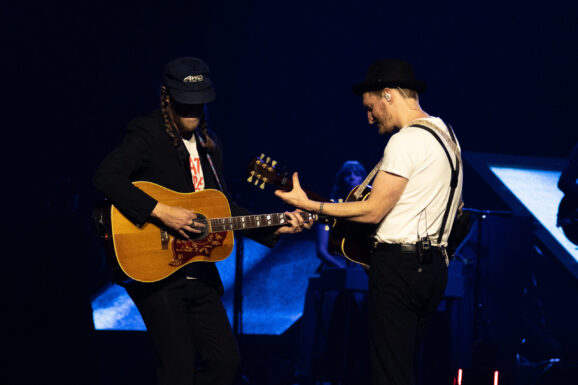
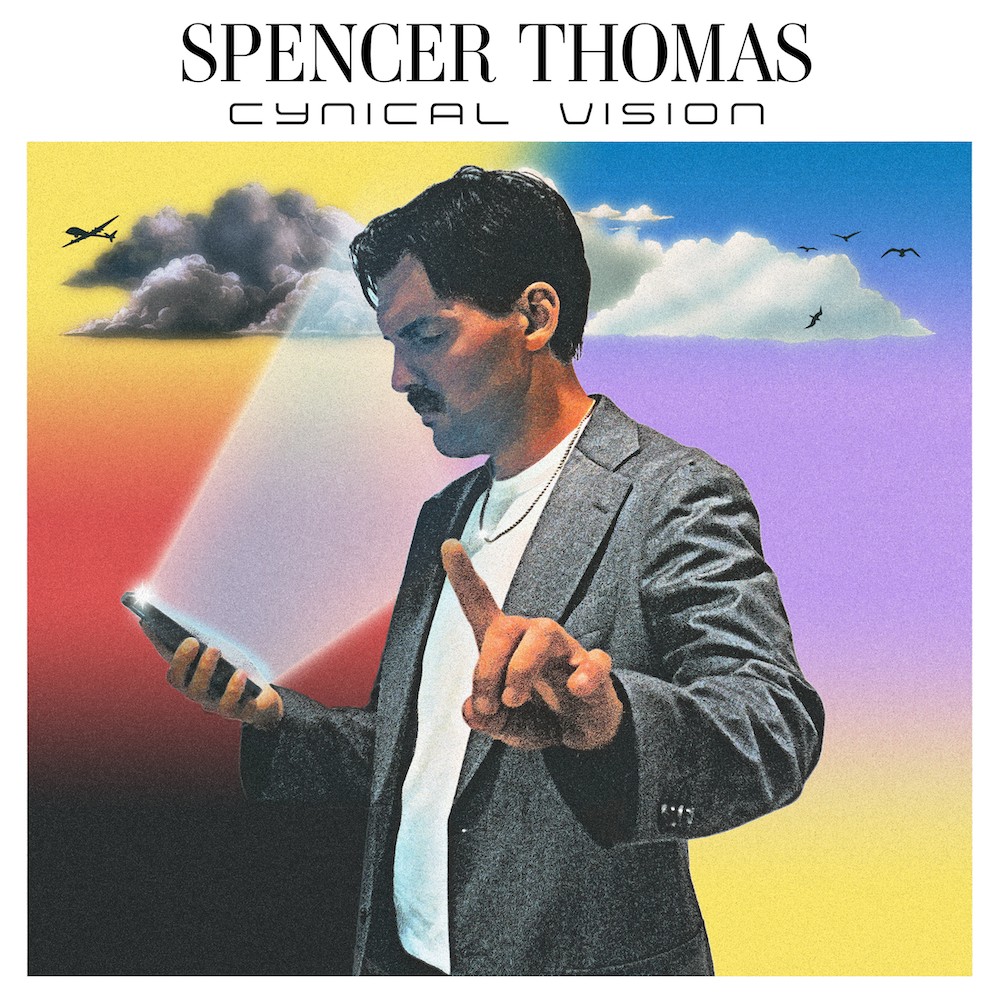
Spencer Thomas doesn’t pretend to have invented himself out of thin air. In fact, he’ll tell you the opposite—plainly, even cheerfully. “If you like Tom Petty, Bruce Springsteen, you’ll probably like my music,” he says. “I’m pretty shameless about that.” It’s not false modesty. It’s a working philosophy, one that has come into sharper focus with Cynical Vision out Friday 3/20 via Strolling Bones, his third album, where influence is not something to disguise, but something to wrestle with, inhabit, and ultimately transform. Glide is also premiering the album in full below this feature.
Raised in Madison, Mississippi—“a pretty boring brick town…just classic suburbia”—Thomas grew up in a place that didn’t necessarily advertise itself as a creative hub. Still, he notes the deeper pull of the region: “Born and raised in Mississippi…but my mom’s from Louisiana, my dad’s from Maryland. I would say that more of my roots trace back to Louisiana.” That blend—grounded, Southern, but slightly unmoored—echoes in his songwriting, where tradition and restlessness tend to coexist.
His path into music was less mythic than methodical. At Delta State University, he found his footing in Cleveland, Mississippi, playing in bands and absorbing the loose, anything-goes ethos of a small but vital scene. A bar called Hey Joe’s became a proving ground. “It was kind of an oasis,” he recalls. “There was no other place for real original bands…they would make a proper show out of any college band that wanted to play there.” In that setting, genre boundaries blurred, and expectations loosened. “Anything that you did, people were down to see.”
Thomas played in multiple projects, most notably Young Valley, a country-leaning band he co-founded with a friend. But even then, he was quietly stockpiling songs that didn’t quite fit. “I’d write some songs and think, ‘I don’t know if this makes sense in this band,’” he says. Those songs went into his “back pocket,” accumulating until they formed the backbone of a solo debut.
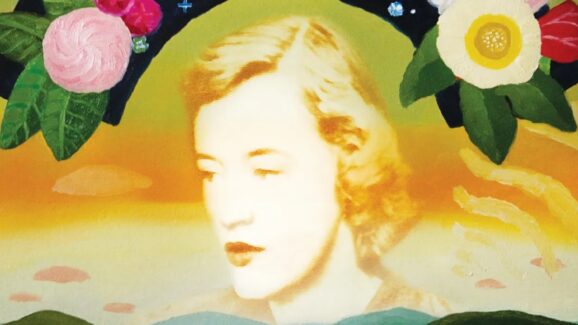
That first record, Hangin’ Tough (released in 2019 after years of scrimping from bar gigs and sock-drawer savings), was, in his words, what most first albums are: a collection of whatever you’ve got. His second, The Joke of Life (2024), sharpened the sound—leaning into a stripped, four-piece band approach with echoes of Petty and Jackson Browne. But even as his solo work gained traction, Thomas found himself pulled in another direction, touring heavily as a member of the band Futurebirds. The dual commitments took their toll.
“I ended 2024 just completely exhausted,” he says. “I was trying to tour a record and promote it while touring with Futurebirds…it just beat the hell out of me.” So he made a decision that would shape everything that followed: he stepped away. “I just knew I wanted to put all my efforts into my work.”
That shift—from divided attention to singular focus—gave rise to Cynical Vision, a record that arrives not only faster than its predecessors but with a clearer artistic identity. If earlier albums hinted at Thomas’s influences, this one leans into them, particularly the shadow of Warren Zevon.
“I was in a heavy Warren Zevon phase for a year,” he says. “And that was kind of the one…once I had a dash of a Warren influence, I was like, that’s the special ingredient in the sauce.” What Thomas found in Zevon wasn’t just a sound, but a sensibility: the ability to balance darkness and tenderness, sincerity and satire. “He’s in on his own joke,” Thomas says. “That’s the biggest takeaway.”
That sensibility permeates Cynical Vision. Songs move fluidly between emotional registers, often within the same narrative frame. In “Honey Burn,” he adopts the voice of a deeply flawed, even unsettling character—“an incel songwriter who kills off people in his books”—a move that channels Zevon’s dark humor. “Somebody asked me, ‘Is that your ‘Excitable Boy’?’” Thomas says. “And I was like, that’s exactly right.”
This embrace of character-driven songwriting owes as much to Zevon as it does to another influence Thomas absorbed through reading: Randy Newman. An avid consumer of musician biographies, Thomas treats these books not as trivia, but as creative fuel. “It’s nice to read somebody else’s story and kind of wear their perspective around for a little while,” he says. Newman’s approach—writing through personas, illuminating truths indirectly—left a mark. “Just kind of personifying a character…that’s something that Randy did a lot.”
For Thomas, influence is not imitation but immersion. He describes writing “wannabe Petty songs, wannabe Springsteen…wannabe Zevon tunes,” not as an end goal, but as a process. “If you wear their hat for long enough…something comes out that really feels like me,” he says. It’s a belief grounded in demystification, reinforced by the biographies he devours. “You realize there’s nothing super magical about it…they just kept going.”
That clarity extends to his view of the modern music landscape, which he tackles head-on in the album’s opening track, “This Is Your Life Now.” The song, which he calls a “destined opener,” sets the thematic tone—grappling with distraction, comparison, and the erosion of personal focus in the digital age. “You can really lose a lot of time focusing on what everybody else is doing,” he says. “You’re never really feeling good until you’re taking steps for yourself.”
The track, like much of Cynical Vision, emerged through a more fluid recording process. Unlike previous albums, where songs were fully formed before entering the studio, this time Thomas allowed for experimentation—cutting sections, reshaping structures in real time. “We could just surgically remove eight bars…because we could,” he says. The result is a record that feels less rigid, more alive to discovery.
That spirit carries into “Video Farm,” a centerpiece that skewers the culture of constant visibility. Accompanied by a deliberately chaotic, trope-filled music video, the song critiques the performative demands placed on artists in the social media era. “We’re rewarded for slop,” Thomas says bluntly. “Videos with effort are kind of overlooked.” His response is both satire and surrender—leaning into the absurdity to expose it.
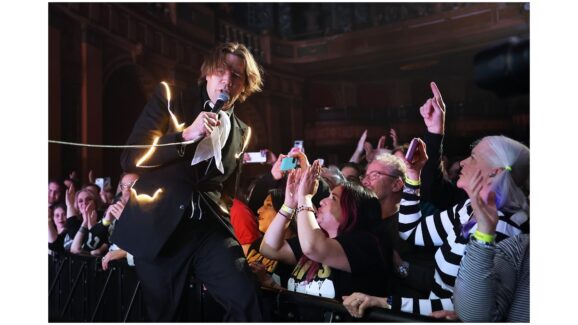
If all of this suggests a more playful Thomas, that’s by design. “It took a long time to get that humor out of me,” he admits. “But there’s really not much of a point in taking yourself too seriously.” It’s a lesson learned not just through influence, but through experience—through the highs of playing iconic venues and the surprising hollowness that can follow. “The most depressed I felt was after playing places like the Ryman and Red Rocks,” he says. “It didn’t feel right.”
These days, he’s redefining success on his own terms—playing intimate living room shows, connecting directly with audiences. “If I have 30 to 50 people in a living room, that’s success,” he says. “There’s no middleman.”
It’s a fitting evolution for an artist who has come to see influence not as a crutch, but as a compass. In Cynical Vision, Spencer Thomas doesn’t shed his heroes—he walks alongside them, borrowing their voices just long enough to better hear his own.
Press Play to hear Cynical Vision in full.