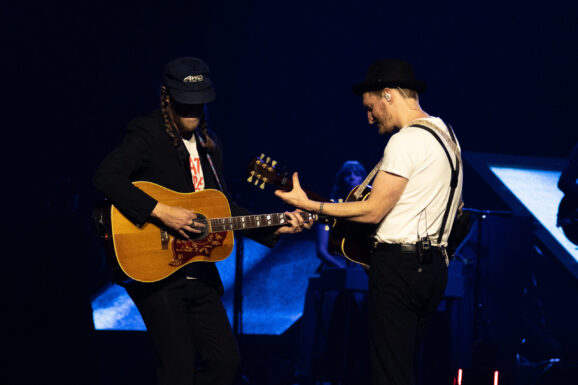
Brooklyn-based Indie Rock band Evil Twin released their debut full-length album, Upside Down We’re Flying, on March 13th, following on from an EP and the release of several singles. It draws on a love of multiple 90s music genres and creates an immersive atmosphere you might associate with psych rock while experimenting with song structure. Though the compositions are often layered and complex, the album was built mostly live in the studio, with all four members playing together, mirroring their live band experience since coming together in 2021.
The album was produced by Brayden Baird and features front person, songwriter, guitarist, and vocalist, Peter McGee, guitarist and vocalist Claire Stevens, and bassist and vocalist Riina Dougherty. Prior to their departure from the band, Thomas Kikuchi also provided drums and percussion. I spoke with band members Peter McGee and Riina Dougherty, as well as with Producer Brayden Baird, about how creating this album was a new experience, taking a more focused and intentional approach in the studio than their past, more single-based approach. We also talked about writing the songs musically and lyrically, their unique structures, and how images form a haunting counterpoint to the music on Upside Down We’re Flying.
I know that you all have a live play history and have released an EP, though this is your first full-length album. Does that mean that some of the songs on the album go back further in time for you?
Peter McGee: Yes, some of the tracks we’ve had for years before we recorded them. Track number 5 we had tried to record a few times before, but had never really gotten it right. There’s a variety on the album. This wasn’t the first time we’ve been in the studio, but it’s the first time we’ve tried to do this many songs. As a band, we’ve been together since 2021. We’ve done a bunch of singles and an EP in 2024.
Riina Dougherty: With all of our previous recordings, and some of the EP even, we recorded with separate Producers. We have Brayden Beard here with us, so maybe he can speak to the process, but sitting down with one guy and keeping all of the songs in that room was a newer venture for us.
Peter McGee: Brayden produced the record with us and was the lead engineer on everything.
Brayden Baird: It’s a great album and was so fun to work on. It was so cool to lock in and work on it. We spent eight months or so tracking, Producing, and trying different things.
Peter: It was a long process. It’s been a long time in the past, but we did a lot more work this time than we did with the singles. It’s different when you’re working on one song, and we often had to space things out back then because of when people were available, but Brayden was always there to work with, a lot more so. We were able to try a lot more stuff, and everyone was able to come in to do overdubs.
We also did a lot more live sessions, which we hadn’t done as much before. We did the initial tracking of the album with all four of us in the room, which was really great. We got a good foundation from there for everything. It helped that we had played almost all the songs on the album live before then. We hadn’t played “C74” and we did not play “Aren’t You Lucky” beforehand.
Riina: But we did trial all those songs about a month before we went into the studio. Every rehearsal was just fine-tuning and getting it down so that it would be right during the live recordings. I feel like that made the tracking process quicker.
Peter: It went very smoothly because of that, yes.
Brayden: You guys were so tight when you came in, you just knocked songs out, one after the other. The band itself has a great sound when you’re all playing together, so much love. It’s great.
It’s becoming a little rarer for a band to form itself live and to be really shaped by that.
Peter: I’ve noticed that. It’s kind of unfortunate.
It definitely has its benefits. Because when you do go into a studio, you’ve already made some decisions. I’m sure you might make some new ones, especially if a Producer makes suggestions, but older bands who got their start in the 60s and 70s would often record right after a tour and perform those new songs.
Peter: I’ve always admired that about classic rock bands, like Led Zeppelin did their first album in 12 days, or something like that. It’s also nice to have that level of experience with the songs. You can really get inside them. We’ve also tried other approaches, like writing and recording them from scratch, but this album was a mix. A lot of them we spent writing during practice sessions, so we’d play them live while we were writing. That was also really cool.
I feel like a lot of pop music and rock music now is just written on a computer, and I don’t have a problem with that, but there’s something less organic about it. When you’re playing along, four people contribute the whole time.
Riina: I feel like playing a lot of these songs live helped us fine-tune them, too. There’s a moment in “In Flames” at the end where the bass and the drums cut out for a second, then come back in. Those were things that we discovered through playing together, and gauging audience reactions. In general, we think about how things will translate to the live set.
I’m surprised that you mention “C74” as one that is newer and hasn’t been played much, because that is a very complex piece!
Peter: It is!
Did that take a lot of rehearsals beforehand to work out the different parts? It’s very orchestrated.
Peter: We did spend time on that.
Riina: Claire, our guitarist, comes from a classical guitar background, so that song started off with the verse parts. She brought it to us and said, “I didn’t even realize that I wrote this in a weird time signature.” So the first part was us just getting that part down in the rehearsal space, just counting together. It developed from there. Claire loves to call that song “three songs in a trenchcoat” just because it has a bunch of different parts.
Peter: They are like movements into each other, which is what’s nice about them. That one is definitely one of the more complicated ones that we’ve tried to do. It was ambitious and cool. We also spent a lot of time practicing, trying to figure out how to remember it. You kind of have verses at the beginning, then it flows into another part, and into another part, almost like a different song. What I like about it is that there are quotes that refer back to the earlier parts. It keeps quoting itself.
The lyrics and the musical motifs repeat in those limited ways. I see a lot of classic rock ‘n roll in what you’re doing as a band, but I feel like your song structure is more open and experimental, like with “C74”. One of the bands that really opened that up was Radiohead, and gave Rock permission to do that.
Peter: I definitely think that’s true. Radiohead is one of my favorite bands. They did the “Paranoid Android” thing, where they string together three different songs that they were working on. They also took many different approaches to Rock music, and I think many bands have followed suit after the fact. I like 90s music a lot, and we all love different bands from that era. I know Riina loves Nirvana, and I like them a lot too. Claire really likes classic 70s Folk music. I feel like we take after that style of pulling disparate elements together and crafting them into a cohesive whole. I think bands like Radiohead paved the way for that.
Riina: I think with song structure, that’s a challenge that we set for ourselves, where we’re trying to figure out the next chronological part. We don’t always want it to be the obvious thing, so it’s an experiment. We want to do things that are new, different, and unexpected.
Peter: You want the music to be an adventure. That’s what we’re going for, I feel like, a lot of the time, as opposed to something that’s just catchy. That’s true of this album, especially, where the songs are long. That’s something that we might even be critiqued for, but I think they are nice and long enough that you can really sink your mind into them, which is cool. What I love about music is getting lost in it, as opposed to just flipping through different things, and I think that’s the approach we all take.
A lot of these songs have strong visual images that I feel like help guide the audience through them, creating cohesion and atmosphere, too. Like with the song “Frost on the Lillies”, that’s such an evocative image and carries important emotion in the song.
Peter: Well, everything in my life for the past five years has taken place in the post-COVID setting, and I wanted to draw attention to that with some of the images. I think about the snowfall that happened just before leaving college. Riina and I both graduated from Northwestern in 2020. The pandemic happened during our last Spring, right before graduating, and it was crazy. I remember that on one of the last days that I was there, it was snowing, and it was pretty far into springtime. I remember thinking that there were flowers blooming, but they were frozen.
Riina: Growing up in Chicago, we always got our April final snowfall. So for me, it signifies spring, the last snow that we’re going to get. But for a New Jersey fellow like Peter, it means the opposite.
Peter: You get different things out of it, and the images recur, so you can build a narrative in your head about what they mean. You can create a structure, too, around images that recur across different songs on the album, each with a different tone. How do you connect those things together, as a listener? Eddie Vedder used to say that he hated music videos because he didn’t want to put images into people’s heads about what songs could be about. He wanted people to create their own images, and I relate to that.
Riina: For me, I view each song in terms of one of the four elements. I do a lot of the graphics for the band, and I think that’s informed the general vibe of whatever image I’m creating for the song. “In Flames” is obviously connected with fire, but “Frost on the Lillies” is connected with ice and water. I think “Eta Carinae” is more like air. That’s how I view it. Before we went into the studio, I didn’t know what the lyrics were for the songs, so I developed my own metaphorical relationship to them while Peter was working on the lyrics.
Peter: It’s hard to hear what I’m singing during practice, too, due to the acoustics. I knew what I was singing, because I had it written down, but a lot of times people didn’t know what I was singing until we went into the studio! [Laughs] It was a funny thing to hear what they thought I was singing, afterwards. Sometimes I’d switch it out! I do a lot of subconscious writing, and if someone else’s subconscious gets involved, that’s interesting.
Riina, did you create the album cover art, too? I think it’s really captivating, and I love the colors.
Riina: Yes! It’s partly based on an old plane we saw on a lamp.
Peter: It’s like a plane from a World’s Fair lamp.
Riina: We went through a bunch of iterations on the album cover, too. I’m hesitant to share works in progress, but towards the end, Peter and I were going back and forth on some of the details. We decided on no text. A lot of the way that I work, graphically, is like the way Peter was talking about when it comes to subconscious writing. I do it almost subconsciously, but in Photoshop. I would consider my flow kind of like automatic writing or drawing. I start throwing things onto the screen to see what works, what doesn’t. Sometimes that involves deleting a lot of things, but it’s a lot of trial and error. I’m so happy that I was able to make something that we all love for the cover.
Peter: The colors really are amazing on that one.
Riina: I wanted to make sure every texture I used was my own to create a complete work of art. I used some elements from a previous version of the album cover that came out kind of abstract and blurry, and I ended up reshaping them. It ended up becoming this rusty, flame-like texture in the background. I was a little hesitant to put a plane on the cover, initially, because it seemed a little obvious with the title, Upside Down We’re Flying, but with the plane situated in this chaos, and it being the negative space of the clear sky, it worked. It mirrored the ways we made the album and some of the chaos we had to go through just to get here.