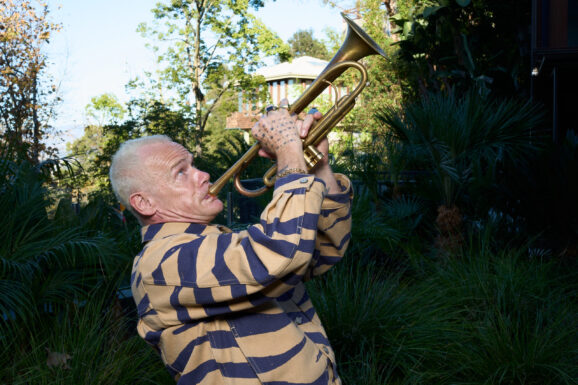
Just a couple of measures into the opening song of José González’s new album Against the Dying of the Light, you get the feeling that even if you had heard the percussive downbeat and the fragmentary guitar flourishes unannounced, you would know them for what they are. The years-long gaps between albums can’t dim the memory of the spare, rhythmic music that Swedish singer and songwriter González creates.
González’s solo career has been a path of subtlety. On the surface, his approach hasn’t changed much since his first album, Veneer, hit Sweden in 2003 and the US in 2005. But in a way, that’s the point. González’s music doesn’t change so much as it deepens. Each album seems to strive for greater nuance as he presents the subtle shifts in perspective possible within his chosen musical expression.
On Light, González continues to navigate different song structures through the dichotomy of his deeply rhythmic, expressive classical guitar playing and the passive quality of his voice. González’s debt to the music of Mali, particularly the desert blues of the Tuareg band Tinariwen, is as apparent here. To hear his guest vocal on Tinariwen’s song “Imidiwan Takyadam” (from 2026’s Hoggar) is to put his inornate style in relief. Songs like the opener, “A Perfect Storm” and “Losing Game (Sick)” with their repeated guitar figures and the sometimes chant-like nature of his singing are particularly emblematic of this style.
To one’s ear, González owes other musical debts that are worth pointing out if only because, like Tinariwen, they add dimension to what is sometimes a challenging soundscape. The way he vamps on the mode of “Sheet” in between declaratory phrases recalls Canadian guitarist Bruce Cockburn, who was internalizing world music long before it was given that title. On the beautiful “Etyd” (the Swedish word for Etude, if Google Translate is a reliable authority), Gonzalez follows the trail of a delicate, wandering melody with a classic finger-picking pattern, evocative of etudes, or musical studies, in the western classical tradition. It’s one of his most charming compositions, even if the lyrics are a pointed rebuke, and it’s rivaled only by the album’s closer. “Joy (Can’t Help but Sing)” follows one of his most harmonically rich chord progressions, with some of the changes recalling the work of Joni Mitchell.
In many ways, Light sounds like a wilder and older sibling to González’s previous album Local Valley (2021). The clean, polished studio sound of Valley, with its drip-drop electronic percussive sounds, has been set aside for a more intense tone palette. Most of the songs were recorded in reverb that sounds like it’s coming from the room, with an untamable feel. There’s a willingness to let the sound get messy, as sometimes the guitar distorts in the louder passages of songs like the opener. The two exceptions (which, interestingly, are the two Spanish-language numbers) are the playful “Pajarito” and the aching “Ay Querida,” which sound like they were recorded dry, giving them a close, intimate feeling.
Against the Dying of the Light is perhaps González’s most passionate and challenging song cycle. It shifts through a thematic narrative that is part polemic, part mindfulness guide. Beginning with González’s declaration that “It’s not random/ If we’re the ones to cause the storm,” it ends with dawn emerging through the rain of that storm. “As we cognify everything,” he sings, “We’re still primates/ Who can’t help but sing.” In a second iteration, he calls us “conscious souls.” Between the storm and the singing, González attempts to follow a path that turns like switchbacks up a mountainside.
“Disconnect from every algorithm,” he sings in the title track. And later, “Kill the codes that feed the hate/ Keep the codes that make you thrive.” (Perhaps this is why the profanity is disguised in the lyric sheet, replacing shit with sheet on “Sheet” and fucking with funking on the title track. On Spotify, lyrics are added by the artist.) But then he seems to double back on “For Every Dusk.” “Sail on by/ This is not your fight/ Allow yourself to move on/ For every dusk, there’s a dawn.” This sort of back and forth between resistance and acceptance, mostly through the jargon of guided meditation, moves the album towards the hopeful imagery of the dawn-to-dusk metaphor that is taken up at the end. Or it might be hopeful.
Gonzalez never clarifies why it is that, in his metaphor, for every dusk there is a dawn, and why, in the face of darkness or even the dawn that ends it, we can’t help but sing. To put it another way, how is Gonzalez’s resolution so different from “pretending that everything will be just fine,” an attitude he rebukes on “Etyd”?
Against the Dying of the Light is an admirable work whose musicianship in the telling far outshines what is ultimately told and creates many beautiful moments of reflection.