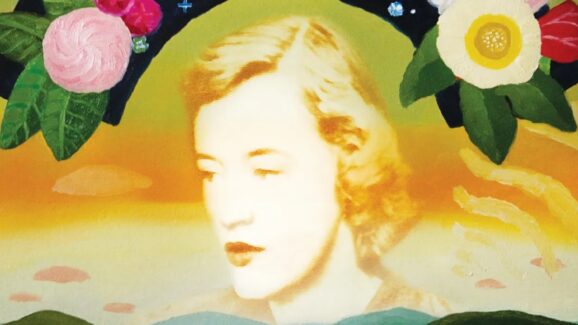
Portland-based Chicano Rock artist Joshua Josué has recently released his debut full-length album, Beneath The Sand, via Electric CholoLand Records. Like his live performances and influences, it blends Americana with Latin Folk and Rock ‘n’ Roll. While Josué has been making music for a number of years, this particular collection has a specific focus in bringing together the journals, poems, and more that he created while on a motorcycle journey that he made into Central America in the wake of personal grief and loss. The songs that came out of that time are a blend of elements and move through lyrics in both Spanish and English, hitting on the emotions and the acceptance that Josué needed to find. A couple of additional songs were borrowings or more recent additions, bringing the experience full circle.
When Josué felt ready to make this album, it was recorded at Goat Mountain Studio, near Joshua Tree, with a very impressive lineup of musical guests, including Roly Salley (Chris Isaak’s Band), Mitch Marine (Dwight Yoakam’s band), Hershel Yatovitz (Chris Isaak’s band), Steve Berlin (Los Lobos), Joel Guzmán (Los Super Seven), and Murry Hammond (The Old 97’s). It was a process of collaboration and also of pulling sounds that Josué had long imagined out of his head with the help of his friends. What we find with Beneath the Sand is an air of the wide-open spaces, the thrill of the road, and the sense of seeking and finding new emotional ground. I spoke with Joshua Josué about the stories behind the songs and about the importance of creative work in his life.
I know that you love to perform live. What’s the relationship of the album songs to live performance? Have they been under wraps until now?
They are all pretty new. I think maybe one song, “Big Train”, had been worked through live, and that was one I had written quite a while back. But everything else happened in the studio, and recently we’ve started bringing songs out. The ones we haven’t brought out, [we debuted] on August 9th at Mission Theater in Portland.
I’m familiar with that theater. Do you think that’ll be quite an emotional night for you, given the history of this album, dealing with a personal journey of yours, and also given all the things that came together to create this album?
Yes. I think I’ll be emotional. I’ve started playing the song, “Beneath the Sand”, live, and I think I can pretty much separate myself from the music when I play live, but for that song, it’s harder. I just started playing it, and I was surprised when I was telling that story, that I had to concentrate on not getting too teary-eyed on stage.
Steve Berlin from Los Lobos will join us at the Mission Theater, though, and that’s huge for me because Los Lobos and Ritchie Valens are what influenced me to play music. To have him be there, and be part of the album, to play music with us is so huge. I think it’ll be emotional, but happy-emotional.
You’ll be making the kind of personal and professional memories that you want to hold onto.
I’ve had a lot of moments like that, I feel, in the past few years. I’m just eternally grateful that I get to do this. Some of these moments are just driving in the van, driving to a different city, and I think, “Wow! We’re out here on the road!” I love going to truck stops, and getting coffee, and you’ve got the band in the van, and the interactions in the van are different than anywhere else on earth, really. It’s just such a special place to me. Then, there’s walking on stage, or arriving at the venue. All of it is special. I have many of those moments, thinking, “Wow! Is this my life?”
Listening to this album, and hearing what you’re saying, it sounds like you’re someone who’s affected by being on the road, and in the landscape, anyway. It sounds like something that reaches you. And then you add the music, and the journeying aspect of music, and it’s a potent combination.
I think being a musician, having that opportunity that allows me to travel and to be on the road, is something I’m grateful for. But as long as I can drive my motorcycle and be on the highway, I feel my anxiety and depression subside. The first song on the album, “Restless Heart”, has a line that says, “Ay Dios mio, look down on me, guarda this fitful soul, because I do have such a restless heart…Bless me with an open road.”
If I do have an open road in front of me, I’m content, and I hope one of the things that I can do for the rest of my life is travel and play music. There’s something about going down the highway, going through towns, being in the middle of nowhere, there’s just something so romantic about it. It’s where I always want to me, and many of the musicians who I talk to see it the same way. People get into it for the music, but I think that for a lot of people, the ones who like the road fall in love with the road, and those who don’t, stop touring.
The challenge, though it’s a creative challenge, to build a life for yourself that can exist both at home and on the road.
I think those of us who get to be an artist get to do something that challenges us, and that we also love. I feel like there’s mainstream society, and then there’s this other corner that’s maybe a little bit different, and it’s a really cool place to be.
I was thinking about that the other day, because I get used to being among creative people, and I have to remember that there was a choice, and I took a very different road a long time ago, and I’m glad that I did. I’m relieved that I did! For you, it enables you to speak to everyone, no matter where they are coming from.
I’m relieved too! And I agree with you there. I feel like I’m around so many people who do I what I do, so it’s the norm, but when I meet someone who’s not creative, I wonder, “Why not?” I’ve had people tell me, “I’m just not creative. I wish I could play music like you, I wish I could write, I wish I could paint.” My thought is, “Why don’t you?” But some people don’t feel like they have access to it.
That may be that people have experienced a lack of access, through a lack of resources, a lack of mentorship, or misperceptions. But one of the best way to hope that spreads is to make art, and really authentic art, since the emotion forms instant connections.
I have a number of records of music that I’ve recorded over the years, that I had always intended on releasing, which I recorded, and was proud of, but it sits on a shelf! Sometimes I will create art for the sake of creating art that I might not show to my family, or maybe my partner.
It’s the situation where you simply need to do it, regardless of if anyone is going to see it.
Absolutely. At the core, that’s what I think art is about. It’s really nice to get external gratification, but at the end of the day, if I didn’t do this, I would not feel like a fulfilled human being. I don’t want to be dramatic, and say, “My life would be shit!” But it might be. I can’t imagine my life without music and the creativity that goes into that. That, and being on the road, makes my life livable, and when I’m not doing it, I have a harder time battling my demons.
What made these particular songs the ones that went forward for you for studio recording, versus these other ones you’ve worked on?
When the opportunity came about to record this album, I actually did not have this album written. I had ideas from the time I’d spent in Mexico and Central America, where I’d journal and write parts of songs, but I hadn’t developed them completely. And I decided to record this album, and scheduled the studio time, got the Producer, and got the musicians, and we had the dates set. And then I had to take all these ideas that I had in my mind, which weren’t complete, so I spent about two months doing something that I’d call “arranging my ideas.” I was making parts of songs into more complete songs, taking two ideas and putting them together and seeing what worked. It was important for me to share these songs because they are a picture of a certain time in my life.
This was a time when I wasn’t sure how to cope with a tremendous loss in my life when my father died unexpectedly. I was living in Guadalajara, and then I moved down to Tulum, and was living there, playing music, and then I went into Central America, and really wanted to disappear from the world. I was disenfranchised with a lot of the way things were happening here, in the United States, and with life, in general. My father, who had seemed to be in good health, had just dropped dead, and I wanted to just be away. When someone close to you passes away, your whole world just got shattered, but it’s like the world around you just keeps moving. It was strange to me, when that happened, thinking, “Shouldn’t the world take notice?” I came back to the States and took care of everything that needed to be done for my family, but then I just rode into Central America and…disappeared, I guess.
But I was always writing parts of these songs, journaling, and writing short stories. And I took those short stories, journals, and poems, and turned them into the songs that are on this album. It was important for me, even if nobody hears this record besides myself, that I was able to finally put them into a physical form, and have them be part of the universe, part of existence.
I can definitely understand that having that huge experience of taking that journey, and creating those documents, felt like it deserved a next step, turning it into an album. It’s a way of honoring that experience.
That’s a great way of putting it.
Then you got those amazing collaborators to take part, and that’s another way of kind of making an offering to that experience, respecting it. Were these places totally new to you?
I had spent several years riding in and out of Mexico, and when I ended up in Guadalajara, I joined a Mexican motorcycle club there, called Buitres, the Vultures. So I spent a lot of time riding around the country with them. But Central America, I didn’t know where I was going. I had a backpack full of clothes, and a guitar, where I had strung it so I could put the case on my back. I didn’t have much money, so I found places where I could play music, and bartend to make ends meet.
What led to your decision to include both Spanish and English lyrics on these songs, sometimes both in one song?
In some ways, I do write the songs, and in some ways, I don’t. I think if I pay attention enough, they tell me what they are supposed to be. I enjoy singing in Spanish, and I enjoy singing in English, and I think that sometimes writing a song in both languages helps get my message across a little bit better. There are some people who don’t speak Spanish, and they might enjoy the music, but they don’t appreciate the lyrics. But with some of the songs that are bilingual, the Spanish is pretty basic, and I think people can figure out what the song is about. And I think with the little bit that is in Spanish, they could get a sense of things.
“Restless Heart” is a very good example of this, with a very classic Western sound. I felt like having both Spanish and English on that one did make it more accessible, like “This is for everyone.”
Thank you, that’s exactly what I was going for. Getting the sounds on that one was interesting. For my entire life, pretty much, I have tried to copy the guitar tones that Chris Isaak gets. I love the guitar tones on his records, and I’ve seen him live. I kind of mimic those guitar tones, which are kind of surfy, Southern California, Spaghetti Western.
So when I got Hershel Yatovitz to play the guitar, who is Chris Isaak’s guitar player, and has played with him for 35 years, it was just so great! I didn’t have to try and get the tones. Hershel asked what I wanted, and I said, “Please play the guitar tones that you are known for!” So when I got the first mix of the album, I said, “Oh my God, these are the guitar tones that I have been searching for forever, for my whole life!” There they were. It just made me so happy.
I think that’s how a lot of people feel when they hear him playing guitar! There’s just something so archetypal about it. But to go back to talking about the use of language for a moment, the song “Cartas de la Amor”, that is in Spanish. But I think it’s interesting that some of the vocalizing is not language, it’s sound. So that creates an open feeling, too, and is very accessible.
On the album, I wrote all the songs except “Cartas de la Amor”. That one I learned from Enrique Bunbury. He does a great version of it that’s very different from mine. I reached out to the publishers of the song, and got the okay to do it, and when I went to the studio to do it, I started to play it the way that, traditionally, it’s been played.
And our drummer on that session, Mitch Marine, said, “Let’s try something different.” So we spent an afternoon in the studio trying new ideas, and came up with a completely different arrangement of it. We also did change some of the words a bit. Now, technically, it’s not by me, but it was definitely arranged by myself and the band.
The way that song sounds is very fitting for you, and for the album, so it’s interesting that the sound came about in that way. I do think the rockier aspect is really cool and energetic. It really is a different version.