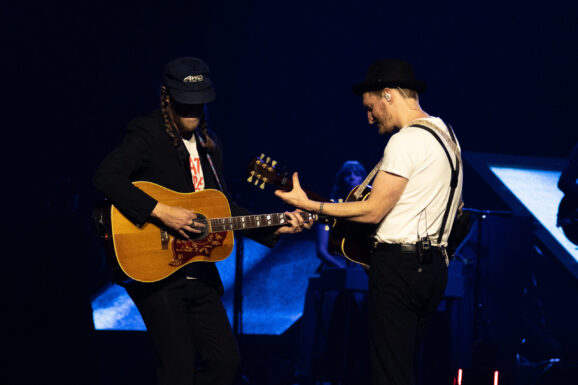
Connecticut-based Indie Rock trio The Problem With Kids Today released their third album, Take It!, on August 22nd, via their own imprint, In The Shed Records. While they have had a full gamut of studio experiences, from small to large, this time around they decided to bring an amenable Producer, Joe LeMieux, into their practice space, known as “The Shed” to record as live as possible. The result is high-energy as full of rewarding twists and turns as a live show would be.
This time around, they felt they were influenced by ideas coming particularly out of the UK from Mod and Punk traditions, and we see that expressed through the artwork and photography for Take It!, as well as through the ethos of the music. The trio of Tate Brooks, Silas Lourenco-Lang, and Reena Yu, decamped to Brooks’ house and the location of The Shed to make the recording across an eight-day period, and couldn’t be happier with the result. I spoke with Tate Brooks and Reena Yu about the experience of being in a big studio for their previous album in comparison to the homey but focused experience of laying things down in The Shed and keeping it fun for them, and for the audience.
I understand that you recorded your previous album, Born To Rock, in a larger kind of studio setting, whereas with this one, you created a space to record on home turf. What were the pros and cons of using a studio before?
Tate Brooks: It was definitely pretty different for us, because we’d usually done things low-key and in smaller studios. It was pretty awesome to have so much at our disposal and so many toys to play with. It was like a toy shop, in a way! I think for pros, it was definitely cool to go outside of our comfort zone, and working with the Producer Adam Lasus was awesome. I think, as far as cons, it was maybe a little daunting, and there were a lot of people around, hanging out at the studio. That was a little different for us. It was a huge room, which was different than what we were used to. But it was definitely an eye-opening experience. What do you think, Reena?
Reena Yu: The pros were that it was awesome to see all the gear, and have so much room. The drums were really awesome. Hearing all the stories about the old gear was great, like hearing that one amp was from The Cars. I guess one con was that it was a lot of pressure to get a good album out of that studio. You want to make it worth it.
Tate: For sure. We put a lot of pressure, kind of on ourselves.
Reena: Tate lost his voice doing so many takes!
Tate: Yeah, I lost my voice immediately! That was really intense and nerve-wracking.
Reena: I had to take a break from drumming because my ankles were giving out. I was putting a lot of pressure on myself to get a good album out of a big studio.
I just asked that question because I feel that artists right now are making a decision based on preference, and every time they make an album, they might do it differently. There’s no one way to make an album these days.
Tate: One hundred percent. We’ve always said from the beginning that we want to do it a little differently each time.
Reena: Just to have that experience.
Tate: To feel out what we like the best.
It’s funny that you mention the “big room” which reminds me a little bit of Abbey Road or something. That can be cool if it feels like an audience space, but alone, it can be a little intimidating, I’m sure.
Tate: It was definitely a Studio A, Abbey Road kind of a feel. We actually brought the drums into the big room and tried, as much as we could, to make it like our rehearsal space, “The Shed.” We got as close as we could in the big room, so we could play off of each other.
Was “The Shed” already part of your music lives, before this album? I know you fixed it up and used it to record this new album, Take It!
Tate: Yes, The Shed was one that Silas and I built with my grandpa back in 2017. It was meant to be a storage space, but pretty soon after that, we said, “This is a perfect place to rehearse!” That’s been our rehearsal space for a bunch of years, so The Shed is part of us!
Was there a discussion or a day when you all were talking, and made that decision to record your next album at home?
Tate: Kind of. I think after we recorded in the big studio, we thought, “That was really cool, but also daunting. Let’s go back to our basics, and our roots.” Then we looked at a few different spaces to record the album, and I think it kind of hit us all, at once, and I said, “It could be really fun just to record this here, in The Shed, at my house.”
The guy that we recorded this album with, Joe LeMieux, said that he would record us wherever we wanted. He said, “I’ve got all the gear. We just need a small space to do it.” We thought, “This might be just perfect to do it here, where we’re in our most natural state.”
It reminds me of a tendency of mine, when I walk into a store, to immediately see the item I’m looking for. But then I make myself look at every item in the store before I let myself go with my first instinct and get that first item.
Tate: That’s so true! Even last week, before we did it, I was kind of skeptical and had second thoughts. I didn’t know if it would work. Silas, our bass player, said, “No, we should just go for it! We should just see what happens!” It really worked out. It was perfect.
I think a lot of people will find that inspiring because a lot of people have been building home studios, or upgrading what they have. Did you have to fix up the space much to get it ready for that?
Reena: Joe already knew exactly what he had to do, and was bringing all the recording gear. We just had to clear out the studio as much as possible so that we would all have room. Joe was really nailing it with all the mics and stuff. He had them hanging on the ceiling, and he was micing up the kit.
Tate: He really knew what he was doing in terms of placement. We had one really big clean-out day where we moved stuff into another shed that we have.
Reena: We actually had to set up a tent for more room.
Tate: We had to set up a tent on the side of The Shed for some additional space. We laid down a couple of rugs for some soundproofing.
How did you choose which songs you wanted to record during that time?
Tate: After our big studio experience, we wanted to write a bunch more, and I think we got into a kind of a flow state or mode. Looking back at them, we said, “These are all really fun to play.”
The live aspect of your sound is something that I pick up on from listening to your record, and Joe must have had that in mind, too.
Tate: I think the live-ness was a big thing, and kind of always has been for us. We like playing live, and we’ve always wanted to capture that emotion. Joe was totally on board for that. We shared bands with him that we were influenced by, and he had a lot of good input on certain songs. There were some good overdub parts that he thought of.
Had he heard some demos from you before the recording dates?
Tate: Yes, we had a bunch of iPhone demos that we sent him, and he studied up on them. He had an idea of what the record would be, definitely going for a little bit of a raw sound, but clean, and simple, I think. That was a big thing, too, saying, “Let’s record these songs as simply as we can.” The last record, we went crazy on overdubs.
Reena: Oh, yeah!
Tate: We did wacky instrumentation and stuff, but this time, we said, “Let’s just highlight the live band.” He had a lot of really good ideas for getting a vibe going. We were practically living together for eight days! We’d get up early, drink coffee, and crack right into it!
It’s funny because that’s the public perception of how bands are, and how they live, but it’s not true usually. You lived the Beatles’ Help experience, like in the film!
Tate: Totally! We were like “the lads” and we were watching a lot of Halloween movies, because it was close to Halloween. Joe didn’t really like scary movies, but we kind of got him into it.
I notice that the design for the album cover, and some of your photo shoot material, and even the video for “I Dunno” feel retro and Brit Rock. When did you decide on that? Did it come out of what music you were listening to?
Tate: When we were getting the songs together, we noticed that there was a bit of a Mod vibe going on. It almost felt like The Who, or The Jam. I think a lot of these songs are pretty poppy and we wanted to reflect that. We always wanted to do a video with a soundstage like we did with “I Dunno.” It was a retro kind of thing.
We based a lot of the artwork off of Mod or Punk bands, and we had a whole list of album covers that we were influenced by. The Buzzcocks have an album cover that’s pretty similar to ours and we wanted something like that. There’s also the Mod target logo. It was some visual stuff coming up in our brains, and we leaned into that, that British thing.
A lot of those bands made their marks through live playing, really winning audiences over that way. That really works for this album, too, since you’re going for the live sound.
Tate: Definitely. We like a high-octane, fun live set. We like to jump around and keep it moving. If we could afford to smash our instruments, we would! But not yet.
There are some interesting differences between the songs on the album. Some are heavier than others, some focus on guitar solos, or higher notes and registers. But I would say that they are all fast, they are all high-energy and the pace is there. I can see how a live show would be very energetic and blow peoples’ hair back.
Tate: [Laughs] Yes! We were listening to the record the other day, and said, “Wow, we can’t even take a breath on this record!” It goes from rocker to rocker, definitely.
What inspired the song “Take It!”, which is kind of your title track? It speaks about bearing a certain weight in life and trying to decide how to handle that. I was really interested by that guitar layer that comes in later in the song, and the electric guitar solo that comes in towards the end. I thought it was really wild and inventive.
Tate: Thanks! I used to work a retail job, selling liquor at a liquor store, and I used to get a lot of grief from customers. I think that was a big inspiration in writing the song, not “taking it from the man” anymore! [Laughs] That was the idea behind it. The guitar part that comes in was us trying to be a little more jangly, like Power Pop, and then we went right into a big riff.
Having some differences between songs like that, and bringing in the unexpected, is probably good for a live show, as well as for the album.
Tate: For sure. We didn’t even have a second part for that song. I was just kind of noodling around with Joe in the studio, and he said, “That’s it! That’s the guitar part, right there! Let’s lay it down.” That was pretty cool. It came to us right on the spot.