On October 16th, David Byrne brought his Who Is the Sky? concert tour to Philadelphia’s Metropolitan Opera House (for the first of three shows), beautifully restored in 2018, and the perfect stage for the legendary 73-year-old polymath to present his latest live multimedia experience. Who Is the Sky? marks Byrne’s first album of new music since 2018’s American Utopia and its extensive and wildly successful tour and award-winning Broadway show, and concert film – a tough act to follow, even for Byrne himself.
Yet he’s doing just that and then some, charting a new course and demonstrating a degree of savvy learned both from home runs like Utopia and Talking Heads’ Stop Making Sense, as well as from less critically and commercially successful projects like Here Lies Love, his album and musical with Fatboy Slim about the life of Imelda Marcos. The music and presentation of Who is the Sky? feel very “same same but different,” a (non-pejorative) theme that infuses and informs Byrne’s own work. (Meta!) And while I wouldn’t presume to say I know Byrne’s meaning or intention, I definitely have thoughts that I’ll raise in italics – mostly framed as questions – throughout this review.
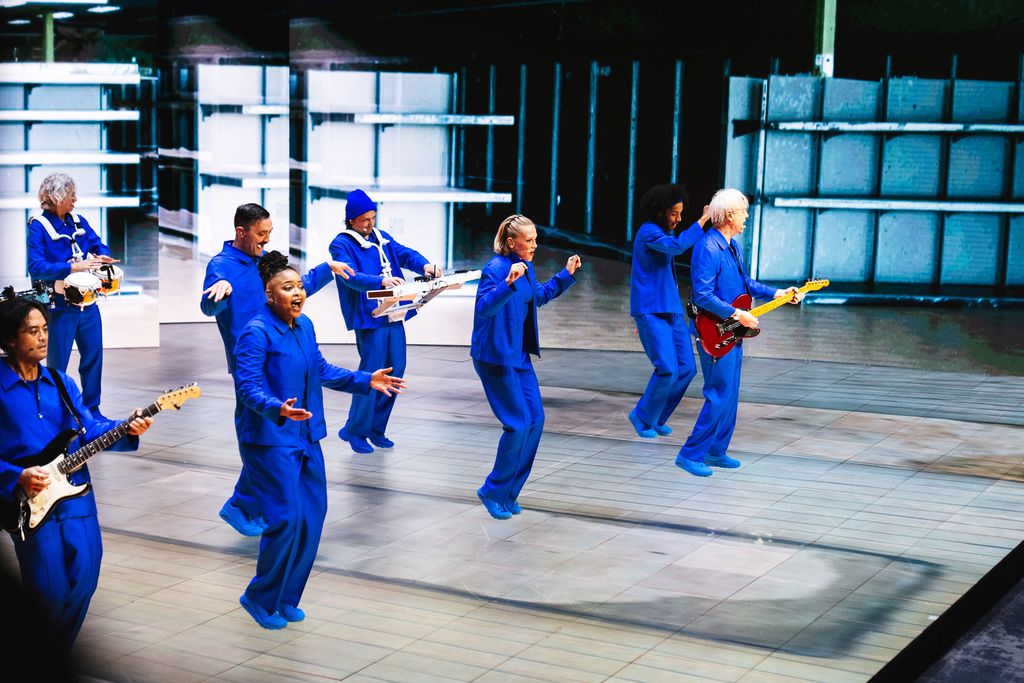
The lights darkened at 8:10, and from the second Byrne and the first three members of his band trickled onto the stage, the trichromats in the room noticed a big difference between this show and Utopia: everyone donned matching royal blue button-up shirts, pants, and sneakers, in stark contrast to the grayscale formalwear and bare feet from the last tour. (Is this a deliberate effort by Byrne to celebrate the more casual and colorful aspects of modern life, rather than be mired in a stark formality?) Another immediate difference was the floor-to-ceiling curved LED screen that stretched across the entire stage, presenting a wide variety of images in every color imaginable, as compared to the chain-link curtain that served as the only set piece in the Utopia tour. (During the show, he displayed some stunning pictures he’d taken while biking through Philadelphia, including from Isaiah Zager’s Magic Gardens and the hella creepy Mütter Museum.)
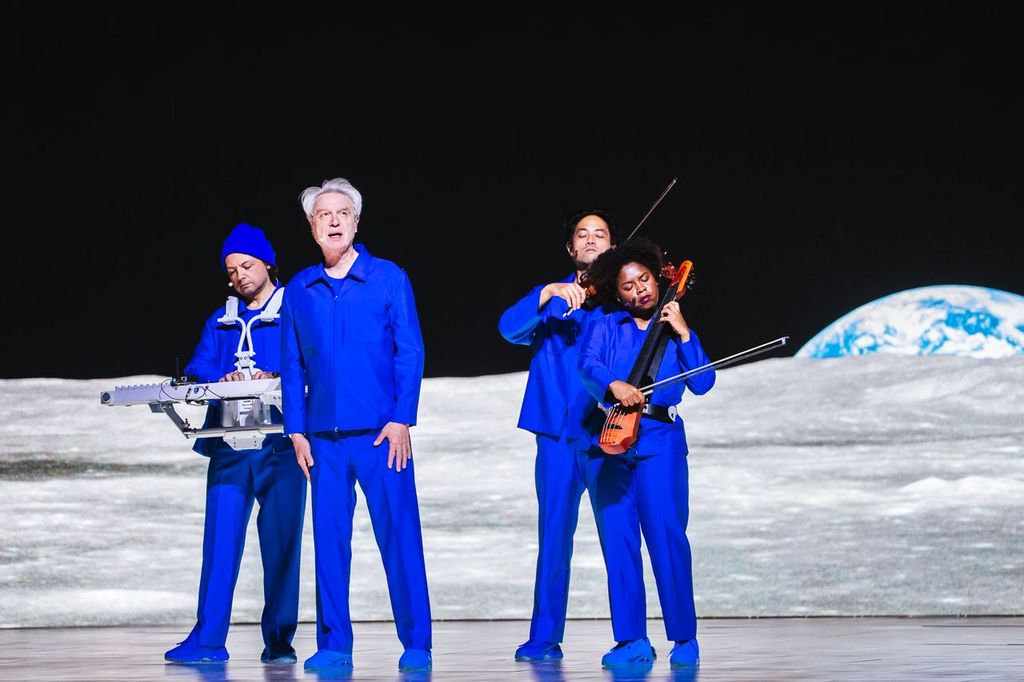
The violinist started the first song pizzicato as Byrne began singing Talking Heads’ “Heaven,” a longtime staple of his solo shows, and his keyboardist and electric cellist gradually joined to build the sound. Byrne’s voice is as strong, clear, and in tune as ever. Between songs, he pointed to the screen – an image of Earth from outer space – and described it as the only heaven we have. (Pretty “on the nose!”) A guitar tech brought him a green acoustic guitar that he strummed to open “Everybody Laughs,” his first track from the new album. The song’s lyrics imply connectivity and certain universal and often banal aspects of the human experience, both ongoing themes over Byrne’s career.
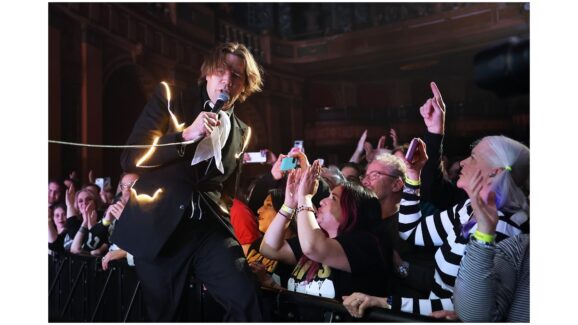
This is also where the show started to get fun, with the music, visuals, and choreography all in sync and accompanied by shit-eating grins on the faces of most dancers, both on the stage and in the crowd. (Fun seems to be another major focus of Byrne’s these days, consistent with the stated mission of his nonprofit, Arbutus, and the “Reasons to be Cheerful” project launched under that umbrella in 2018.) As with Utopia, Byrne and the rest of his 13-member band – including some Utopia alums like longtime percussionist Mauro Refosco, as well as members of Ghost Train Orchestra and a handful of background singers – carried or wore their instruments and amplified them wirelessly, enabling them to participate fully in the choreography of the evening. (Byrne has been dabbling in marching bands since as early as his Contemporary Colors project in 2008.) They walked, ran, danced, hopped, and jumped their way all over the stage, matching movement with meaning, presentation with intention, across songs both old and new.
Some of Byrne’s Talking Heads era songs – including “Psycho Killer,” “Life During Wartime,” “Houses in Motion,” and “This Must Be the Place (Naive Melody)” – have formed part of his solo set for decades, and it’s been interesting to see how their meaning and relevance evolve with the world around us. For example, during “(Nothing But) Flowers,” a song about longing for creature comforts after abruptly returning to an Eden-like pre-technology lifestyle, the screen displayed what appeared to be an empty office building or cubicle farm, in contrast with the green fields projected earlier during “And She Was.” The abandoned skyscraper seems less far-fetched today than when Talking Heads released the song in the late 1980s, particularly since the COVID-19 lockdown. (Is that part of why he chose it?)
It’s also easy to imagine how different aspects of Byrne’s life have informed these songs and their presentation. For one, the pandemic informed much of the intention and manner of the songs from Sky, as well as the visuals during the performance. During “My Apartment is My Friend,” Byrne’s ode to his abode, the screen projected pictures of his apartment as the stage set for the performance. “Moisturizing Thing” is equal parts mundane and absurd: pretty “on brand” for life during lockdown. And just weeks ago, Byrne married his girlfriend of nearly a decade, which could suggest that some of the lovey-dovey songs about “she” or “her” may hit close to home for Byrne.
He also isn’t shy about raising social and political issues with his music, stage set, and public statements more generally: the visuals that played during his new song, “My Beliefs Are on My T-Shirt,” featured countless T-shirts bearing slogans – some funny, some sweet, and others reflecting a point of view on various social and political issues of the times. (However, I thought he was less direct than I’ve seen him before; perhaps he sees the irony of writing a song about pithy expression as he simultaneously uses an album, legacy catalogue, and choreographed show to express his beliefs.) And in a move he’s honed over decades – covering a thematically consistent song by a popular and talented female artist – he also performed a cover of Paramore’s “Hard Times.” (Hayley Williams sings on the album version of “What Is the Reason For It?”) He closed his set with “Once in a Lifetime” and returned for a two-song encore: the sparsely arranged “Everybody’s Coming to My House” and a rollicking “Burning Down the House” to conclude the night.
The entire evening affirmed that David Byrne remains an eternal nonconformist whose work is fueled by an enduring scientific and artistic curiosity, along with a perennial desire for us all to love (or at least tolerate) one another. Having long engaged in vast multimedia projects that have played out across film, Broadway, and books, Byrne successfully distills his decades of exploration into a concise, powerful statement in the Who Is the Sky? Tour, which undoubtedly would look amazing at the Sphere. David Byrne continues to dedicate his energies and considerable talents to finding and amplifying the signal of hope in the noise of modern life.