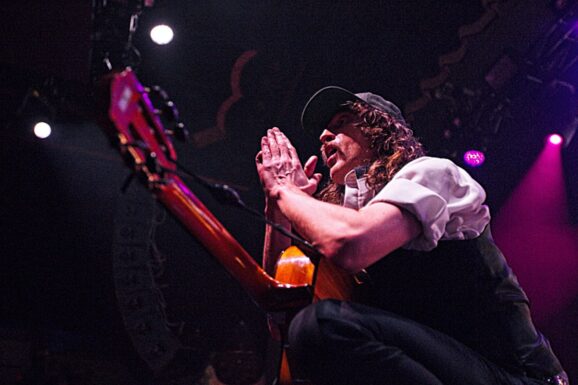
Steve Hackett’s show at Revolution Hall on Saturday, November 22nd felt important. For starters, it was the final stop on a lengthy North American tour that had this Rock and Roll Hall of Famer criss-crossing the U.S. and Canada. It was also the final show for keyboardist Roger King, who has provided his masterful musicianship to Hackett’s band for multiple decades. These factors gave Portland’s show a palpable sense of excitement amongst the Genesis diehards and prog rock nerds who filled Revolution Hall. And while Hackett, at the youthful age of 75, could easily rest on his laurels and phone in his performance, this nearly three-hour set saw him doing exactly the opposite as he presented his solo work and Genesis material in grandiose fashion.
Looking dapper as ever, the English rock star and his band leaned fully into his solo material during the first set, starting with the orchestral rocker “People of the Smoke.” “Circo Inferno” off Hackett’s most recent album The Circus And The Nightwhale followed with its bursts of Middle Eastern sounds before the dramatic guitar meditation of “These Passing Clouds” and the prog-rock rollercoaster “The Devil’s Cathedral” that saw King laying down some of the spookiest organ of the night.” “Every Day” was an early standout, with the band firing on all cylinders with perfect breezy harmonies and King’s soaring, buoyant synth work allowing Hackett’s epic shredding to levitate before he took off on a ferocious solo. “A Tower Struck Down” let Rob Townsend shine with his mysterious flute introduction giving way to a sinister melange of haunted house sounds as he swapped for a saxophone to play in harmony with Hackett’s guitar. Bassist Jonas Reingold had his moment in the spotlight with a solo that was jazzy, melodic, playful, and sneaky all at once, also incorporating classical composition as he laid the foundation for the marching triumph of “Camino Royale.” The catchy only the fool chorus line found Hackett’s vocals in fine form before he chewed into a mind-bending, blues-laden solo.
When the band returned to the stage after a short break, the twinkling keys and guitar of Genesis’ “The Lamb Lies Down on Broadway” drove the crowd into a frenzy. The band focused a significant chunk of the set on the 1974 concept album, with Hackett laying down foreboding guitar theatrics on “Fly on a Windshield” and steering the band into the urgent rock sounds of “Broadway Melody of 1974” with Nad Sylvan giving some of his finest vocal performances of the night. This continued during a version of “Carpet Crawlers” that was slow building and immensely powerful, with Hackett’s guitar work ever-so-delicate to slice through it all, while “The Chamber of 32 Doors” kept up the momentum as a proper vehicle for each band member to showcase his chops. With Sylvan’s commanding vocals leading the charge, “Lilywhite Lilith” was a major standout that saw Hackett’s guitar and King’s synths ascending to new heights. “It” galloped along with speed and precision, setting the table for the massive set-closer “Supper’s Ready.” This final tune was met with a fitting roar of applause from the audience, eager to embark on its ambitious musical journey. The sprawling and fantastical suite of rock and roll power that combined storytelling with instrumental prowess provided the perfect bookend for the performance. It also reminded the fans how Hackett is a true master of creating nuance and moods with the many effects and tricks he deploys on his instrument.
The set concluded with a champagne toast to Roger King before the band returned to the stage and King opened “Firth of Fifth” with an eloquent and stunning solo. It was around this point, as the band cruised through this tune and welcomed an impressive drum solo from Nick D’Virgilio before unleashing a churning pool of instrumental technicalities on Genesis’ “Los Endos,” that the experience took on a wholesome, almost sentimental quality. Perhaps it was the knowledge that it was the final bow for King, who played a classy piano line during the tune, or the fact that music of this expansiveness, complexity, and depth rarely gets made anymore. For those in attendance, it only reaffirmed the signficance of seeing Hackett carrying the torch so many decades later.