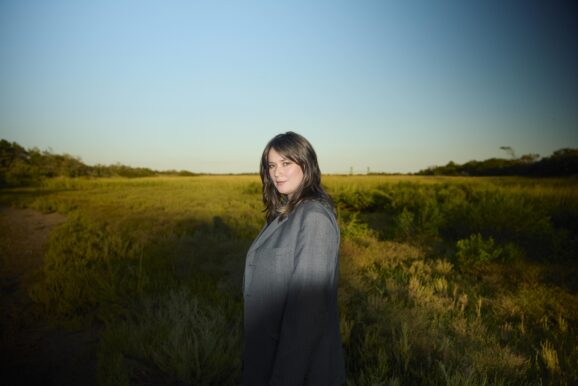
At this point, we should treat singer-songwriter/poet/visual artist Courtney Marie Andrews’ music as evolving and taking on more polish with each release. Her previous release, 2022’s Loose Future, came with these words in our headline – “Breezier and Poppier.” Her latest, Valentine, is not anywhere near as uplifting, but some of the vulnerability and fragility that marked her first two albums have returned. However, what attracted me, and likely others, to Andrews initially were her achingly vulnerable, soaring gospel-soul vocals. She had a devastating ability to sing about heartbreak like few others. Andrews is consistent in singing about heartbreak and loneliness, but the raw power felt on her first two releases has waned. She received a Grammy nomination for 2020’s Old Flowers. That kind of recognition often results in smoothing out the edges. Discipline and elegance hold more sway. Yet, by her own admission, Andrews admirably wants no two albums to sound the same. Arguably, her songwriter has improved too. It’s still very much direct but more succinct and carefully crafted. Her voice remains a gorgeous, acrobatic instrument, albeit less emotive.
On Valentine, Andrews does not work with a full band but with co-producer Jerry Bernhardt (12-string acoustic guitar, bass Juno 60, and Mellotron), along with drummer Chris Bear of Grizzly Bear. Andrews stretches out instrumentally, playing flute, high-strung guitars, and a myriad of synths. So, while it is stripped down in terms of personnel, there are plenty of sonic layers at play, resulting in her most sonically adventurous effort to date. The trio was inspired by the music of Lee Hazelwood, Big Star’s Third, and Fleetwood Mac’s Tusk.
The album was written at the juncture of an intense breakup and newfound love. Although she was experiencing immense pain, she tried to embrace it with defiance, crafting songs of energy and strength. “Pendulum” begins with starkly dense chords offset by Andrews’ soaring vocal singing direct lyrics such as – “Man, I love a heart with one foot out the door/One that leaves you hungry, coming back for more.” The pulsating “Keeper” is replete with vocal sighs, emblematic of being worn out by chasing an unsure love. It’s the album’s only co-write, posing the question of whether she is a keeper, an honest statement of vulnerability. The gentle acoustic strum of “Cons of Clowns” blossoms into a full-out statement of defiance, without falling prey to the many pretentious types that seem ubiquitous. Her voice modulates from a whisper to an aggressive dare.
“Magic Touch” stands out as a direct love song, free of pain, and wrapped in sonic layers that deliver a hymn-like joy. Sonic layers grow thicker as Andrews adds flute and organ to Bernhardt’s impressive array of instruments, while adding Brian Wilson-like harmonies, embellishing a tune with a simple, devastating image. All that’s left of a serious, complicated relationship is a picture of a little butterfly in a tune of the same name. “Outsider” floats in the ether as Andrews sings of her desire to mask the pain by staying outside of it. The epitome of the stressful balance she’s dealing with is on vivid display in “Everyone Wants to Feel Like You Do,” wherein she indicts the stereotypical male braggadocio stance that claims they can do whatever they want without consequence. The chorus, ironically, becomes infectious, while the message reeks of defiance.
“Only the Best for Baby” is an expression of vulnerability, while the mostly acoustic “Best Friend” seeks reassurance. Her conflicting emotions come to a head in the closing “Hangman,” which opens with a single note and Andrews singing practically a capella. The tune captures her defiant stance, not pleading for reciprocity but instead laying it out directly in these lyrics – “Don’t wanna live playing hangman/ Always asking for vowels/On the edge of death.”
Valentine may well be Andrews’ most well-crafted album in terms of songwriting. We do hear smidges of the aching pain in her vocals that drew most of us to her artistry in the first place. Yet, although the grit and rawness of earlier efforts are gone, she remains honest to the core while growing more exploratory musically.