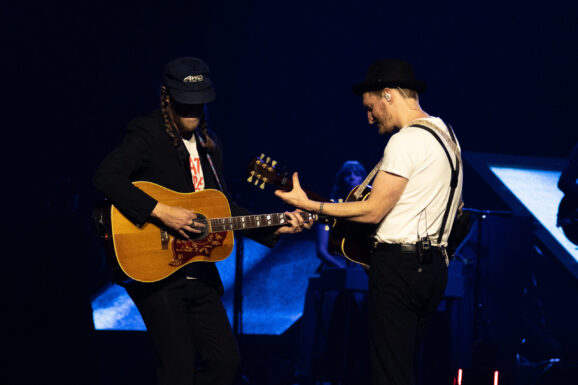
Soen is a Progressive Metal band from Sweden who released their new album, Reliance, via Silver Lining Music on January 16th, and are coming to the US for a North American tour in March. If you’re really quick, you might catch them on the “7000Tons of Metal” cruise from Miami at the end of January, too. The new album homes in on the use of everyday language to directly confront aspects of modern life. Its lyrics examine how our social structure limits our humanity and how we limit ourselves in our daily lives. The emotional core of the album is as audience-friendly as ever, with conversational hushes as well as sweeping dramatic sound, while the picture of street-level modern life is something that fans will definitely recognize.
Soen is led by Joel Ekelöf (vocals) and Martin Lopez (drums), and the new album was produced, recorded, and mixed by Alexander Backlund at Fascination Street Studios, with mastering by Tony Lindgren. I spoke with Joel Ekelöf about the band’s journey into this album, how it fits into their discography, and the dangers of glorifying the alpha male image.
I’m aware that you’ve just come off a lot of playing in 2025. Have you played the new songs yet?
It’s great to play, that’s what we do. We didn’t play these songs yet. We wanted to wait, to make sure that we are really prepared when we do the new songs, and that people have heard them before we play them.
You’re also coming to America in 2026. Will that be where you first play these songs?
It’s going to be some Scandinavian dates in late February, and then in March, we will play them in America. Between that, we’ll do a small thing on a cruise ship. That’s the second time we’ve done a cruise ship.
Those are becoming quite popular, the cruises.
I can imagine it’s great for fans. It’s fun for us artists, too.
How are the acoustics?
[Laughs] Probably not optimal, but it’s a boat. It’s going to be great.
Can you tell me about the journey into this album since the time of your previous album? Are these all from more recent writing sessions?
They are all new. There are always a lot of leftover songs from every album that we have, and they never get used. It’s always new songs. It’s more fun to do new stuff.
I can understand that, but it makes me a little sad to hear that. At some point, you need to do a B-sides album of all the songs that didn’t get released.
There are three or four B-sides per album that have never been released, so that’s a good point. Some day. They all get recorded and are fully produced like the other songs. Maybe we could release them all on one album.
I do feel like this album is a development. I really enjoyed the last one, where I could feel the heaviness and the drama of it. This album, I feel, is a little more subtle and goes further into psychology and observations from modern life. The sound is also a little more subtle, with softer and heavier elements. The conversation with the audience feels more close-up.
That’s probably true. It’s probably a clearer album. It’s not simple, because there’s a lot of detail, but it’s very clear in its structure. We know what we want to put on display, and how to display it. It’s clear what the songs are about and what they are supposed to convey, but then if you want to look beyond that, there are all these details.
I was listening to the album Cognitive today, and it’s a mess! It’s a charming album, it’s lovely, but it’s a mess. [Laughs] We didn’t have a clue about what we were doing back then, but we did something great.
It reminds me of when an artist looks at their older drawings or paintings and thinks they look like they were done by a child.
Yes! I think that’s common, for artists, of course, to feel that way.
Audiences have heard a few singles from this album now. How have they responded? Are they noticing some differences?
I hope so. Then there are some people who, whatever they hear, say, “It’s the same. It’s derivative.” What can you do about those people?
Ignore them.
Yes, ignore them. The thing is, I am very proud of this album, and I think it’s a fantastic album. The thing is, if I feel that way, I’m sure that there is going to be someone else who likes this, too. And if they don’t like it? At least I like it.
Yes, that’s the most important criterion, for sure. It has to feel like the right thing, as a band, to be saying and doing. But I think every song makes an emotional appeal to the audience, and I would find it strange if they didn’t realize that. I’ve seen some live performance videos of you and the band in the past, and there’s always a big connection to the audience, and they are reacting, so it seems like part of your approach. I think the album is about half-and-half, with half about internal experiences, and about half of it observing the world and commenting on it. Are you aware of trying to do both of those things?
Yes, I think you’re spot-on right there. That’s one aspect, but then there’s the existential aspect: our existence. Who are we and why are we here? But those three aspects have always been there in our work, and probably always will be there. But those are in different proportions, of course. Maybe on our latest albums, we’ve been more outward-looking and looking at our role in society. For some periods, like with Lykaia, there were a lot of existential themes. So we have this balance, and it goes up and down, depending, probably, on where we are, as individuals, at any moment.
There are some bands that do existential albums every time, and without criticizing that, I still say that the difficulty will be in making that feel personal for the audience. The big picture can feel impersonal. Bringing it down to earth helps.
If I’m having a conversation with a person, and they are starting to tell me about stars, the universe, and philosophical aspects of why we exist, I would rather hear about what that person’s relationship is to how they exist. I don’t want to hear someone proclaiming things or explaining things. It’s more interesting to hear about how something reflects upon a person. I don’t care much about albums that only have existential themes. I can find that in a book.
This makes me think of your song “Primal” because a lot of Metal albums that talk about existential themes present an oppressive system that’s kind of faceless and ambiguous, and fight against it. But in your song “Primal”, you do explain in very clear, modern terms what you mean by that. It’s not nameless, it’s the billionaires, for instance, who oppress humans. It’s real. It’s here.
I think with this album, we want to use a more common language and be more straight-to-the-point in terms of words, to be more direct. We have to have the courage not to be so abstract. We want to tell it like it is.
It’s kind of the view from the ground, or on the street?
Yes, I think it gets more interesting that way.
Do you see a difference in how, as a vocalist, you handle the interpretation of these kinds of direct lyrics? Is it more challenging for you?
No, but if you compare things, you can see that using common language is harder when you sing. Then, you really have to do it with 100 percent conviction. You have to be 100 percent convinced of what you’re singing. You have to do it properly. That’s probably why many bands just choose to blur their songs into fairy tale language, or something, because it’s easier.
Like using poetic language, or the language of someone giving speeches?
Yes, and that’s more beautiful to sing, and to blend that in. But a common language is harder. In the song “Primal”, it says, “They are parasites dependent on the working class, that build their thrones on our broken backs, and feed us the remaining scraps.” There’s no sugar-coating around it. It’s very raw.
Maybe that’s why it’s so chilling, because it feels like it’s said by someone you might bump into on the street. There are moments when the songs get really big, but a lot of the key passages are delivered in a very conversational tone, without a lot of dynamics. I feel like those are the moments of connection, and then you go to the big moments.
Yes. Hopefully, it feels more relevant and more honest that way. At least that’s the way that I feel.
It feels less like a game or a play that way. It just feels real.
Yes. Especially nowadays, when you can create lyrics with ChatGPT, and throw words into a tombola to make things. [Laughs] But you can’t fake this kind of stuff.
Ugh! Yes! The AI slop is on the rise. Another thing about using normal speech that’s challenging is that we are not brief when we are having everyday conversations. I can imagine it’s hard to fit the right words in. Poetic speech is more compressed.
We write the music first. I think we’ve always done it that way. The music gives you an emotion and an idea that leads you to the theme of the lyrics.
Do you actually get an impression from the sound as to whether it will become more of an internalized or externalized song?
Yes, I think by now, we can, having done so many songs and albums. There are moods in the songs where we can tell, “This is inward-looking.” Or, “This is outward-looking.” It depends on the temperature and the vibe of the song, definitely.
I was thinking of “Discordia”, for which you have a live play video. The black and white footage is great in that video. I like the fact that in “Discordia”, the speaker is responsible for their own problems, and they admit that. They admit that they haven’t let their life be a good, happy one. I think a modern problem is not realizing that.
Exactly. With that song, I imagine the lonely, misanthropic, alpha male, who never lets anyone into their lives, and are supposed to be 100 percent confident all the time. And never trust anyone, never let anyone get under their skin, you know? Then, when you’re summing up your life, you realize that you’ve been very lonely because of this.
It seems like there’s a bit of a glorification of that kind of figure in America. Definitely of alpha male figures!
Tell me about it!
And even glorification of the loner male figures.
Oh, yes, the old Clint Eastwood thing! They are strong and lonely, not dependent on anyone. It’s the idea, “Real men don’t cry.” We have it too, of course. But with that alpha person, who’s like Clint Eastwood, at least they took pride in not bothering others. But today, these kinds of clowns are polluting everyone with their alpha talk, putting weird shit into kids’ minds. It’s weird rhetoric.
In Sweden, we have the idea of the traditional man who lives in the forest, but he takes pride in living there by himself. He doesn’t talk to many people. He doesn’t bother anyone. And that’s fine.
That’s better than someone who insists on their own way of life for everyone else.
That’s the problem today: you are able to spread that kind of mentality around because of the media.
That’s absolutely the case. I feel a little bit of hope in this regard about the loner figure, because in popular culture, we seem to be intent on rehabilitating those figures, like in shows like The Mandalorian, The Last of Us, and others. Where a tough man develops a family relationship. We know it’s not the best state of being to stay isolated.
It’s an interesting drama to have that kind of person. It’s a classical drama, that lonely person who gets attached to something. The old movie, Leon, had that too.
Maybe this song will help people who are heading in that direction, but I think it’s universal.
I think everyone can relate to it, yes, and this feeling where you’re afraid to be dependent on other people. Of course, that is something that everyone has experienced: you don’t want to be vulnerable, and you wish that you were bulletproof.
It’s very common, I think, to look back on your life and realize that you ended a relationship in the past because you were afraid of it, afraid that it was getting serious.
In order not to get hurt, right?
This is a little bit like the song “Mercenary,” as well, because the type of people we are putting in charge these days is that kind of person, who is isolated. They are actually misanthropic sometimes, like the vultures in the song.
It is crazy, yes, we do. I hope that will change, so we don’t have to make these kinds of albums, which are anthems to being normal and having common sense! The politicians should be normal and average, and we should be the rock stars and rebels, writing songs and being subversive against society. Unfortunately, this is not the case.
You’re right, when the heavy music has to be the reminder of common sense, that’s crazy.
[Laughs] That’s when it’s really fucked up in today’s world.