
Toad The West Sprocket are celebrating 40 years of a band this year, an anniversary that comes on the heels of their extensive Good Intentions Tour in 2025. Along with this anniversary arrives a stonkingly entertaining new collection of their music, reinterpreted acoustically, titled Rings: The Acoustic Sessions,which arrives onJanuary 30th. With songs chosen from throughout their discography, bringing older and newer tracks together in conversation, the band really let their imaginations run wild with these new recordings.
The emotional accent is often quite different from the original studio recordings on these acoustic versions, and far from being stripped down, these songs span the wide range of more traditional sounds, with some more spare, and some more layered. The result is a vibrant portrait of the musicians as they are right now, and it carries a lot of clarity drawn from the band’s long live performance history. I spoke with Glen Phillips about the band’s fairly laid-back approach to putting this collection together, and about how it connects with their live play history, as well as with their current creativity.
Is this the kind of album that’s been on your mind for a long time, or did something particular nudge you in the direction of an acoustic album?
It was probably inspired by the version of “Good Intentions” that we were doing on tour. We were talking about doing a little acoustic breakdown during the set. And at some point, I think as a joke, I started talking about playing “Good Intentions” in more of a Bluegrass way. Everybody was like, “That kind of works!” It was that idea, of going in and reinterpreting some songs, that seemed like a good 40th birthday gift from the band.
I was aware that “Good Intentions” played a role, and it’s a great place to start.
We had a little bit of exploring to do to figure out what the record would be. I had probably intended more for it to be something really stripped-down, and it ended up turning into much more of a layered studio project. But I’m also really happy with where it ended up going. It’s a strange record, because it’s acoustic-based, but it’s layered and arranged. It’s not a normal-sounding record in a way, because it has this aggressive quality to it that kind of creates its own vibe.
I don’t know if I thought it was aggressive, but I hear what you’re saying. I think I know what you mean.
There are things that are larger-than-life in it. It is certainly not as aggressive as a Tool record! [Laughs] But it’s a little bit furry for an acoustic record, I think, but I enjoy it.
Before I listened to the album, I wasn’t expecting as much orchestration as I then found, as you’ve said. But I love Americana music, so to me, it sounded like “The Americana Album”. Because in Americana, it could be very stripped down, or it could be very orchestrated. It’s whatever you want.
Totally. And you can be very straightforward, photographic in your mix attitude, or you can be very Buddy Miller in your effects and slather on distortion. Americana is a very broad banner.
I think the intensity of the tracks is often brought out by the dynamics. Some albums stick to a narrower range. These songs allow for a driving energy and a more subdued energy, often on the same tracks. You get that contrast.
Yes. Our “aggressive” is everybody else’s cup of tea and a crumpet, probably.
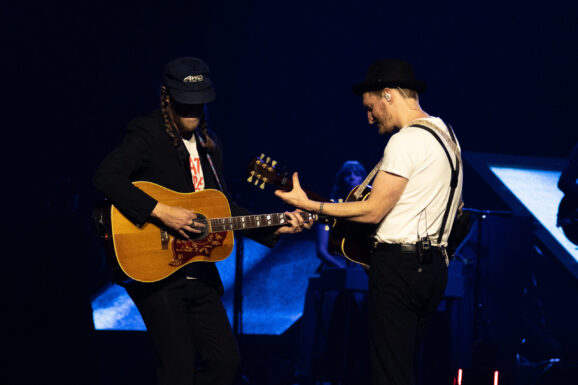
There’s a great video of you and the band playing “Rings” live at the Ryman, and you had done a concert there that was also livestreamed. How did the way that you performed that show relate to the way in which this album was recorded? Are the songs pretty similar?
We started all of these songs sitting together in a room, so the basis of these interpretations was live performance. The basis of that is the same. Certainly, for “Rings”, that’s straightforward piano, vocal, and guitar, so it is what it is. Some of the other songs are much more layered. We’d do one song, and realize that the acoustic versions had been growing for years. It’s their background, since most of these songs were written on an acoustic guitar. I spend half the year touring solo acoustic, so it’s familiar territory.
I actually had assumed that all these songs had acoustic versions already that had popped up in live shows over the years. I thought perhaps this was just the album version. But it sounds like some of them were a totally new interpretation.
It’s a mixture. “Rings,” I think, was the unexpected jewel. That was a song that had always been this more back-beat, Rock ‘n Roll tune, and we’d always liked it, but it was never my favorite. When we shifted into a piano ballad, we suddenly said, “So that’s that song! That’s how we should’ve done it in the first place!” [Laughs] There were some discovery moments in the recording process for this, like that song, and the song “Jam.” I’d gone away, actually, and they’d muted my guitar, and our friend Shawn added this really great arpeggio part, which was way better than what I’d been playing.
There were some surprises like that, but we hadn’t recorded a lot of acoustic versions of these songs. I think we did an EP about 35 years ago of some of our songs acoustic, but we play them all the time at radio stations, meet and greets, and VIP things. So it’s part of the background of touring that you grab the guitar, go to the lobby, and play for 30 people. So it’s something that we are accustomed to doing, it’s just that we hadn’t bothered to put a mic in front of it.
When did you decide to put the microphone in front of you?
It was a couple of years ago. We recorded most of it at my friend Shawn McHugh’s place, who’s a local engineer and Producer. It was kind of an experiment. We did a quick batch, and liked how it turned out, so we did a few more. Then we’d be on tour again, and do our own thing. It took a while because it was done in fits and starts. We then realized that 2026 was going to be our 40th, and it would be kind of cool to do a retrospective. And every album that we’ve ever put out is represented on this.
A long time ago, we did some rerecords, as bands do, since Sony owns the Sony versions, but that was more of a business decision than a creative decision. But to be able to go from our first record to our last record as a creative decision and to be able to draw that throughline through these songs and have them all be part of the same project, I think that was a special thing to do. Instead of a “greatest hits”, these songs get to sit together in the same room, wearing similar clothes, of a similar era, and get to know each other, regardless of the circumstances of their recording.
Listening to the album made me think of the fact that you get to introduce the songs to who you are now, and you can express, musically, your current ideas through them.
I would agree with that. We also get to appreciate the songs in a different way that isn’t necessarily so tied to the time in which they happened originally. We just get to let the song be the song, with its own intrinsic value.
And not everyone’s songs age well, so it does show off the solidity of these songs, their flexibility. They still have emotional punch.
Not every song ages well, and there’s a reason that there are 15 songs, instead of a thousand! We’re not necessarily proud of everything we’ve done, but we’re proud of this collection. We may have less of some stuff out that may be popular, but didn’t age as well. But yes, I’m grateful for the number of songs that we have that still feel relevant, meaningful, and have value. It would be hard to go on tour every year and play songs that didn’t make me feel anything.
That would be an inhumane life. Do you feel that any of these songs now bring out different things, emotionally, than they did before for you? There are choices that affect the feeling of the song in terms of vocals and instrumentation.
I don’t know if there was a specific intent to do that. The songs that have been the most “fun” for me are the ones that are quite different. With the song “Rings”, in particular, there’s a longing in that song that didn’t come across in the initial version, that I love hearing in this version. There’s a certain sense of fun in “Good Intentions,” which was a song that we appreciated, but it was nobody’s favorite track back in the day.
We were at a strange point where we were insisting that we were an Indie band. Like a lot of bands in the 90s, we wanted the cool kids to like us, and make us feel relevant, by being Indie even though we were on a major label. That album didn’t make the Fear record because we thought it was too Pop, and we didn’t want to be a Pop band. We had that attitude, and then the song did well, and we played it, but nobody loved it. So there was something about taking that song and having fun with it that let us all appreciate it again. There was stuff like that, which was helping us appreciate what other people saw in these songs.
The 90s were a strange time. Pearl Jam had a great debut record, and the idea that they didn’t play these amazing songs, like “Alive”, for a while is weird. There was something about the 90s ethos that you were supposed to kind of spit on your own success. I don’t know, we should all go to therapy together about it! I still don’t understand it, but it was definitely part of that era.



One Response
I appreciate this album more than I thought. I always like hearing new music however this recontextualization with improved vocals really brings these older songs to life. I’m thankful that Toad continues to tour and record new music as their endorphin-producing sounds has followed me much of my life.