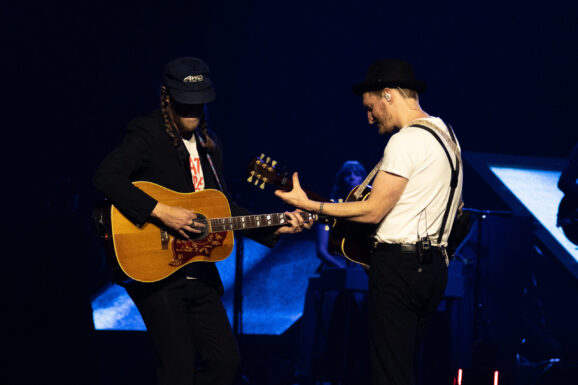
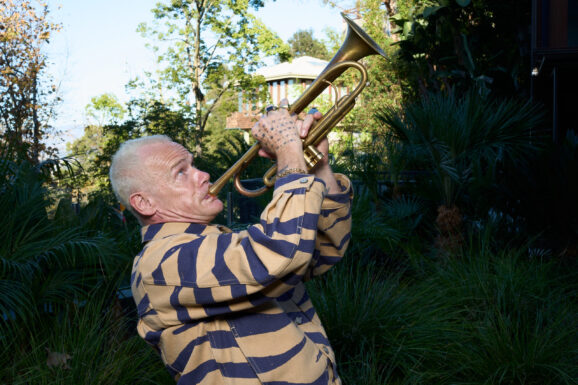
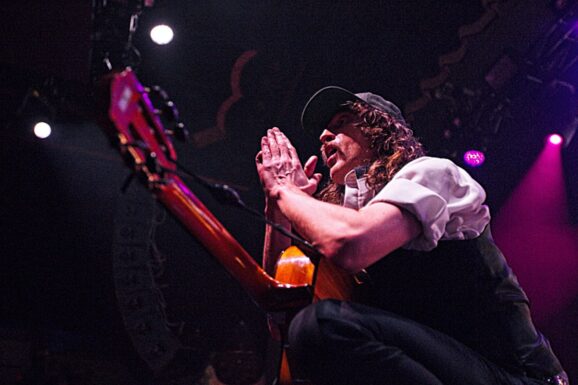
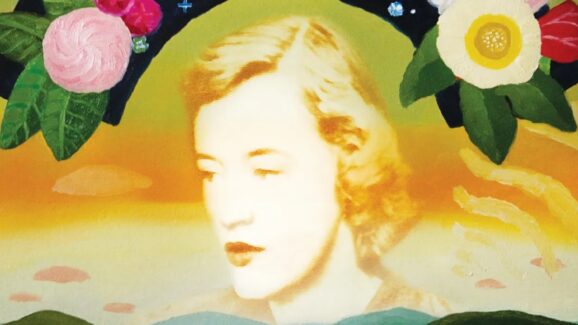
HÉR is a Polish experimental music group, whose name translates roughly as “here, now”, who will be releasing their first album, Monochrome, via Season of Mist on January 30th. That seasonal release is very appropriate since the album draws inspiration from the icy spirit of the Old North that we find in Viking sagas and mythology, in particularly a medieval Icelandic collection called The Poetic Edda. The members of HÉR live in the city of Gdansk, on Poland’s northern edge, and feel particularly close to the influence of Scandinavia, which led to the resonance the quintet members felt with this material. Out of it they crafted an album which musically, and thematic, encourages audiences to “find the light” even in dark places.
The experiment in their music has been going on for several years as mainly a live performance experience for audiences, one which uses projected visuals, dims the lights, and allows the quintet to play together sitting in a circle. Their goal was always to capture this music in album format also, and share it with the world, arriving now as Monochrome. Their line-up consists of Maciej Świniarski (vocals, percussion), Tomasz Chyła (vocals, violin, synth percussion), Piotr Chęcki (saxophone, percussion), Tomasz Sadecki (bass Guitar, synth, percussion), and Sławek Koryzno (drums, percussion), and I spoke with vocalist Maciej Świniarski about the multi-faceted musical life that he leads, as well as the mood and atmosphere that lies at the root of Monochrome in both its live and album formats.
I understand that you play with different musical projects, Maciej. What else have you been playing lately?
Another formation that I am in is called Magda Kuraś Quintetand we have been playing a modern interpretation of traditional Polish music from the region in the South East of Poland.
What is it about that kind of music that inspires you to work with it and to create new versions of it?
Reaching towards the old stuff, you know that somebody wrote it or sang it many years ago, even hundreds of years ago, and yet still to this day it is beautiful, it is universal, it is actual. We can get so much influence and inspiration from that kind of music, especially right now, when we have so much AI slop and mainstream music. My friends and I like to call it “a new nothing.” There was Renaissance music, Baroque music, even medieval music, but now we have “a new nothing.”
It’s amazing how with old music, you can hear one verse, or one bar, and then you can just tell that it’s real, and that it has resonance. You’re right, you can’t manufacture that. You can make new music that has some of those qualities if you are trying to.
Of course, but you have to have something to say. And you have to have something inside of you to make the new music about something, and be meaningful.
It’s amazing how you can work out a good song mathematically, but something is just not there to make it real until something else arrives.
You’re right. It’s when somebody finds a spark in there, or lights a spark in there. I also have this experience, too. When I write songs, and I have two songs in my catalogue like this, sometimes I write them just because a phrase sounded nice. I wrote the whole song just because of a phrase, like one bar. It’s so beautiful that I wrote a song about it.
That’s devotion! That’s dedication. I’m guessing the other band members of HÉR are on other projects too, but you’ve all come together to work on this new, experimental approach.
Yes. In Gdansk, we have this crazy situation where there are a lot of musicians, and many of them have finished the Academy of Music in Gdansk, and that’s how we meet. We all play Jazz and studied Jazz music, so we probably met during some Jazz sessions, studying music, or partying. In Gdansk, you have this mixture of backgrounds, and many of the same people play in different formations, with maybe one person who is changing.
That is how we in the music scene in Gdansk experiment with different ideas and different genres. I don’t know how many formations there are, but it’s always been my dream to make a map of all the connections between all these people, and that would be hard to read! The lines would cross each other out. It would be like a tram-line map.
I know that being on multiple projects can be a practical thing, but is it good for you, creatively, to be able to switch between projects? Is it good for your mind?
Yes. It’s a good refreshment. I always think, and say, that I would have something close to musical claustrophobia if I only worked on one thing. One day I can sing with Magda, and be performing Folk music, running barefoot on stage, and singing about the fields and old stories, and then I have a project with my friend that’s a duo, and it’s like an electronic Noise experimental thing. Then, I also have a solo project which is completely different, like Post-Rock, called Orchestra, because no one will tell me that I can’t call my band Orchestra! We sing and play songs about love in a Post-Rock way.
All of those are very different from a performance perspective, too. You mention the Folk music involves running around on stage, and Rock will be more physical, but Jazz is usually more about sitting still. Do you like the variation as a performer, too?
Yes, and much of the time I treat it like acting, an acting dilemma to solve: How should I perform, and how should I present myself on stage? Those different types of me are serving different purposes. In some bands, I’m not a lead member. But in my formation, I am a leader, so I act differently. Sometimes I’m a secondary vocalist, so there are different roles to serve. I definitely like that.
The big question about the group HÉR is why you chose to be inspired by this northerness, and Icelandic poetry, for your work on this first album. Why did you decide to use that as a linking device in the music?
I guess it comes from the feeling when we are in the North of Poland. Probably all Northerners and Pomerians in Poland live as far North as you can get. It’s very high up. It’s this fantasy of being the Northerners among those in Poland. Above us is only the sea, and it feels like the end of the world. But then, when you travel through that sea, you find other places, and there are people who are also living in the North. And they also fantasize about going even further, to the pole! What is there? Can we go any further? I guess it’s this longing of Polish Vikings to be connected with the higher-up Vikings over there. It’s this feeling of longing to travel, and to get there, to find this cold and weary solitude somewhere up there.
In Poland, when you talk about Gdansk, there are a lot of jokes that it’s always windy here, always raining here, and you always have fifteen types of outerwear. You never know if, within five minutes, it’ll be snowing, raining, a wind storm. You never know. It’s this feeling that we are the Northerners, but there is another world that we can explore, and connect it with our feelings. Where will this get us?
It seems like a natural geographical connection to those further North, just over the water.
If you want to travel across Poland by train, it takes about nine hours. But a trip to Sweden would be by plane and it would take one hour.
That’s so close! Did you come across this poetry, the Icelandic Poetic Edda, and bring it in to start working on it along with the music, or was it a later development?
We actually started from it. It started because of the Poetic Edda. If was something that our violinist found, and he said, “Maybe this will be the inspiration.” I started to go through this, finding the phrases that I liked the most. I found some phrases, and words, and poems, and said, “This resonates with me. This I hear in a melody. Okay, let’s do this.” So it started with the Edda.
I’ve read some of that poetry, and I know there’s a lot there to work with. When I look at your album, Monochrome,I see that you chose things from the Eddathat were very open to interpretation and left room for development. It’s fascinating what you picked. You didn’t strike on a myth or a story, particularly, but you created your own narratives through images and emotions.
It’s because we wanted to play with it, and use it, but we didn’t want to be so obvious with it. We didn’t want to pick obvious stories, which is why we made this selection. What you say is actually very much correct, because we try to create this atmosphere of the unknown during our concerts. We don’t show ourselves much. We play in a circle, and we play towards each other. We create this atmosphere of mysticism, and something that everybody tells us is that it’s like a ritual. It’s like some kind of a mass. In Poland, some people call us diabolical, and satanists sometimes! [Laughs] Because we do that. But no, we are not.
Those lyrics, and this narrative, and this story that we play throughout our show, brings you two sides of things. You can see that an impending doom might be coming towards you, and it feels like it will reach you, and grab you, but there is also this story of finding the light in the darkest of situations, in my observation. And there is some light that runs and rushes through, and reaches us, too. The whole story is about grabbing this light as much as you can, and as much of it as you can, even if it’s just this spark, like we said earlier.
When you all perform this music together, it sounds like it’s very much about the atmosphere that you want to create for the audience. How do you get yourself in the right mindset to do that?
I think it just comes to us very naturally, as long as we manage to create the circle, the circle of our stage. We also dim the lights. We play as a quintet, but there is also a sixth member of the formation who is a visual artist, and who does all the visuals during the concerts. When we play the concerts, we basically don’t use any sources of light except these visualizations. Many times, we operate in states of zero and one, it’s either complete darkness, or complete brightness. It’s always pretty gloomy, and you cannot see us.
Being in a circle is something that we actually decided to do after rehearsals, because we practiced by looking at each other, and we imagined and wrote all of this music in context of being with each other. When we’re playing the concert, with me as the vocalist, standing with my back towards the drummer just didn’t feel right. I didn’t want to do this. We also don’t want to be so standard about things, like the vocalist is the leader. No, we didn’t want to do that. We just wanted to be a whole, and present the story, and present the emotions to the audience.
Our personal moods also influence how our sets are different every time. We come from a Jazz scene, so we are not afraid of improvisation, and we sometimes even change things. Sometimes it happens on stage that somebody does something crazy, and you think, “That’s a great idea!” And when we’re angry, we get overdriven and loud, and when we are sad, we play more in a mantric way. Our manager, who comes with us to the shows, says that I play the concerts at my best when I’m angry! Sometimes she even tries to mess with me, so I will get angry, and play better!
I can see how with a song like “Needles and Bark”, you need a certain harshness to the tone. The way in which you deliver the lines could make it either very sad or severe, or very matter-of-fact.
Yes, it changes with different intentions. And with all the stuff that’s happening around the world, whether it is good, or it is bad, though most of the stuff that’s happening is awful, that influences the idea behind the lyrics. That changes them. I imagine that somebody can get what I am actually trying to say each time I play the song, even though it’s the same song with the same lyrics every time.
Right, the different intentions will come across each time. There’s a video for that song, which made me think that you liked visuals, though I didn’t yet know about the visual aspects of your shows. The video for “Needles and Bark” is very spooky and ambiguous.
Yes, that was basically the goal. [Laughs] We didn’t have much time, so it had to be done without much budget. Our bassist is like the Hitchcock of Gdansk and the music scene. Any idea that came up that had some spookiness, we said, “Good idea!” He wanted this clip to be the opposite of cozy.
You meant to be off-putting or disturbing?
Yes, something like “off-putting.” You hear the music, and the melody, and you watch the clip, and you hear, “Needles don’t protect, neither nor the bark.” There is nothing that can actually help you, and nothing that can save you. Well, God dammit! What now?
It definitely has an uneasy atmosphere. After I heard the song, I thought about Old Norse stuff, and I thought of the World Tree, Yggdrasil. Then, I listened to the song differently and it seemed even darker. What if the World Tree is not safe? Then we are all in trouble.
Yes, because when the foundation is breaking, when even the foundation of the world, Yggdrasil is not safe, how can we stay safe? How can we have the strength to look for this light that we are talking about? Maybe you could say that this is actually a positive album, actually, because it tells you: “No matter what, you have to find the light.”