Germany and Netherlands-based Progressive Death Metal band Alkaloid have recently released their first-ever live album,Bach Out of Bounds,that combines many “firsts” for them, since it was also the first time they performed work by another artist in a focused way, and the first time they collaborated with other musicians. It was all the product of three major and highly ambitious shows that they played in 2024, where they brought the baroque master composer Bach’s work into dialogue with Heavy Metal. To do that, they adapted some of Bach’s songs so that they could take shape in the world of Metal, but they also wrote all-new original songs to perform alongside his work, where they tried to “think like Bach” and compose their own work along his lines.
Together, these tracks formed some epic performances with dynamic sound ranging from the soft to the thundering. While Alkaloid might have stopped there with some very enjoyable shows for fans, they thankfully were able to record tracks from the shows and mix them in a way that worked for a live album release, as well as capturing some video footage. Members of the band include Morean, Hannes Grossmann, Linus Klausenitzer and Christian Münzner, and I spoke with Morean about the heavy lifting and ambitious dreaming that brought this event and album to life.
This is a great time for this album to come out because people need music to listen to in the winter, and this is a live album, so it has a little bit of that live feeling which audiences might be missing more at this time.
Right! That was actually a big reason that it meant so much to us for it to come out as an album. We did three shows here in the Netherlands, but we have fans and supporters around the world. Some of these crazy people even flew in for these shows, and came in from Japan and the United States! It’s unbelievable. But not everyone can do that.
The idea behind the album is also that we’re living in a time when a lot of what we get to see is fake or processed, and we are old school in that sense. We go on stage, we do our thing, and for better or for worse, that’s what we did. To release something that is very real, in that sense, is important to us. It was mixed in the studio, but it’s very much what happened live. I feel like, during this time, that is what has become of great value. It’s becoming a bit of an oddity. So we are extra-proud to offer something that is really, purely that.
I agree, and I have a lot of different reactions to that thought and that reality when I look around at the world. It should not be like gold dust to encounter something human, but it is, so it’s extra valuable when people make the effort to get that across. I feel like that’s the hard job now, to catch that.
Yes. One positive thing I can say about this experience, and the experience of any live concert these days, is that, to me, what makes being a musician magical is that you get to share it. You share it with your bandmates on stage, and you get to do that together, instead of alone in your room, but you also get to share it with the people who come. People come from absurd distances to see what we five nerds are doing on stage, and that is really special. The crappier everything else becomes, the more sacred this actually starts to feel. It is something special and precious that these things happen, and I think we all have to make sure that doesn’t go away. We shouldn’t let it sink into that huge puddle of crap that everything else is becoming.
That’s a great statement. All this would be true, even if it was one human doing this on a stage. But this is a big undertaking, what you did! There are a lot of people on that stage, and a lot of moving parts. I’m amazed by what I know the complication would have been to start from zero, and create all of this music, and then also to capture it live and release it. The videos really set the stage, too.
The videos were as good an approximation as we could get with our circumstances.
I think it is true that it would have been easier to do a new original album than to do what you did with Back Out of Bounds.
[Laughs] That’s a good question, because also in our studio albums, there is a lot work. It takes years for us to get one done the way we want to do it because we refuse to compromise, in an artistic sense. We wouldn’t ever want to hand in something that was half-assed. But in terms of comparison between that, and this album, it’s a very different process. When we are creating for the studio, most of us write individually, and everyone finishes their songs with a little bit of collaboration. But mostly, we’re a band of composers who all do whatever the hell we want! That was the reason that we founded this band in the first place.
But this time, there were also a lot of “firsts” which made it different. This time, we have a lot of guest musicians for the first time. It was the first time that we played music that is not our own, at least in a serious way. And then, tackling some of the music of one of the greatest composers of all time also bears a certain risk. There’s no way that you’re going to actually improve his music, is there?
It’s also your first live album, too, right?
Yes, the first live album, too. Actually, it was a bit of an afterthought to do the album at first, because it was so much work to put on the event, to get to funding, with all the notes, the musicians, and everything. It was only when we were already on stage that the sound tech offered to record the tracks that we have into the mixer. And some friends brought cameras and said, “We’re going to film a little bit.” But it wasn’t set up that it was going to be this product. I have to admit, I wasn’t sure if we were going to pull it off, because we had so little control over how it was captured. But we do have a drummer who happens to be a fantastic Producer, engineer, and composer. With a joint effort, it was possible, but it was done in a skeletal way. Everything was calculated to the millimeter to make it work, and it only worked because everyone gave it a lot of passion, and lifeblood, walking the extra mile. That was also a beautiful experience, where everyone was conspiring to make it happen.
Thank you for sharing that. Just the little bits of video where you can see the musicians’ faces, and the audience, and the participation, is just so meaningful. You can see how enthusiastic everyone is to be involved.
It is meaningful. What I realized once these shows started to happen was that the joy of music, the joy of what we do, and what we share, was there. We had these beasts of musicians on stage who eat the hardest stuff and then ask for more. That is something that no money can buy, and cannot be gotten anywhere else. It’s beautiful to see that this, when it happens, is still as sublime, inspiring, and invigorating as it has always been. We’ve been screwed over as musicians for many years, and it’s only getting worse, but the thing itself is as powerful and as glorious as it has always been, if not more so, by comparison to everything else that is going on. That really helps to renew your motivation to keep doing this.
I found the vocals really fascinating, the strategies for making them heard above heavier instrumentation. Everyone is very energetic, but also very precise, or I think it wouldn’t be properly audible.
I think all this only works because we had the right people, both the band members and the guests. In the case of our bass player, Linus [Klausenitzer], he’s from a classical music family. His dad is a renowned conductor, and violinist, and Linus grew up listening to classical music. He’s a profound music lover who loves all kinds of music. Maybe with a standard Metal drummer, they would have given me the boot after three measures. But I knew, in this specific case, I could give him these parts to him. I knew that he would understand and he wouldn’t mind pretending that it’s a totally different instrument than he’s used to playing. And these things make it fun, also! You get the feeling that this hasn’t been done before, and no matter what people think, at least we could offer a version that hasn’t been done before. And thus make the thing unique, and not just go through the motions of a set thing.
When you set out to do it, you take a gamble, and you only know after the concerts if it worked out. That was true of the concerts and of the live album. I was the one who had to actually put it all on paper, and it took a while for me to believe that it had worked. You worry about it, since even if everyone plays the notes, it doesn’t mean that everything is going to work. So much can go wrong. It was a weird setup, a small stage, with only a little rehearsal time. The fact that we pulled it off makes us very, very proud and happy.
So even when you were in the moment, playing the shows, you couldn’t tell for sure that it was working? Even though people seemed happy?
Of course, you see people enjoying it, and that definitely helps, but before you’ve heard it yourself properly, you don’t know. You’ve heard yourself, your guitar, your voice, and maybe the high-hat, and the kick drum, maybe a blur somewhere in the distance of what everyone else is playing. That’s the challenge of a composer; if you’re playing music yourself, you can’t “be there” yourself to know if it is going to work or not. Also, there, you have to have really good people there who you can trust completely. Also, the sound engineer. We needed someone who was at home both in extreme Metal and in Classical music.
This is so true! I was wondering how that worked, especially live.
Yes, because if you just have a member of one world, or the other, half of it is not going to come out right. It’s this hybrid spirit and a proper crossover between different worlds. I think that you can only do it if it’s done by people who understand the importance of understanding both worlds. You have to have a mental image of how to make a classical accordion work next to a beast of a Death Metal drummer. There are so many little things that you have to solve, and that, of course, is what makes it interesting, too. Once I got the mixed version of the album, I thought, “At last! This is going to work. We can release this with a clear conscience because it actually became what we were hoping for.
The dynamics are so far apart in places, but they are captured so well. I can see how the mixing must have been pin-point. On “Agnus Dei”, you go full baroque! You’re not messing around. You allow that gentleness, but you put that right beside “The Fungi from Yuggoth” and someone has to make that work, from a mixing standpoint.
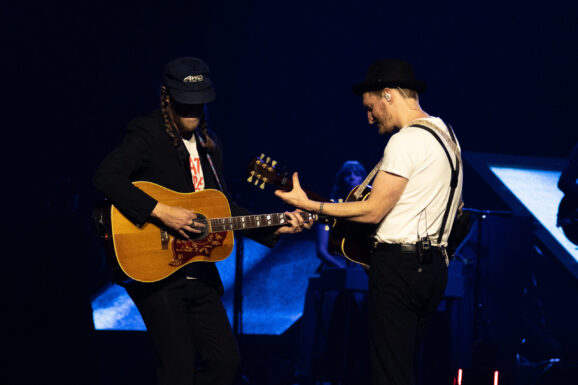
[Laughs] Right. It meant a lot to me to include “Agnus Dei” because it is so quiet, and because it’s really beautiful, and the whole thing was very much about visiting each other’s worlds. I also really wanted us, as a Metal band, to really try to go into that quiet, fragile, gentle Classical world. I mean, it’s just two guitars. There’s no bass, or drums, or growls in there. I felt that the music was so beautiful that it would mean a lot to us, as a band, to be able to look back and say, “Look, we played even this.”
We are adventurous. We like trying out new things. We all love challenges, and we all love so many kinds of music and art. We never want to limit ourselves ahead of time. We will do that when we try something out, and see that it doesn’t work in the studio, or it doesn’t work live. But, in this case, and because for one of these shows, we were at the actual Bachfestival, with a Classical audience, we owed it to ourselves to try to do one piece closer to what the master himself would have liked, or at least, his fans.