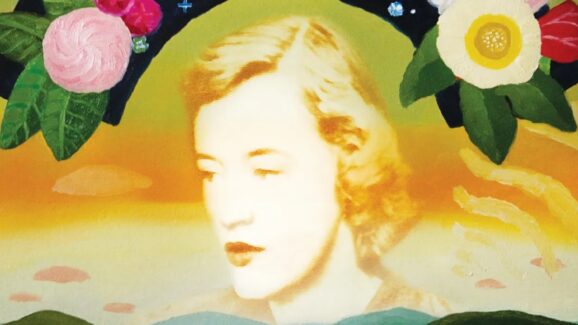
Eliza Noxon doesn’t hide behind metaphor. Her songs arrive unguarded—clear-eyed dispatches from the messy interior of becoming. Rooted in traditional folk but streaked with an indie-rock pulse, Noxon’s music wrestles with loss, identity, and the off-kilter ache of growing up. Open tunings bloom into widescreen arrangements on her debut LP Good Monsters with Bad Habits, a record that feels both electric and close to the bone. It’s a study in fractured selves, stubborn love, and the long, unshakable echo of grief.
The album is due out February 27th (PRE-ORDER).
What began as a coming-of-age document—an attempt to process leaving home and stepping into early adulthood—shifted irrevocably after the death of her brother in 2019. The record transformed into something more urgent, more necessary. “Writing these songs saved my life,” Noxon admits. “They allowed me to express the depths of my grief without fear of judgment or worry.” That gravity lingers throughout the album, but it never curdles into despair. Instead, Good Monsters with Bad Habits traces the painstaking act of rebuilding—of stitching together a new identity from what remains.
Sonically, you can hear echoes of Big Thief’s emotional candor, Typhoon’s cathartic swell, Pinegrove’s restless introspection, and Feist’s luminous restraint. But Noxon’s voice—both literal and artistic—cuts its own path. Her lyrics favor emotional clarity over ornamental flourish, and the music mirrors that ethos: expansive yet grounded, curious yet anchored. The open tunings feel symbolic, too—strings stretched wide to make room for life’s unanswered questions.
Offstage, Noxon’s path has been just as unconventional. A graduate of Brown University with degrees in Education and Interdisciplinary Artistic Studies—a self-designed major blending performance, visual art, and sonic exploration—she’s since worn many hats: puppeteer’s assistant in New York, farmhand teaching kids to milk cows in Vermont, and sailing instructor aboard a Caribbean schooner, leading sea shanties for underprivileged youth. It’s the kind of winding résumé that mirrors her songwriting—restless, immersive, and always reaching for connection.
With Good Monsters with Bad Habits, Eliza Noxon steps fully into her own mythology—not as a finished product, but as an artist unafraid to document the work of surviving.
Today, Glide is excited to premiere the standout track “One More Round,” which begins as a quiet indie-folk piece before exploding into a layered, tender rock track. Emotional and introspective, the song serves as a proper introduction for listeners unfamiliar with this up-and-coming artist. It is atmospheric and moody, making for the kind of song that leaves you wondering what Noxon can conjure up next.
Noxon describes the inspiration behind the tune:
I’ve had a tradition since I turned seventeen. Every year on my birthday, I take a long walk somewhere and I write a new song. I haven’t been perfect about keeping it up but my upcoming album, Good Monsters with Bad Habits, is bookended by two birthday songs four years apart. The first one I wrote when I was seventeen and you’ll hear that one when the album comes out in a couple weeks (!). “One More Round,” I wrote on my 21st birthday. It was the first time I was going to be older than my older brother, who had died almost three years before. I was in a weird stage of my grief where I had some distance but it would still sneak up on me and wipe me out. I felt like there were two versions of me fighting to live my life – the one that was healing and the one still broken. This song is a kind of conversation between those two voices. The final lines, “I am but ash and dust, the world is for me,” are an interpretation of a talmudic teaching. The story goes that we are meant to carry two slips of paper in our pockets at all times – one that reads “the world was created for me,” and another that says, “I am but dust and ashes.” My older brother loved this teaching – he said if he ever got tattoos they would be one of the phrases on each arm. This song, to me, is about the tension between your best self and your worst and the struggle of finding balance somewhere in between.
LISTEN: