On The Map is where we highlight famous and not as well-known musical sites that you can visit. This month we check into a place that is top to bottom nothing but music: the Musical Instrument Museum in Phoenix, Arizona. Let’s Explore!
THE SITE
If you are a lover of everything music, then the Musical Instrument Museum is your treasure island. There is no other place like it, where you can walk in and be totally immersed in the world of sound and how it is made. Two floors with 80,000 square feet of exhibition space puts you into the heart of rhythm and every kind of tune you can imagine. Located at 4725 East Mayo Boulevard in Phoenix, Arizona, be prepared to spend several hours perusing displays of instruments, costumes and traditional dress outfits, and many other music-related artifacts.
INSPIRATION BEGETS ACTION
“We hope that everyone who comes through our doors will be enriched by music,” Chief Engagement Officer Brian Dredia explained to me in a recent email about the museum’s hopes for its visitors. Inspired by a trip to the Musical Instruments Museum in Brussels, Belgium, former CEO and Chairman Emeritus of Target Corporation Robert Ulrich and friend Marc Felix returned to America with an idea to develop the same type of historical and cultural experience through a museum of their own.
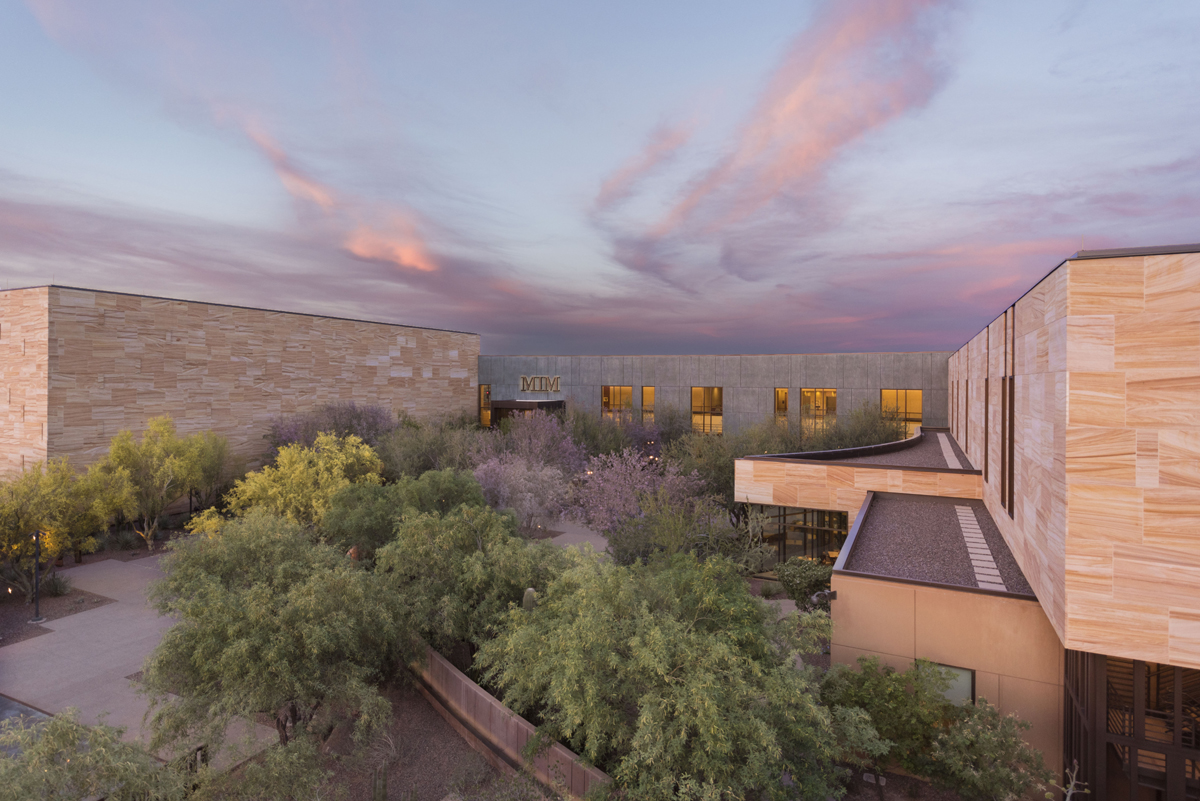
Envisioning the museum as interactive, stimulating, educational, and sensory-fulfilling, its architectural design absorbed the natural patterns of the landscape surrounding it in Phoenix, which flowed seamlessly into the visual aspects of the displays within. Artifacts were gathered from donations, loans and purchases. A 300 seat theater was built for performances, galleries devoted to countries and their cultures were designed to showcase music we might only read about in books; even a café was added to tempt your taste buds; all to enhance the overall experience that music can bring to your every sense. They opened their doors on April 24, 2010.
IT’S NOT ALL ROCK & ROLL … BUT WE LIKE IT
Music in some form or another has been around since the beginning of time. It’s only natural that enchanting melodies and harmonic rhythms get into our soul so easily. It’s nature coming alive in instrumentation.
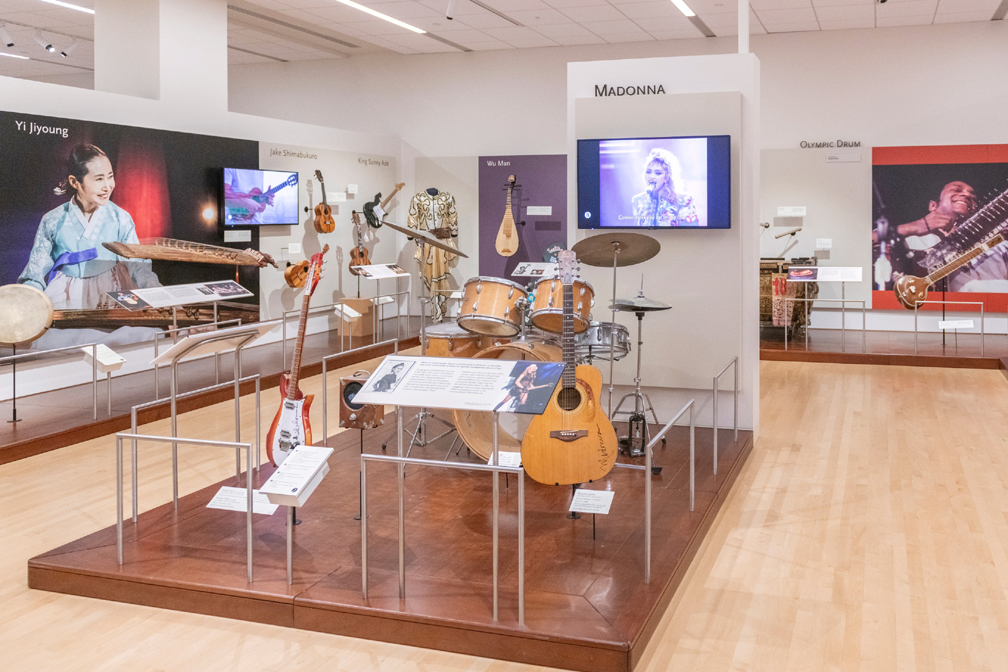
The MIM has over 7500 instruments from over 200 countries, with galleries devoted to five different regions: U.S. and Canada, Africa and the Middle East, Asia and Oceania, Latin America and the Caribbean, and Europe.
Have you ever seen a paigu goblet drum? How about a kultrun? Or a Hawaiian uli’uli or New Zealand putorino? This museum has them all. In fact, the paigu goblet drum is their oldest object, dating to China’s Neolithic period and around 6000 years old. It’s absolutely incredible to be in the presence of something so simple-looking yet so powerful.
And that is only the beginning …
HAIL HAIL ALICE COOPER
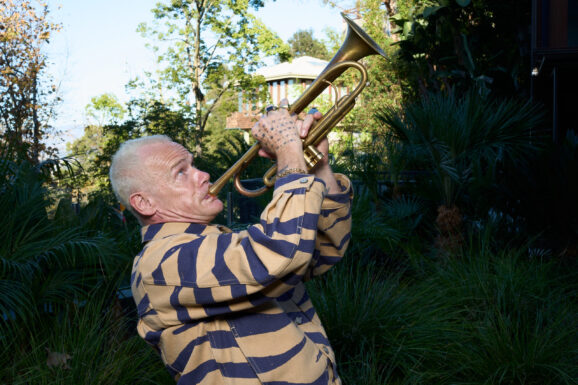
“The Alice Cooper exhibit has been a popular highlight for many years,” Rich Walter, Senior Curator and Curator for the US/Canada galleries, told me, “with authentic instruments, stage wardrobe and props and other personal artifacts illustrating the Phoenix roots of [his] amazing career.” Cooper, born Vincent Furnier and a 1966 graduate of Phoenix’s Cortez High School, has made this area his family home since the mid-1980’s. But even back in his teenage years, Alice Cooper was Alice Cooper.
Alice Cooper Band bass player Dennis Dunaway once told me a story about a 1964 Halloween gig he did with Cooper when both were in high school together: “We had a guillotine that worked. It wasn’t very big, though. It was about seven feet tall, as I recall, and then Alice and I put spider webs we made out of white clothesline, and Alice and I made cardboard coffins and painted them to look like wood,” he said during the 2013 interview for Glide. “We had a couple of coffins on stage, but one of them had this guy inside who was dressed up like a ghoul with the dark make-up like Alice eventually wore. And he was like a ghoul, and we had tombstones on stage. Alice and I were very active artists, so we put this all together. Between songs, the ghoul would come out of the coffin, and then he would do something funny to keep the audience entertained while we decided what song we were going to do. We didn’t know what a setlist was yet, I guess (laughs)”. Continued Dunaway about those very early performances, “We used anything that wasn’t nailed down in the show. We’d take our grandmas’ teeth out if we thought it’d work in the show (laughs).”
“Our school tour groups always get excited to see the infamous severed head prop that has been part of Cooper’s stage act for decades,” Walter added.
ROCK & BLUES & JAZZ & POP & COUNTRY & …
“Throughout the museum, we have personal instruments from some of the most influential and well-known artists in the history of rock, jazz, country, blues, and other major genres,” explained Walter, who has been with the museum for eleven years. Just a fraction of the musical memorabilia you can see includes: Prince’s purple piano he played onstage in the 1990’s, some Elvis Presley guitars, drums from Aerosmith’s Joey Kramer and Def Leppard’s Rick Allen, guitars played by Sister Rosetta Tharpe, Waylon Jennings, and George Benson, and sitars played by Ravi Shankar. Other artists represented include Madonna, Carlos Santana, Earl Scruggs, Buddy Holly and ZZ Top’s Dusty Hill.
NOT JUST FOR THE KIDS
In the Experience Gallery, children and adults can get their hands on and play instruments from around the world, such as African drums, a theremin, a Peruvian harp and much more.
And in the Mechanical Music Gallery, there is one thing that really gets the kids’ attention, according to Communications Manager Sydney Rich: “Standing over eleven feet tall and twenty-five feet wide, this two-ton orchestrion from 1926, built in Antwerp, Belgium, is the largest instrument in our entire collection. Every day at noon and 3 pm, one of our volunteer team members leads guests through a demonstration of the orchestrion, nicknamed Apollonia. During these performances, the gallery comes alive as nearly 700 organ pipes, two accordions and a full drum kit play in perfect synchronization. Apollonia historically read music using punched paper books, much like early computer code; we now utilize a modern MIDI system. This allows us to maintain a library of more than 300 songs for guests to have a chance to hear during their visit.”
FOR THE COMMUNITY
As with most museums, the MIM has outreach and special programs for people in the Phoenix area and beyond. According to Dredia, who has been with the museum for fifteen years, “We have children’s classes, student field trips, adult workshops and lectures, teacher trainings, senior programs, and more. At least once a month, we hold large-scale public programs called Signature Events that highlight diverse musical cultures and genres through performances, workshops, scholar talks, and other activities. Of course, we also have the wonderful MIM Music Theater, which connects audiences to live programming from local, national and international artists.”
There is also a program called the Memory Care & Music Series, which was developed, explained Dredia, “in collaboration with music therapists and experts in the field who understand the cognitive and social benefits that come from music and music making for those living with memory loss. The sessions pair a gallery tour with a participatory music-making session led by a music therapist or a trained facilitator. These sessions are currently offered monthly, and the session themes rotate to allow for exploration of different galleries and different types of music making on each visit.”
THE VENUE
Tucked inside the larger museum complex, the MIM Music Theater is an intimate, acoustically pristine space that seats just under 300 people. There’s not a bad seat in the house. Sightlines are clean, the sound is warm and detailed, and the room is tuned for listening—not yelling over clinking glasses or fighting a boomy PA. It’s the kind of place where subtle fingerpicking, hushed vocals, and dynamic shifts actually matter.
VISITING
The museum is open daily from 9 am to 5pm, except on major holidays like Christmas and Thanksgiving. Admission runs from $20 to $10 and they do have free parking onsite. Photography and video is allowed, no flash though, for personal use. The gift shop features souvenirs alongside handcrafted instruments, and the Café Allegro offers a scrumptious and diverse menu for those looking for a bite to eat.
The museum is currently hosting a special exhibition titled The Magical Flute: Beauty, Enchantment & Power. It runs through September 13th.
Upcoming concerts in their musical theater include Smokey Robinson on March 18 and 19, the all-woman Spanish group, Maruja Limon, on March 23, Lisa Fischer on April 8, and Peter Noone on April 18 and 19. Seating is limited, so check the website for availability and upcoming shows.
MUSICIANS & THEIR INSTRUMENTS
Over the years, I have spoken with many artists about their chosen musical instruments, from their high school days in bands to their glory years as successful musicians. Below are a few quotes from those interviews.
Cindy Blackman Santana on the drums – I’ve only been to South Africa, but the drum, obviously, is revered in the motherland. We get our rhythms and our rhythmic concepts from there and we take those rhythms and we play them between our four limbs and between the rest of the sounds. So we can get four different sounds, playing four different parts with four limbs but then we can break that up and have more parts playing because you can move your limbs around, especially your hands, you can move them around; you can move your feet around too and drummers do that very well. So Africa certainly reveres the drum.
Jake Shimabukuru on the ukulele – When I was maybe like eleven or twelve years old. That’s when I started being a little bit more experimental because prior to that, I was always playing traditional Hawaiian music. And I’ll never forget the first time I saw a video of Eddie Van Halen playing, and I remember thinking, that is so cool! It was so high energy, and they were running all over the stage, and I remember thinking to myself, that’s what a ukulele concert should be like (laughs). Cause prior to that, like whenever I’d see a ukulele concert, people would just either sit in a chair and strum and play, or be standing and playing. But I always thought, no, it should be more physical, like a sport! (laughs) And that’s when I started really kind of branching out and experimenting with different sounds, and I started using electric guitar pedals and things like that.
Mickey Raphael (Willie Nelson Band) on the harmonica – What surprised me the most is when I finally started figuring out that there is a method to the madness, a way to get around the notes and play. It’s just such a personal instrument and it’s not something you can look at like the guitar where you can look down at your fingers and watch the notes. It’s something that you play by feel and you have to hear the notes. You have no idea where you are, what note you’re playing, until you hear it. So you kind of have to have command of the instrument.
Myles Kennedy (Alter Bridge/Slash) on the lap steel guitar – It’s funny, that instrument is all over this record and I’d never played it before. I’d never really sat down and messed with one. Elvis [Baskette, producer] bought one cause he thought it would be cool to put one on this record [Year Of The Tiger] so I put it on my lap and started messing around and it felt like I had been playing it forever. It felt very natural and it was just a very haunting and expressive instrument. I really, really enjoyed utilizing that on this record and hopefully I’ll be able to grow and learn how to play it more in the future and it’ll become kind of part of my sound going forth. I just fell in love with it.
Robby Krieger (The Doors) on the trumpet – You know what I really wanted to do was be the kid that played the trumpet for Reveille in the mornings at school but this other kid got the job and I was never quite as good so I gave up on that.
Steve Hackett (Genesis) on World Music Instruments – Although I play guitar, I do tend to think of the wider picture and love the combination of guitar and orchestra, for instance. You know some of the most wonderful classical music I’ve heard – evocative, really truly moving stuff that I’ve heard – is Russian composers where you get piano but you’ve got these sweeping vistas of great orchestral things as well between the two, so it’s a bit like God and man, really. I think that was what was going through my head. So yeah, we have a few things on this. We have the duduk from Armenia and we have the tar from Azerbaijan on the same track; people who were at war with each other. They didn’t know they were going to be on the same track together because I’d gathered together the performances separately but it was just ironic that these two nations were blasting the hell out of each other and meanwhile we had this piece of music. So music is reaching places that politics fail to reach.
Warren Haynes on the slide – I started playing slide at a really early age. I would say maybe fourteen or fifteen. At that time I had a Gibson SG guitar. I first started playing it in standard tuning because I didn’t realize that some people tuned their guitars to a different tuning, like open E or open G, to play slide. Then once I discovered that, I started using the open tuning but I went back to playing mostly in standard tuning eventually because I felt like it gave me more of my own voice, since most people played it in open tunings. It allowed me to kind of express myself a little bit differently and not have to think about playing traditionally inside a certain tuning.
Mark Mullins (Bonerama) on the trombone – I did trombone in the band and then I tried playing guitar after and I sucked and I couldn’t do it. I got so frustrated, I said, I’m going to make it work on the trombone. Give me some pedals and I’ll figure out how to do this on trombone. I wish I could play guitar. I’m so influenced by so many guitar players and it’s such a fun instrument but at the same time trombone was like a less-competitive instrument. When I went to school to play trombone, my brother said, “Play trombone in the band because you’ll be first chair right away cause nobody plays trombone. You’ll be the only one.” And he was right and I was like, wow, nobody wants to play this instrument, what’s up with that? (laughs). That was a long, long time ago before Trombone Shorty made it cool or we did what we tried to do to make it cool. There weren’t too many good things going on for the trombone at that time.
Vivian Campbell (Def Leppard) on the guitar – Well, when you’re first learning to play it’s always a technical challenge. That’s the hurdle you’re overcoming and that just takes years, literally thousands of hours of playing to where that becomes second nature. But it’s phase one of learning to play guitar. Phase two is finding your own voice and that’s the more difficult thing. That takes a lot longer and takes a lot more experience to recognize it and be comfortable with it. I was always very frustrated in my early years, my early twenties. I was never happy with the way I played guitar. Now, I am very content with the way I play guitar. But nothing has really changed. I don’t play that different to how I did back then. The difference is that now I recognize it and am more comfortable with it, you know. You kind of grow into your own skin and I grew into my own guitar style and I learned how to embrace it. Sometimes it’s our limitations that define our style. My limitations as a guitar player frustrated me immensely when I was in my twenties but now I realize in recent years that it’s my limitations that actually helped shape my style and makes me who I am. So I embrace that.
Jerry Douglas on the dobro – It’s got such a soulful sound in the right hands. It can be a torturous thing in the wrong hands. I’ve met many people who go, “You’re the reason I play dobro.” And I look at their wife and I say, “I’m sorry.” And they’ll go, “No, no, no, he’s allowed in the house with it now.” (laughs). But it is one of the instruments that is closest to the human voice, just in the emotional parameters that you can go to, vibrato and loud/quiet, all the different ways you can play and emulate the human voice.
Nancy Wilson (Heart) on the mandocello – The mandocello is actually a really gorgeous sound. The one I have is by Ovation and it’s one of my great go-to’s, one of those sounds that really belongs in a romantic song. It’s just part of the landscape in a song so it normally doesn’t stick out too obviously but it’s just a pretty sparkle that goes into a song.
Chris Brooks (Like A Storm) on the didgeridoo – We kind of found playing the didgeridoo at the start of the set was the fastest way to get everybody to stop talking and just watch the stage. It’s such a unique sound, a hypnotic sound, a dark sound, and that’s what drew me to the instrument. It was unlike anything I’d ever heard. So then we kind of started incorporating it in that way and then on our first record we made that as an intro to the album when we played live.
THE ULTIMATE SATISFACTION
“The goal of the Musical Instrument Museum is to illuminate what is unique about cultures, and also what is shared and universal,” founder Robert Ulrich states on the museum’s website.
But it truly is a whole lot more personal than that. “Maybe a field trip student gets excited about the science of music, or a guest makes a connection to an exhibit showcasing their cultural heritage, or someone is blown away by their favorite artist performing in the MIM Music Theater,” Dredia suggests. “But the ability to resonate with people in so many different ways is one of the reasons music is such a remarkable art form. Music connects us all!”
WEBSITE
WHAT YOU CAN DO FOR US
If you have been to the MIM, go to Glide’s social media pages & in the comments to this article’s link, post a photo of yourself at the museum. Be sure to tag Glide and the museum. We want to see you!
Photographs courtesy of the Musical Instrument Museum; photo of Alice Cooper by Leslie Michele Derrough