Throughout his decades-long career, Shabaka has proven to be a vital organ in contemporary jazz, pushing the boundaries of the genre without force by simply trusting his vision and seeing it through. From his time spent with bands like Sons of Kemet, to the way he manipulated his saxophone, all the way to the moment he laid the brass down to pick up the flute, there is an immense amount of pressurized risk in every move he makes. Yet, the water never boils over the lip of the pot. Rather, Shabaka maintains an air of mystique that allows his work to thrive and flourish without borders, presenting as effortless despite the amount of courage put into every second of releases like 2024’s Percive Its Beauty, Acknowledge Its Grace.
After dominating the jazz world within the safety of his bands, even though those albums are as daring as they come, Shabaka took an even bigger leap when he decided to enter the solo chapter of his career. This chapter was a moment of self-analysis, a chance for the artist to define himself and build his own worlds, rather than lending his sprawling prowess to the progression of jazz as a whole. The results of this difficult process can be found on Of The Earth, the entirely self-produced twelve-song LP that acts as another reinvention for Shabaka.
Of The Earth redefines what it means for an artist to be vulnerable in their songs. By single-handedly working on every moment you hear throughout this tracklist, up until the mastering, these songs act as a window in the creative headspace Shabaka currently occupies. These songs were created on the road, with nothing but a man, his instruments, and an iPad, but that is far from the obvious narrative on Of The Earth. This is the moment Shabaka proves to be more than a forward-thinking saxophonist, but a full-blow multi-instrumentalist and producer hellbent on creating something that can’t be compared.
Moments like the blissful “Those of the Sky,” with its subtle Hip-hop flavor, are quickly juxtaposed by the spiritual jazz of “Marwa The Mountain,” with its blaring brass and unapologetic syncopation. “Light the Way” is an ambient, electro-jazz meditation that evokes the calm the artist must feel as he pours his soul into his beloved flutes. At the same time, “Step Lightly” toes the line between modern tropes and Shabaka’s newly found, signature production style. We also get to hear the world debut of the artist’s vocal stylings, with Shabaka delivering thought-provoking Hip-hop on highlights like “Eyes Lowered” and “Go Astry,” adding yet another sonic element to his ever-evolving artistry.
Of The Earth is not a jazz album; it is a Shabaka album, something that can’t be taken away from the artist, because it is wholeheartedly him.
Glide recently hopped on a Zoom call with Shabaka for a detailed conversation about Of The Earth, the process of finding yourself over and over, and growing as both a person and artist. You can read our full conversation below. Of The Earth arrives on March 6.
It’s officially release week for your new solo album, Of This Earth. How are you feeling now that the album is about to be out of your hands? Do you find that there is a sense of relief when you release music, or are you already thinking about the next project?
There is that sense of relief that I can get onto the next project, because all of the ends have been tied up in this thing that I’ve been working on for so long. I’ve got multiple things in my general orbit, and as deadlines come into focus, then I‘ll gather material for a particular project or album. But that means that I’ve constantly got things that aren’t taking the most importance because I’m dealing with, for instance, an album release.
So once the album is actually out, even with the live element coming, I can let my headspace be in the music coming up in the future.
With all these projects, is it a matter of compartmentalization, or simply a case of inspiration striking?
I wouldn’t say so; much of the inspiration is just perseverance. The difference in how I dealt with this album was that it would obviously just be me. I kept adjusting, editing, and reviewing the material to see what worked for breaks and buildups. So it wasn’t so much that I had any particular moment that was like, “Oh, I had this amazing breakthrough session, and I got down a miraculous solo.” It was more just many, many late nights or early mornings, just chipping away at material.
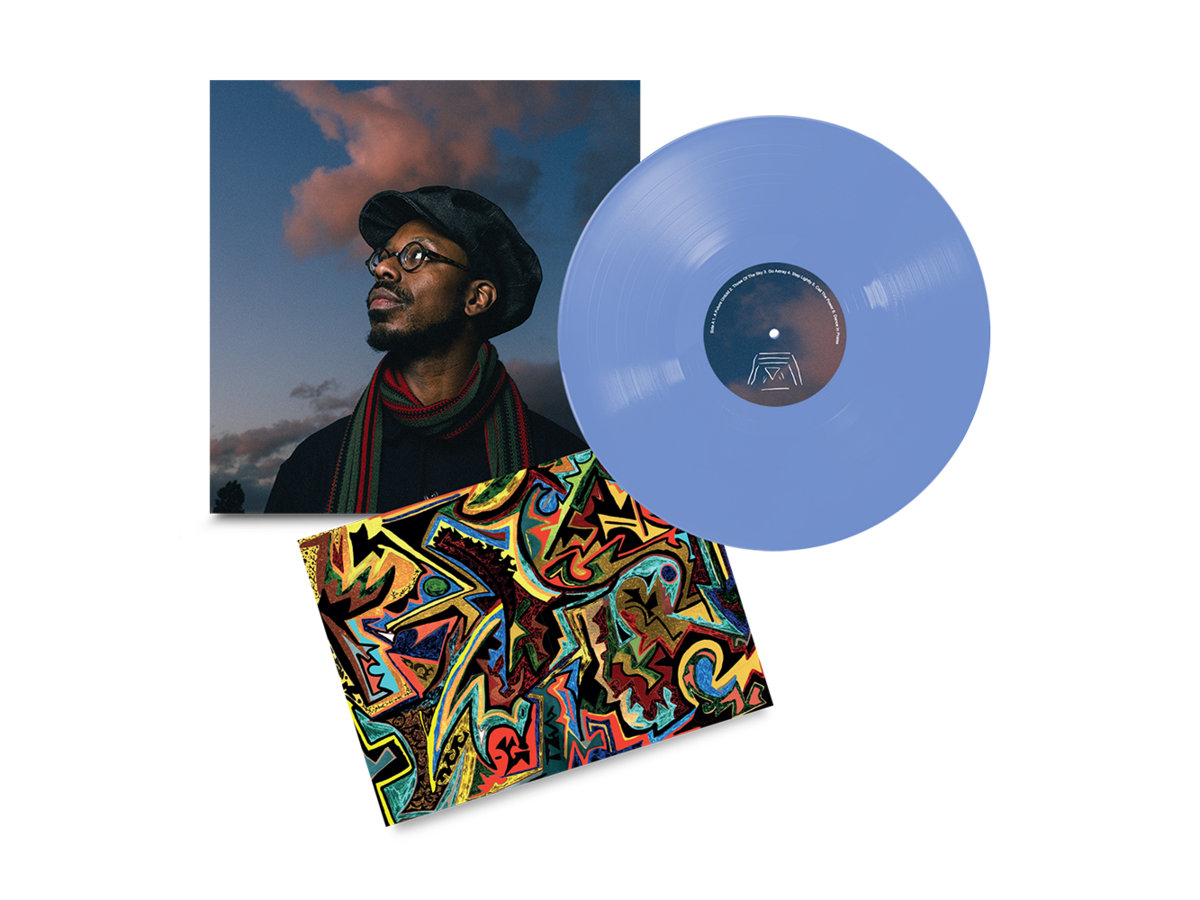
Of The Earth is an entirely self-produced effort. Does that add a level of vulnerability to the release?
When I realized I wanted to just do it all myself up until the mastering process, I told myself [Of The Earth] wasn’t going to be a particularly big release. There are no music videos for it. There’s not a big campaign in terms of a massive machine that’s getting a slick product because, actually, I’m just tired of it. I don’t like when I see people, and they’ve got this avatar that immerses itself within them, just for this album period, and all of a sudden, it gets shined up, and they’re glossy, you can see the money dripping off of them.
Since I’m doing this album through Shabaka Records, it’s just a lower profile. It’s just me making songs and beats for myself that I’ve decided, actually, at this point in my artistic trajectory, I’d like to just work on them, chip away at them, and share them with the world. It wasn’t like I was “This is the thing that me and the guys made, it’s something amazing, and it’s going to be the thing that changes everything. It’s me showing the world what I’ve made. Obviously, you do interviews, and as the release date approaches, it becomes more real. As in, it’s a recording just as every other recording is a recording, but I think that’s more of a defense mechanism. I just acted as if it was going to be a small thing that slides under the radar.
This is your first release on Shabaka Records. What inspired you to start putting out your own records, and what sort of freedoms does this open up for future albums?
Yeah, just the ability to have freedom to release what I want without really having to explain or justify it to anyone. Not that I was in any way inhibited by Impulse Records with that contract, but all major label contracts are imbalanced in terms of the amount that they take from the artist in relation to the amount the artist gets back. Actually, the imbalance might make sense for a particular point in an artist’s career, in that what I got from Impulse was invaluable in terms of that association and the leverage that was able to give me at that point. At some stage, you’ve got to look at the pure numbers, the overall situation that you’re in in relation to any big organization like that. I was thinking, “Is it actually worth it?” because the amount that they take from your royalties is not really equivalent to your hand in the music.
So was it a matter of your contract with Impulse ending?
The contract ended, and I had multiple options. One could be to continue with Impulse, but I looked at all my options in the cold, hard light of day and decided that this was the one that made the most sense on a business level. And on an artistic level, and on a level of inspiration in that, we’ve got to have musicians that are a generation removed from the ones coming up, that there are more roots in the whole music industry than just getting the biggest contract you can find, signing it, and having a great post on social media. There are many options where you’ve got to explore and think about what’s best, what’s the best one for where you’re at in particular.
Not to say that you shouldn’t go with a big label, or that I had a bad time on a big label. I had a great time on Impulse, but it just made more sense at this particular point to go independent.
A lot of this new album was made while you were traveling. What sort of restrictions did that come with, and did those restrictions shape Of The Earth?
I guess it comes with restrictions, but all restrictions can be freedoms, depending on how you turn them to yourself. I guess one of the restrictions is that I decided it was going to be DIY in terms of the sound, just the basic sound of it. The majority of the flutes and instruments were done with a microphone, into an audio interface, and into GarageBand on my iPad. And to get rid of the nakedness of that scenario, in terms of having to record in different acoustic spaces that aren’t studios, I stacked up all the flutes. I realized that actually, if every single flute you hear is played in unison five times, then it makes that basic flute sound a lot less noticeably of different spaces.
The first couple of times I started recording, I could tell the difference in where I recorded. You could hear the sound of the toilet in my mom’s house, or the sound of a hotel room with carpets everywhere. But then, as soon as I started layering up flutes because of that restriction, there was a different vibe and energy. Obviously, I recorded in a different way because if you know you’re going to have to layer up parts, you have to become really sharp and understand how you’re playing that initial line.
When you’re traveling, one of the things that happens is that you’re able to assess the material that you’re dealing with in quite a deep way. One of my favorite things to do is work on something, be it a beat or just any piece of music, and then have a situation intersect between that point of creating and the point when I listen with fresh ears and edit. The best thing is to have some time in an airport lobby, work on some stuff, go up in the air, fall asleep, and land back down. Maybe in the car ride to the hotel or wherever I’m going, re-listen to the material, and I always get this great, fresh perspective from just being in a completely different scenario or environment. That attitude is over the whole album, just assess things, not from chipping away at them night after night in the same space. I was able to get fresh energy.
Of The Earth is your first album with your own vocals on it. Why did this album feel like the right time to debut your vocal stylings?
I got a friend, Confucius MC, with whom I’ve recorded and produced albums for Native Rebel Recordings. He’s always told me, “You’ve got to rap. You’re into Hip-hop, you’ve got a great voice in terms of speaking on the mic.” So, it’s been a thing. We have this joke about André 3000 going to the flute and me going to rapping, just a wild turn of events. And then all of a sudden, I was in the process of making these beats, and I went, “I’m doing all this stuff, why don’t I just rap on it?” If you see the voice as an instrument and the words you say are just the ideas you think, it’s pretty straightforward as long as you understand the principles of projection and you’re not shy to do it in front of people or in a recording scenario.
It became a challenge of trying to go around, day to day, writing down in a little notebook things that I felt and ideas that came into my head while the beats were just playing around and around. I tried just to be free with it. I tried not to go like, “Oh, I’m going to do the art of rap” or “I’m going to try to fulfill some preexisting notion of what a rapper should be. I’m just getting my thoughts on the paper, and then I’ll mumble cadences. Sometimes it would be in voice notes, other times just to myself, and then put it all together and practice.
Was this your first attempt at writing raps?
Yeah. Years ago, I used to write poetry and go to poetry slams. It was nothing like rap, though. This was the first time doing it, and I learned a lot from it in terms of having a massive respect for the actual vocal and projection technique of rappers, being able to actually know the words so much that you’re able just to recite them and get this meaning and emotion, getting to the heart of every word that you enunciate.
You hear rap, and you nod your head and go, “That’s a great rhyme,” but until you actually try to do it yourself from the point of not having done it before, you can’t really appreciate how much technique and skill go into it. At least, I found I didn’t fully appreciate how much skill there was in the art of rapping.
I wanted to ask about your exploration of the flute. What were some of your biggest takeaways from those years you were really studying the instrument?
The biggest takeaway from all of the time I’ve spent on the flute combined is that the instrument’s voice is you. It’s almost like you’ve got different types of megaphones at your disposal, each of them sounds completely different; they’ve got a different type of delay or crunch to them. Your job is to get to articulate your faults in a way that people can understand that it’s you. They can recognize you. So it’s about how you mold yourself into the instrument.
Sometimes, playing a traditional Western instrument that’s tempered is in a particular temperament, you can just blow and move your fingers and think about the person that you admire the most on the instrument. Playing all these different flutes, it really takes that away, because there’s only one of each instrument. It’s not like a production line of bamboo flutes; even if there is one, they’re not going to be the same because every piece of wood is different. It means you actually have to take the time to understand the particular instrument and your voice in relation to it. I think that whole period of time has brought me closer to the recording process in terms of being very particular about the sound of my flute recordings. Not that I’ve got it together completely, I’m just more aware and discerning about the particularities of my sound than I was before.
With the sax, you can blow really hard, you can get a lot of air through the instrument, and just get a lot of sound being produced. So the very small particularities can be lost, not saying that they are necessarily with everyone. Still, I find the more intense I play with the sax, the less I’m focused on the small sensibilities of the instrument. Whereas with the flute, you can’t let go of those small sensibilities because you’re so close to the root of the resonance of the instrument.
Would you say Of The Earth is your return to the saxophone? What was it like picking the instrument back up after so much time?
I wouldn’t call it my return to the sax, because that makes it feel like I’m making this ground-shaking proclamation that changes the course of how people see the instrument in popular culture. I don’t think I’m doing that on the album, but I think I’m redefining myself on the album with the sax as a multi-instrumentalist. It’s kind of seeing my vision of the saxophone as an orchestration device, something that can produce a particular sound that works in a particular context. That’s what I’ve been wanting for a while, even though I hadn’t necessarily articulated it to myself like that. I’ve wanted to break out of this hole of, “Yeah, Shabaka, that’s the saxophone player from these groups or albums.”
I wanted to be regarded as an artist, a musician, or a multi-instrumentalist, but not aligned with a particular instrument or style of playing.
You mentioned groups, and a lot of your earlier material thrived on collaboration. What is it like putting all of that trust in yourself on this self-produced LP?
It’s terrifying, because actually, what it means to be a band player is that I can focus on my role in the proceedings. I can give all my attention to one thing: listening to what’s happening around me, understanding that whatever I do will change it for the better. Relaxing into just making great music, whereas all of a sudden, if you’re by yourself, you can listen to what’s happening around you, but then you also have to have a part of your brain detached so that you can think about what goes next to create the forward motion of interest.
There is an element where you can’t completely relax and let go, like I was in the bands, because I had to be focused on pressing the button for the next thing or focused on moving the knob, keeping everything in gear. That’s just experience; the more you are in that solo setting, the more you’re comfortable letting go and being free within it.
I don’t see this as the end of my collaborative life, though. Life is long, just in general. I think that the only way to make a valid contribution to the communal setting is, at some point, to go away and understand who you are as an individual; otherwise, you come to the table with compromise built into the equation. Now I know a lot more about my artistic temperament. I understand who I am, what I’m drawn to. I’ve had a long period of being able to examine that in detail. So that means the next time I go into a long-term collaborative project, I’ll be able to bring more of myself because I understand who I am and what I want to bring.
It was just last year that you mentioned in an interview that you “see yourself as a producer.” Did the process of producing Of The Earth change your perception of a producer’s role in creativity? What was it like being both the producer and musician for these sessions?
It’s a strange one because it’s both things altogether. You’ve got to split your thinking. If you’re just the artist and not the producer, all you can do is singularly focus on one thing, which is making the best rendition in the moment, and being completely present. Whereas the producer is the person who doesn’t live in the moment, that’s constantly thinking about the future, like “What does this moment mean in relation to the whole album? What does it mean in relation to what’s coming after it?” A producer has to think about things like “That was a good take, but where was the mic in relation to the intensity?” If you’re doing all those processes, as the producer and the artist, the solo performance is an element that you can’t let go of. You’ve always got to be assessing why you’re doing what you’re doing, and what does it mean in terms of the work that you’ve got to do in the future, because you can’t just go home and let someone else deal with the results of what you’ve done in the studio.
For instance, my file management isn’t the greatest. It’s okay, it’s not completely bad, but I don’t have a really tight system for dealing with all the music that I come up with on a day-to-day level. So it means that there are some lessons I’ve learned in terms of taking every single piece of music that I create seriously, and putting it in the right folder, labeling it properly, really being tight on all of that stuff. If I’m using a sample, note down where it came from and where I used it so I don’t have to search for it in the future. Stuff like that, you start to think about more consciously.
So how many songs were made for this album? How did you narrow it down to the twelve that made the final tracklist?
I went through two different phases of Dropbox folders of tunes before I came to the album. The first one probably had about 25 tunes, the second had about 17 or something like that. There were actually two other tunes that were going to make upOf The Earth, but I didn’t want a double vinyl; I wanted a single vinyl. So I kind of cut those tunes out. Actually, I was at a festival hanging out with Fatboi Sharif, asking him about album lengths. He was like, “Look, Hip-hop guys have a whole different approach. They’re just releasing albums and then making more albums. Instead of making an album that’s an hour long, just make the album half an hour, and release two albums.”
I was going to say I was being a bit too “Jazz” about it, but actually, if you look at the jazz records that are classics like Kind of Blue and Love Supreme, they’re all really short records. I guess it might be the technology at the time, but I just wanted it [Of The Earth] to be less sprawling. I think, in general, I like coherence, so I go towards stripping back.
Of The Earth is incredibly cohesive, considering how many different spaces you recorded in. How did you achieve this consistency?
For me, getting material, the actual music itself, is one thing, but the actual album is made when you get the tracklist. The tracklist is the album; sequencing is everything. Anyone can have bits of music that are randomly placed together, alphabetically or whatever. An album is what happens emotionally when you go from one piece of music to another, on a micro-level, on a macro-level; it’s what happens during that journey from the opening note to the closing one. That’s what is most important to me. For all my albums, it’s really important, that’s the thing. What comes next?
What I’ll do, in general, is I’ll finish the tunes I’m making, and I’ll just have them in a folder, and just keep editing the running order. I’ll listen to the album in its entirety, like tons, just to see how I feel in different scenarios with the kind of break from one tune to another. This album, I think, is the most not-radical necessarily at an abrasive rate, but I think that I’ve achieved a kind of disruption in terms of the flow of the album that I like. I like albums where you don’t necessarily, as it guides you towards the end, but it’s not on a route that’s obvious. I feel like this is the album that I’m most happy with, the guided route through the tunes.
Given how important the cohesiveness of your albums is, how do you select lead singles?
I actually opened up to the broader team that was working with me on the album. I trust my ears when it comes to making music, but I think it’s important to actually trust other people’s ears in terms of how they hear it. I opened it up, and a few different people said that “Marwa The Mountain” really stuck out. So then I started to think about it. Originally, I wouldn’t have made that choice for a single, but since someone mentioned it, I was like, “Actually, that is an oddball suggestion.” I let it sit with me, and I was like, “Yeah, that’s the one.” Then I wanted to have something that reflected the opening, the blossoming out of the album, so that made “A Future Untold” an obvious choice.
It’s a tough one with singles, because you’re considering the impression that people have of you and the album way before the album comes out. I didn’t want people to have a fixed view of the album, like people going, “Okay, I get what this is about.” If we just released “A Future Untold,” I wouldn’t want people to think I’ve made an ambient album. It was a process of not necessarily guessing what people are thinking, but considering all the angles of what happens when music is released to the public before the whole body of work is released.
How long did it take to go through those Dropbox folders of recorded material and sequence your selections for Of The Earth?
I probably say it was about six months. It was actually the end of 2024 when I was touring Europe with a band that had two harps, a synthesizer, and me on flute. We were doing the music from Perceive Its Beauty, Acknowledge Its Grace, and the whole idea was, do I go into the studio and record with that ensemble that I’ve been doing this tour with? And I was close to doing it, but then I sat down, and I thought, “This is great, it’s reflective of the continuation of the narrative of what I’ve been doing this year. But I was working on stuff all Summer, and where does that leave those songs?” If the band is the focus, the element of the production side, and I didn’t even have an album at this point, it was just beats, but I thought, “Do I want this to be a side project, or do I just want to inject it into the public?”
Similarly, in terms of the way I went with the flutes, I just went all in. It’s going to be a risk from this point. I decided to align myself with the beats that I’m making, not the music I’m more proficient in, in terms of a collaboration. That’s what music is about: it’s about taking the risk and just going.
One of the things that I think helped me through the process was, you know, punk as an aesthetic is a thing. Even if I’m making this music, the beat is made on a portable device, and the sound isn’t as it should be, it’s completely fine. Records are all sides of the spectrum, and it’s not like the classic record is the one that’s made in the best and most expensive studio. It’s the thing that conveys some kind of message and integrity that shows what the times are. At this point, I’m just going to do the thing, just make some music and put it out. I had faith that whatever I did, the mastering process would be really important. I worked on it myself up until the mastering, and then that process blossomed everything out.
You have some live shows in the States coming up. What is it like traveling to another country to perform your music? Is there a particular song on the new album you’re excited to have people hear live?
I’m excited to hear how people hear “Marwa The Mountain” live, mainly for the fact that I want to hear that tune through a PA system. I mixed everything through headphones and listened back on little AirPods, just to see if I could make it sound good in those. So it’s a pleasure whenever I hear the music through good speaker systems, it’s fantastic, I love it.
Have you ever rapped live before? What has it been like incorporating the vocals into your live performances?
I forced myself to insert it into the set over the last year. It’s a learning experience, it really is. Mainly, just the tone of voice that I’m rapping in, it’s something very specific, it’s not natural. When I get the mic and I’m saying my thing, my tone of voice has to oscillate between what I’m imagining, what I want in relation to the song, and what I’m technically able to do in terms of vocal ability. There’s this constant awareness of having to mold the sound in my head, but I also have to be conscious of the limits of my own technical fallibility.
You seem to keep the listener very much in mind throughout your creative process. What do you hope people take away from Of The Earth?
In the broadest sense, in terms of someone who is following the story of my career, I’d like them to take away the fact that you can actually do whatever you want. On a personal level, that’s the most important thing for me, because literally, at the start of the pandemic, I didn’t even own a microphone. I had no experience in any aspect of music production whatsoever, and I’m not a fast learner. It’s been a slow process of grinding, going on YouTube, looking for tutorials, watching them multiple times, scratching my head, checking Reddit forums, just listening, and thinking, “Do I like this, or do I not?” Making mistakes and just figuring out how not to do the same thing over and over.
Obviously, the album has meaning in itself, and the meaning of the music, and how the music makes you feel, and the lyrics, and all that stuff. That’s all great to me; that’s the thing that I channel. When I shut my eyes and let the music flow out of me, that’s what comes out. But on another level, what is more pertinent in my mind at the moment is the actual work that it took to take an idea, something that’s abstract, like, “I am going to make an album out of these beats. It doesn’t exist; all there is are bits of music.” It’s the thing of having an idea and slowly making it a reality, and at the end, having something that can be played on the radio next to a tune that was produced and mixed by a trained professional.
When I first told my managers that I was going to do this album, they were like, “Are you sure you’re going to be able to play this in clubs and on the radio? There are things that mixing engineers do that equalize the sound to make it appropriate for particular systems.” I was thinking, maybe there is, but at some point I thought, maybe there isn’t, actually. Maybe if I hear it and I think it sounds good, then it’s fine. Maybe all the equipment makes things more intricate and particular, but actually, there’s a basic level of just music in terms of having an EQ you can put on anything.
What you do with whatever tools are at your disposal is down to your creativity, and if you see creativity as how you use the tools, as opposed to creativity being the tools, then it means that you really don’t need anything. All you need is musical material and a creative mind, and then you can make whatever you want.