Psychobilly legends The Quakes have cemented a long-standing place in the subgenre, being one of the early American influences of the psychobilly scene in the 40 years since the band’s founding in 1986.
Formed in Buffalo, New York, by frontman Paul Roman (guitar/vocals), Rob Peltier (upright slap bass), and Dave “The Ace” Hoy (drums), The Quakes quickly found that they would have better luck as exports to London. As many counterculture subgenres and art forms often do, the band discovered a more eager audience abroad, away from the confines of top-40 radio stateside. They eventually found an audience in Europe during the second wave of psychobilly alongside European contemporaries such as Demented Are Go and Mad Sin.
Following in the footsteps of first-wave psychobilly influencers and pioneers such as The Cramps and The Meteors, The Quakes quickly traded their original concept of a neo-rockabilly sound and aesthetic for the hardcore punk-influenced psychobilly. The genre has its roots in 1950s rockabilly, with a hardcore punk rock edge, retaining the twangy riffs and melodies of rockabilly and surf guitar, while the tempo, volume, and distortion are dialed up to match punk intensity. The driving beat of the standup slap bass was a perfect inclusion into the high-energy music style, rounding out the sound, look, and feel that is synonymous with the genre.
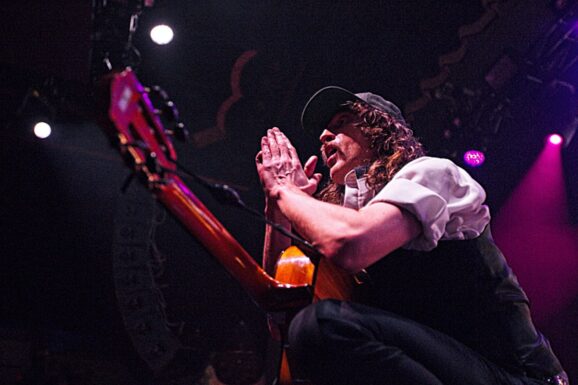
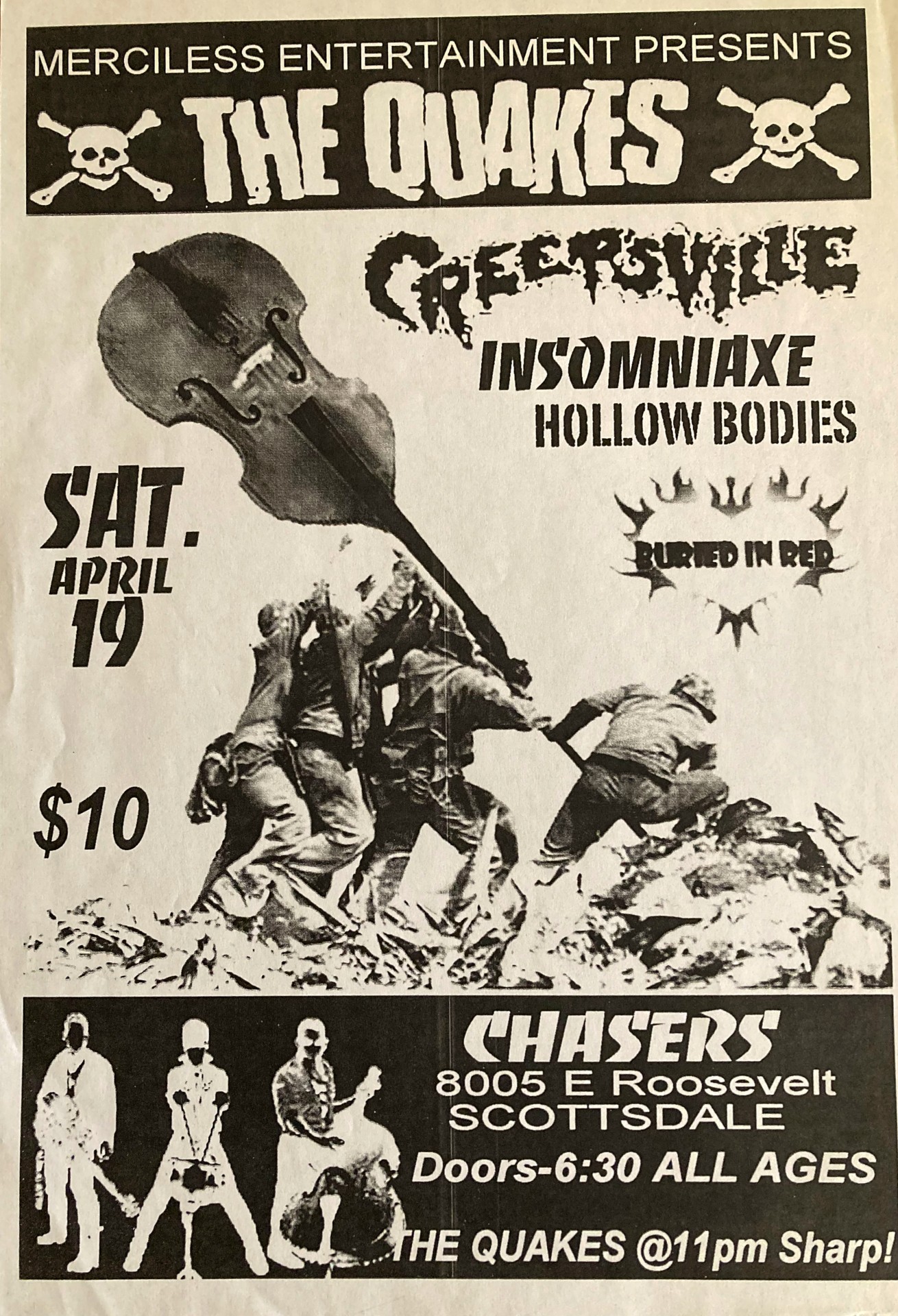
In 2008, I had the honor of opening for The Quakes while I was playing lead guitar for a psychobilly band called the Insomniaxe (pictured). We were so thrilled that we drove from Denver to Scottsdale, Ariz. solely to have the opportunity to be billed with the legendary act. It was one of the most memorable nights I’d had playing in a band, and the audience was insanely high-energy in anticipation of The Quakes. I recall the mosh pit during our performance getting so large that it stretched to the merch booths. When I reached out to Roman via email about an interview, he remembered the performance and even dug up the flier from that night.
With no tour currently on the books, The Quakes will head to Denver to play HQ on May 29 with Southern Colorado band The Dead End.
I talked to Roman about the 40-year history of The Quakes as well as the past, present and future of the psychobilly scene.
Congrats on the 40th anniversary of The Quakes! That’s an amazing milestone. When you think back to Buffalo in 1986, did you ever imagine The Quakes would still be active four decades later—let alone touring internationally?
We certainly had aspirations of touring internationally. If anything, we knew that the scene was not in the USA, and we would have to leave.
I know you guys started with a more neo-rockabilly sound. How did that eventually evolve into psychobilly? Was psychobilly a new interest for you at the time, and a natural transition?
It devolved into psychobilly (tongue-in-cheek). Months before The Quakes started, we had a band called The Quiffs, and songs like “You’re dead” were in the set list. I had been to London in the summer of 1985 for three months, trying to start a band. I did not know what psychobilly was, but I already owned some. Restless’s second album (which I bought there) had some psychobilly on it, and a friend there had bought the first album by The Guana Batz. It was not what I initially wanted to do, but I was starting to become aware of it.
At the start of The Quakes, we were probably more like what would become the style on “Voice of America.” In fact, some of the songs were in the set, like“One of a Kind.” We were playing around Buffalo and having a hard time getting shows. None of us was old enough to be in a bar. There were a couple of clubs that let us play, knowing this, and we had to leave right after we were done. In the meantime, hardcore was very big. Bands like Suicidal Tendencies, DRI, etc., were coming to town and drawing huge crowds of kids. We started going to these shows and setting up on the sidewalk near the entrance. I had a battery amp, and Rob and Dave were acoustic with the upright bass, snare, and cymbal. We would play a bunch of songs and then throw a bunch of flyers in the air and leave.
We noticed that these hardcore kids were receptive to our fast songs, and it kind of went from there. We changed our look from pegs and bowling shirts to ripped bleached jeans and leather jackets, bomber jackets, etc. Make no mistake, The Quakes were the first American psychobilly band. Others have made claims, but they lack the pictures, newspaper clippings, and in our case, videos and recordings, to prove it. That does not pay my bills, but it is a fact. I mean psychobilly in the form of The Meteors with slap bass, etc. That is the birth of our scene. Of course, lots of things influenced that, like The Cramps, but The Meteors were the model for what we call psychobilly.
How has your relationship with the early Quakes material changed over time? Do those songs mean something different to you now than they did in your twenties?
They are all products of the times and our ages. Our set contains songs from all albums. With streaming services, it’s easy to see what songs people like the most. I don’t want to be a slave to that list. We always do a few that we want to do even if they are not so popular. As a fan, I love deep cuts when I see a band I like.
The Quakes tend to stray from the stereotypical horror-related themes that most psychobilly bands indulge in. Why has this been the case with your songwriting?
We did that a little on the first album. How many songs can you write about a “zombie from outer space”? It gets a bit silly at some point, and I think it’s those types of things that make this scene have a lack of credibility.
You’re not touring, but you’ve got at least Denver in the works. Any other gigs on the horizon that you can speak of?
We decided to try Colorado because it’s one of the few places that we can drive to from Phoenix and we have had a good reception there in the past.
After decades of touring Europe, Japan, and the U.S., are there places that have been especially significant?
Japan, of course, when we were on Sony.
Albums like “Voice of America”, “New Generation”, and “Psyops” all marked stylistic shifts—did fans ever push back, or did you feel trusted to follow your instincts?
Yes, there was pushback. Especially with “New Generation,” but we didn’t care. We were on Sony/Japan. We were going to be rock stars.
I think if you are not making tons of money, it allows you to do what you want. If you become popular for doing a certain thing, then you have to keep doing that thing. Luckily, that did not happen, and I’ve been able to put out whatever I want. “Psyops” is actually our biggest album. None of the others even comes close.
Dave “The Ace” Hoy’s death was an early and devastating loss. How did that tragedy shape the emotional DNA of The Quakes going forward?
Dave was a very talented guy. You don’t “replace” someone like that. That, coupled with the fact that we were a little bit better at playing our instruments, and we felt we couldn’t go anywhere with the style on the first LP, led us to “Voice of America.”
The Quakes found early support overseas before the U.S. fully caught on. Why do you think Europe and Japan embraced the band and counterculture music so strongly?
That’s where the scene was, and that’s why we went there very early on. There was a huge scene in Europe. Our first show there was in October of 1987, and about 3,000-5,000 people attended.
As an independent, underground band, what’s it like now that album sales are no longer the bread and butter for musicians?
If you were on a label, you probably didn’t get any money from sales, or very little. I started Orrexx in 2001. I own the entire Quakes catalog now.
Would you say that streaming services help or hurt you? I’ve heard that, while it makes music more accessible, artists are arguably not adequately compensated either.
It depends on how many plays you are getting, really. I know that sounds like common sense.
When the band I played in opened for The Quakes 18 years ago, the audience felt very young and vibrant. Has that changed at all?
Yes, it is not that way anymore. We can see it. My streaming stats are low for 18-24.
Being a longtime veteran and legend in the scene, what is the current state of psychobilly?
We need more young people to get involved.
It was such an honor opening for you all those years ago. We drove from Denver to Arizona just for the opportunity. It was the most energetic crowd I’ve ever played to. I’m really honored that you remember that gig and even still have the flyer!
That was the golden era. That place, Chasers, usually had a sellout of 450 people and all the bands would play there. Texans, Frenzy, Peacocks, Guana Batz etc.
Anything else on the horizon as far as new music? Or is the focus right now on celebrating the history of the band?
No, I’m not really “celebrating,” I just mentioned it in a post. I’m working on new material now and I will be releasing some digital singles leading up to our shows later this year.
Find out more information about The Quakes and tours dates here and the social media links below…