
Before the private jets, the billion-dollar hospitality empire, and the globally recognized shorthand for coastal escapism, Jimmy Buffett was, in the words of guitarist Roger Bartlett, “a mere mortal.” Bartlett was the first-ever member of the Coral Reefer Band, and he is one of many past Buffett collaborators to speak in Occupational Hazard: The First Coral Reefers, a new feature documentary that explores the early days of Buffett’s career, when he and a group of “wildly talented, often unruly characters” converged in Key West to invent a genre that eventually would reshape American music.
It’s a brilliant tale of Buffett’s formative years, told with the band’s camcorder footage shot through most of the 1970s, as well as contemporary interviews with band members for the film: a raw, unpolished history of a time and group of people who built the foundation for the Margaritaville brand that took over the world. The film captures the precise arc of Buffett’s desire to succeed, showing how a “ragged” band helped him find his signature sound before his ambitions eventually necessitated a near-total transformation of the lineup. It is the definitive origin story told by the people who were there.
Narrated by Academy Award winner Jeff Bridges, whose own connection to Buffett dates back to the 1975 film Rancho Deluxe, the documentary traces the evolution of the Coral Reefer Band from its 1974 folk-duo origins through the “heavy artillery years” of the late 1970s. Utilizing rare, never-before-seen archival footage and deeply personal interviews with founding members, the film explores how the laid-back rhythm of Key West shaped both the music and the mindset of the early Reefers.
The Stories We Could Tell
The film does a perfect job of telling Jimmy’s story, which is itself phenomenally interesting, and the filmmakers’ presentation is compelling. The story begins with Buffett as a Billboard journalist in Nashville before moving to Key West and finding a group of laid-back artists and a thriving creative community. Buffett’s creative DNA was formed in the bars of Key West, where he lived alongside literary icons like Hunter S. Thompson and Thomas McGuane, who lived with “no rulebook.”
In the earliest days, Buffett and Bartlett toured as an acoustic duo, navigating airports undisturbed and playing coffee houses for small, intimate crowds. As they decided to build a band to perform Buffett’s songs, the performers were far more than just background players: they were the architects of the Gulf and Western sound. While Bartlett was the first to tour with Buffett in 1974, the lineup soon expanded to include Greg “Fingers” Taylor on harmonica, Michael Utley on keys, and an ever-growing lineup of musicians and singers.
Buffett befriended songwriter Keith Sykes and covered his “Coast of Marseilles” on 1978’s Son of a Son of a Sailor. (Sykes would go on to co-write the title track for the Volcano album during the legendary recording sessions with James Taylor at Air Studios in Montserrat.) Buffett and the Coral Reefers, as the band came to be known, released about an album a year from 1973 through 1979, and as producer Ted Haynes and director John Cunningham soon came to learn, the band recorded hours of camcorder footage the entire time, from A White Sport Coat and a Pink Crustacean through Volcano.
The Treasure Few Have Ever Seen
In 2023, the filmmakers had been exploring the idea of a short film about Bartlett, but when they learned the extent of the available video, they realized they’d found a unique record of Buffett’s “Old Testament” story. Then at a benefit concert for Fingers, they had the opportunity to interview the original members together, anchoring the archival footage with modern-day reflections. “We felt a strong responsibility to get it right,” says Haynes, who realized the gravity of the footage at their disposal.
This “fly on the wall” footage is the film’s greatest treasure. (There’s no shortage of it during the nearly two-hour run time, and it never gets old.) Most of the film footage is honest and unstaged; some finds the band members hamming it up for the camera, which was definitely a “thing” in the days before cell phone cameras became omnipresent. It’s an incomparably intimate view of this time in band history. The film also serves as a definitive history of the transition from producer Don Gant’s traditional Nashville sound to the “hippie” approach of Norbert Putnam, who introduced the indigenous Caribbean instruments that Buffett initially rejected but ultimately adopted as the sonic cornerstone of his career.
The documentary is remarkably candid about the “heavy artillery years,” defined by extreme drug use and a liquor rider that reportedly put Led Zeppelin and the Rolling Stones to shame. Bartlett’s insight was that “nobody knew that anybody had a problem because everybody had a problem.” This lifestyle eventually took its toll, leading to burnout and ultimately a series of personnel changes that reflected an intentional conceptual pivot from hard partying to professionalism. The film offers a candid and unique view into the history itself, as well as the former band members’ present-day perspectives. Looking back, they fondly recall the time and are grateful for the part of their lives with Buffett and the Reefers.
And having the Dude narrate is nothing short of far fucking out. (Lebowski references abound. And abide.) It’s fun to see footage of both of them on the set of 1975’s Rancho Deluxe, as well as to see live footage of Jimmy and the Reefers used in the film.
If We Weren’t All Crazy, We Would Go Insane
In a world dominated by perfectly filtered corporate narratives, Occupational Hazard stands out as the perfect blend of an amazing story told by talented filmmakers with unrivaled access to archival footage and present-day interviewees, all woven together with an undying love for the man at the center of it all.
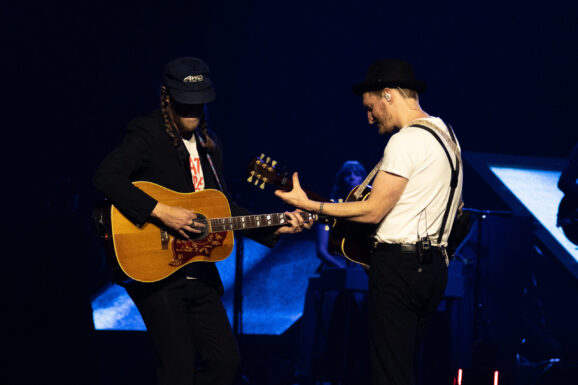
Jimmy may have sailed on, but his spirit remains with many, who do their part to keep the party going. The current iteration of the Coral Reefer Band continues to tour. (Mac McAnally, who leads the Reefers, spoke during the film but wasn’t a centerpiece of it because he didn’t join the band full-time until the mid-1990s. Perhaps a sequel…) Rising jam band Jammy Buffet exclusively performs songs written or performed by Buffett, offering both Parrotheads and Deadheads something to enjoy. (The two are more alike than they might realize.) This documentary mirrors the vision famously articulated by Bob Weir, who mused on what people will say about the Grateful Dead’s work in 300 years. Much like the Dead, Buffett’s music has reached a timeless status that transcends generations.
Occupational Hazard is a rare gift to the fans, reclaiming the unruly spirits who built Margaritaville from the ground up. Despite the nature of life on the road, the original members speak with nothing but love for Jimmy. As Sykes put it, he’s just “glad to be a part of it.” For the rest of us, the film ensures that the essential foundation of that story – the magic that was invisible to most – is finally, beautifully, in view.
4 Responses
Great review, I can’t wait to see this! Thanks for building the hype for me!
This is too cool John, can’t wait to see it!
I remember those days my brother spent with Buffet. He had a great time.
Greater Orlando is so READY for the April 12th event at the Enzian. The Parrot Heads of Central Florida will be there.