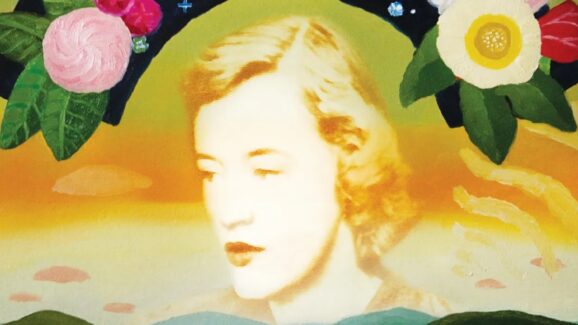
HODJE is a Chicago-based indie pop artist blending sharp lyricism with vivid, satirical storytelling. Her debut EP, Read My Mind, established her voice as an emotionally candid writer, anchored by the listener favorite “Delulu Land,” which was selected as a “Best Of” song winner by NSAI in partnership with Tin Pan South.
Her work balances indie pop sensibilities with pointed observations about the world around her, exploring themes of existential dread, grief, hope, and the strange reality of living through unprecedented times.
Now, she is returning with a punchier single, “An American Horror Story,” and Glide is presenting an exclusive premiere. Over a soundtrack that fuses the kind of big pop sound with elements of punk and New Wave, she conveys her disillusionment with the ever-present and far-reaching violence in the United States, and pulls from her own experience and proximity to a school shooting during her undergraduate years. The song is defiantly political and the energetic, soaring music only serve to elevate the power of the lyrics. For this young, up-and-coming artist, the song is the kind of bold statement that feels needed during our current moment of uncertainty.
Listen to the track and read our conversation with HODJE below…
What inspired you to write this song? What led you to write it?
I wrote “An American Horror Story” as a response to how normalized different forms of violence have become. I believe that when we justify harm in one area of society, it becomes much easier to justify it in others. In that way, the song is about recognizing how interconnected everything is. I also believe that artists are reflections of the times they live in, and I wanted to write honestly from my perspective during a time that is deeply unsettling for so many of us.
What is this song about to you? Why is it important to you and what about the song really speaks to you? Why did you choose to release it as a single?
To me, this song is about confronting systems we’ve been conditioned to look away from, whether it’s human rights violations, gun violence, economic inequality, or the treatment of animals within our factory farming system.
Releasing it as a single felt important because of its urgency. I hope the song inherently asks: what are we willing to question? Especially when it challenges long-held belief systems we may have internalized without fully interrogating them.
What were the studio session and recording process like for this song? Any great stories from the studio? What kind of vibe did you aim for on this song?
The studio process was quick. I knew this song couldn’t feel glossy or overly polished. My producer, Jake Finch, did such a great job capturing the sense of urgency the production needed. The vocal is front and center; I wanted the urgency I felt while singing to be very clear in the mix. This song felt cathartic to belt. It does feel good to scream into the void, or the mic, when you’re feeling frustrated with the world, and I suppose that mix of desperation and catharsis is what I hoped would be captured in the song.
Are there any lyric lines that you really love or that are really important to you? What do you love about them?
Something about me is that I am always going to try to sprinkle a message of animal advocacy into a song. In the bridge, there’s the line: “Torture animals for profit, Big Meat funds the Oval Office, use that ultra-violent logic, extend it to people, got it.”
To me, those lines, in the context of the song, explain why I feel these forms of violence are connected. I’m not sure how widely known it is that factory farming is deeply entrenched in our political system, and that connection felt important to highlight.
If listeners can take away one thing from having heard this song, what do you hope that is?
I hope the song sparks a sense of curiosity about the systems we participate in and the stories we’ve been told about what’s “normal.” I don’t expect a three-minute song to solve anything, but if it opens the door to conversation or encourages someone to question an idea they’ve accepted without interrogating it, that’s very meaningful to me.
What is coming up next for you, HODJE?
There’s another song coming soon that approaches fear from a more personal lens. “An American Horror Story” comes from a macro perspective, and the next one zooms in on my own experience. Beyond that, I’m continuing to explore writing that feels intentional and reflective. I’m interested in expanding sonically and visually, and in creating a bit of a cinematic universe for the songs to live in. This feels like the beginning of a new phase for me, and I’m excited about it.